'%20d='m0%200%2016%2011h61%2061%2061%2061%2060L47%2037h61%2061%2060%2061L16%2063h61%2061%2061%2061%2060L47%2089h61%2061%2060%2061L16%20115h61%2061%2061%2061%2060L47%20141h61%2061%2060%2061L16%20166h61%2061%2061%2061%2060L47%20192h61%2061%2060%2061L16%20218h61%2061%2061%2061%2060z'/%3e%3c/svg%3e)
About
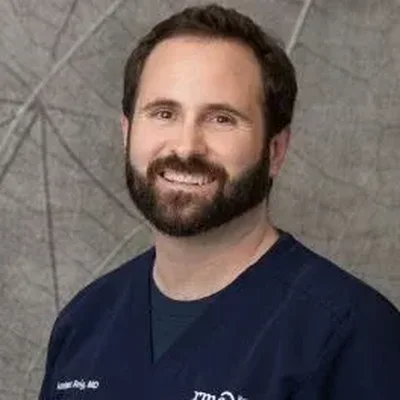
Andrés Reig joined RMA New Jersey on the other side of the desk first. He and his wife went to RMA to conceive their first child, and the experience is the reason he gives for taking a research position there. “When someone is the very best at something, you want to understand why,” he has said. “After you join RMA, it’s immediately obvious: RMA simply cares — absolutely, about everything — to the utmost extent.”
His route into the field ran through three countries. Born and raised in Valencia, he took his medical degree at the Medical University of Lodz in Poland, then moved to the US for a post-doctoral fellowship at Yale School of Medicine, obstetrics and gynecology residency at Bridgeport Hospital (a Yale-affiliated teaching hospital), and a reproductive endocrinology fellowship through the Jefferson-RMA combined program. His title at RMA carries two halves: reproductive endocrinologist and research faculty.
The specialty is hereditary. He is the fifth generation of doctors in his family, and his mother and other relatives practiced reproductive endocrinology and infertility. He describes the origin of his own interest as realizing “that ‘normal’ people I knew were doing great science that could, quite literally, change the world.”
Clinical Expertise
- Low ovarian reserve and poor ovarian response: his stated research focus, and the hardest area to standardize in IVF — the same stimulation protocol can produce very different yields depending on reserve, which forces dose and pathway adjustments by individual response
- IVF outcomes: variable-by-variable work on what determines whether a cycle ends in a live birth, feeding directly back into protocol selection
- Ovarian and embryo biology: research on the gamete and embryo themselves, which is the evidence layer under embryo grading and transfer strategy decisions
- Fertility evaluation and treatment: patient-facing clinical work — infertility workup, stimulation monitoring, retrievals — alongside the laboratory side
- Reproductive medicine communication: he hosts the FertiliPod and produces Fertility and Sterility On Air, the podcast of the journal where he serves as Interactive Associate and Global Associate
Why Choose Dr. Andrés Reig
His research topic is his patient population. Poor ovarian response is where standard protocols most often fail, and where patients are most often told to simply repeat what did not work. Reig’s declared research interests are low ovarian reserve and poor response, IVF outcomes, and ovarian and embryo biology — meaning the case in front of him overlaps with the case he studies.
He was a patient at this clinic before he worked there. That is not a credential, but it changes which questions get answered. Cost, the probability of failure, and why a protocol gets changed are questions he has asked from the chair across the table. He does not leave that part of the biography out of his own profile.
He sits on the intake side of the literature. As an Interactive Associate and Global Associate for Fertility and Sterility, and as host of FertiliPod plus producer of the journal’s On Air podcast, his day-to-day involves evaluating and explaining papers that have not yet become guideline language. Patients who bring in a study and want it discussed will find that conversation is his job description.
Specialty societies have scored his research. He was a finalist for the 2023 European Society of Human Reproduction and Embryology (ESHRE) Clinical Science Award, a 2023 Pacific Coast Reproductive Society and 2024 Midwest Reproductive Symposium scholarship recipient, and in 2019 received a Society for Assisted Reproductive Technology award plus the ASRM Corporate Member Council In-Training Travel Award. ESHRE’s Clinical Science Award shortlist is a peer assessment of a specific piece of work, not of tenure.
He consults in Spanish. He grew up in Valencia; Spanish is a working language, not a phrase book. For patients from Spain or Latin America, direct communication with the physician removes the loss of detail that comes through a third-party interpreter.
He is explicit about the field discarding its own practices. “The speed at which the field of Reproductive Endocrinology and Infertility changes, implements new discoveries, and discards old ones that are no longer proven to be the best is truly remarkable,” he says. Useful to hear from a physician whose stated position is that some current protocols will not survive.
Professional Affiliations
Fellow of the American College of Obstetricians and Gynecologists (FACOG). He is an Interactive Associate and Global Associate for Fertility and Sterility. His subspecialty training came through the Jefferson-RMA program, and his research recognitions include SART (2019), ASRM’s Corporate Member Council In-Training Travel Award (2019), PCRS (2023), the 2023 ESHRE Clinical Science Award finalist position, and the Midwest Reproductive Symposium scholarship (2024).
Suitable For
- Diminished ovarian reserve or poor response: the population his research is about, and the group most likely to benefit from a physician who tracks the evidence rather than running the default protocol again
- Repeated transfer failures: with interests spanning IVF outcomes and embryo biology, the discussion tends to go back to which variable was wrong — lining, embryo, or protocol — instead of repeating the previous attempt
- Patients who read the literature: if you arrive with a paper or a new technique in mind, he works on both sides of that literature and hosts a podcast about it
- Spanish-speaking international patients: native-level Spanish plus medical training in Spain, Poland and the United States, so cross-border care logistics are familiar territory
- Patients who want the reasoning, not only the order: his communication habit is explaining why a field drops a practice, which suits people who intend to participate in the decisions