'%20d='m0%200%2016%2011h61%2061%2061%2061%2060L47%2037h61%2061%2060%2061L16%2063h61%2061%2061%2061%2060L47%2089h61%2061%2060%2061L16%20115h61%2061%2061%2061%2060L47%20141h61%2061%2060%2061L16%20166h61%2061%2061%2061%2060L47%20192h61%2061%2060%2061L16%20218h61%2061%2061%2061%2060z'/%3e%3c/svg%3e)
About
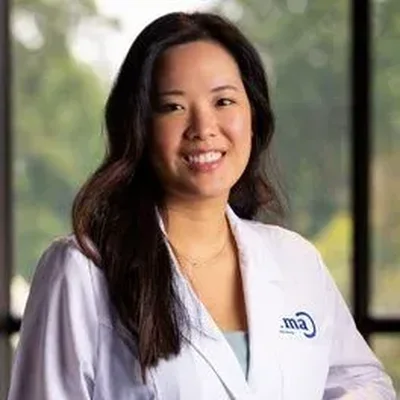
Most of the egg-freezing marketing a patient sees quotes survival rates for the eggs. Angela Leung published the number nobody puts on a brochure: what actually happened to women aged 34 to 42 who froze their eggs at Boston IVF for non-medical reasons and came back later to try to use them. About a third conceived. She also stated the caveat plainly — the odds track the age at freezing and the number of eggs banked, and there is no guarantee that transfers across both.
That study is the clearest signal of how she practices. She trained for it: Princeton for ecology and evolutionary biology with a neuroscience minor, Indiana University School of Medicine for the MD, then three more years after residency in a reproductive endocrinology fellowship run jointly by Beth Israel Deaconess Medical Center / Harvard Medical School and Boston IVF. She is board-certified in obstetrics and gynecology and a Fellow of the American College of Obstetricians and Gynecologists.
She nearly went into surgery — she plays piano and violin and is the first to note the manual fit — but an obstetrics and gynecology rotation moved her aim. “I really enjoyed the relationships I built with patients,” she has said of that rotation. She now practices in Basking Ridge and holds a Clinical Assistant Professor appointment in the Division of Reproductive Endocrinology at Rutgers-Robert Wood Johnson Medical School.
Clinical Expertise
- Egg freezing: her named focus, and specifically the part patients under-serve themselves on — understanding the process and their own probability of success rather than the average
- Fertility preservation: banking eggs or embryos ahead of chemotherapy, surgery, or a reproductive timeline that has not yet found a partner
- IVF cycle management: stimulation design through retrieval and transfer, with attention to how age and reserve constrain the options
- Female infertility: endometriosis and adenomyosis, blocked fallopian tubes, and the evaluation of what at-home fertility tests can and cannot tell you
- Reproductive health over time: menstruation and hormonal issues, preconception counseling, and continuity of care across years rather than one cycle
- Research in patient-facing questions: single-cell sequencing comparing sperm from fertile and infertile men; egg thresholds for achieving multiple live births from a single IVF cycle, which her work put above 15
Why Choose Dr. Angela Leung
She researches the exact question a freezing patient asks. Elective egg freezing is sold on optimism. Her 2021 study followed the women who actually returned to use their eggs, and reported roughly one in three succeeding — then warned that a woman’s chance depends on her age at freezing and the number of eggs she froze. A physician who has done that arithmetic is more likely to run it on your specific case.
Her research covers transgender fertility preservation with data, not policy. She found that prior hormone therapy in trans men did not reduce the number of eggs retrieved during IVF — the counts matched those of cisgender women. For a patient told to stop testosterone before banking eggs, and unsure what the pause or the history costs, that is a first-hand evidence base rather than a general reassurance.
Training built for high-volume IVF. The Beth Israel Deaconess / Harvard Medical School fellowship alongside Boston IVF is a three-year subspecialty program attached to one of the larger US programs. She then took a faculty appointment at Rutgers-Robert Wood Johnson, a role that requires keeping current with the literature she is teaching.
Her awards are research grants from specialty societies. The 2019 New England Fertility Society Ferring REI Research Grant ($10,000) and the 2018 PCRS Merit Excellence in Fellowship Research Scholarship are peer-reviewed funding recognitions during subspecialty training, not patient-choice lists. She is an ASRM member and a member of the Pacific Coast Reproductive Society.
She talks about cost and access. She has written on what IVF costs in New Jersey and how to pay for it, on blocked tubes, on endometriosis, and on the limits of at-home fertility testing. The pattern is unglamorous information that affects decisions.
She defines the relationship as long-term. Her stated goal is knowing things about patients — what they do for work, details about their family — because a patient who does not feel connected, or fears being judged for asking, does not ask about the things that matter. That is a claim about communication, but it is the mechanism by which the right question gets raised before a cycle starts.
Professional Affiliations
Board-certified in Obstetrics and Gynecology; Fellow of the American College of Obstetricians and Gynecologists. Member of the American Society for Reproductive Medicine and of the Pacific Coast Reproductive Society. Clinical Assistant Professor, Division of Reproductive Endocrinology, Department of Obstetrics and Gynecology and Reproductive Sciences, Rutgers-Robert Wood Johnson Medical School.
Suitable For
- Considering egg freezing and wanting the real number: she will estimate from age and expected egg yield instead of quoting a clinic-wide average, which is the appropriate conversation for someone planning around 35 or older
- Preserving fertility before medical treatment: oncologic or surgical treatment with a deadline, where banking has to be scheduled against another team’s calendar
- Transgender and LGBTQ+ family building: her own published finding on hormone therapy and retrieval counts, plus work on how many eggs are needed for more than one live birth
- Endometriosis or adenomyosis affecting conception: she has written on both conditions and their fertility impact, and on tubal blockage causes and treatment options
- Wanting one physician across several years: for patients who would rather the same person know their history through protocol changes than restart the explanation with each cycle