'%20d='m0%200%2016%2011h61%2061%2061%2061%2060L47%2037h61%2061%2060%2061L16%2063h61%2061%2061%2061%2060L47%2089h61%2061%2060%2061L16%20115h61%2061%2061%2061%2060L47%20141h61%2061%2060%2061L16%20166h61%2061%2061%2061%2060L47%20192h61%2061%2060%2061L16%20218h61%2061%2061%2061%2060z'/%3e%3c/svg%3e)
About
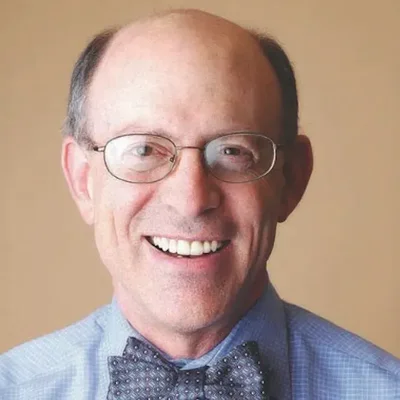
Southern Nevada had no infertility practice of its own until 1988, when Bruce Shapiro, MD, PhD opened one. Almost four decades later he still runs it, and he holds the two titles that matter most in an IVF program at once: medical director and laboratory director. Most patients meet a clinician who orders a protocol and trusts a lab they never see. At The Fertility Center of Las Vegas the person who sets your stimulation plan is also the person accountable for what happens to your eggs in the embryology suite, which is a governance fact worth more than the usual marketing line about “state-of-the-art” anything.
He trained in obstetrics and gynecology at Yale New Haven Hospital, completed his reproductive endocrinology and infertility fellowship at Yale University, and earned a PhD at the University of Amsterdam. He is board-certified by the American Board of Obstetrics and Gynecology in OB/GYN and subspecialty-certified in REI, and remains on faculty as Director of the Division of Reproductive Endocrinology and Infertility at the University of Nevada School of Medicine, teaching medical students and residents. He also consults in Spanish; the clinic’s own profile lists him as its most experienced reproductive endocrinologist, and it is the practice he built.
The research record is the unusual part. His group’s two 2011 randomized trials comparing frozen and fresh embryo transfer concluded that stimulation medications were damaging the endometrium’s receptivity to fresh embryos — a finding that pushed the field toward freezing everything and transferring later. When Fertility and Sterility marked its 75th anniversary in 2025, it listed that work among the most influential in the journal’s history, with one paper ranked 33rd in citations; Jacques Cohen, the IVF pioneer who edits Reproductive Biomedicine Online, called them two of the most important trials of the preceding decade. Earlier work earned him research awards for blastocyst transfer, which he was among the first US physicians to perform and report, and for post-thaw extended culture after oocyte freezing, which demonstrated embryo-endometrial synchrony as the implantation variable that matters. His OHSS work — standardizing GnRH agonist trigger in high responders, then combining agonist trigger with low-dose hCG — is the reason patients at this center can be stimulated hard without the old hyperstimulation risk. His stated clinical focus now is women over 40 and patients with diminished ovarian reserve.
Clinical Expertise
- Freeze-all IVF and frozen embryo transfer: the center’s default cycle design — culture to blastocyst, vitrify everything, transfer into a prepared uterus in a later cycle. In 2023, 98.7% of this program’s transfers were frozen and there were no fresh transfers at all
- GnRH agonist trigger and OHSS prevention: among the first in the world to standardize agonist trigger in high responders, which the literature credits with virtually eliminating ovarian hyperstimulation syndrome, and the agonist-plus-low-dose-hCG combination for patients who need its luteal support
- Blastocyst transfer: day-5 culture so that embryos which will not reach blastocyst never get transferred, allowing single-embryo transfer without giving up pregnancy rates
- Post-thaw extended culture (PTEC): developed after oocyte cryopreservation to time the transfer window against embryo-endometrial synchrony
- Diminished ovarian reserve and treatment at 40+: his named special interest, and the group that most clinics route toward donor eggs. The clinic states it does not require donor eggs of patients with remaining ovarian function
- Laboratory direction: as lab director he owns culture conditions, vitrification protocol and biopsy timing, not only prescriptions
Why Choose Dr. Bruce Shapiro
He is the reason the freeze-all debate was settled. The 2011 trials are cited in the same breath as the studies that changed practice worldwide, and the ranking is the journal’s own, at its 75th anniversary. You can read those papers’ conclusions in this clinic’s current numbers: near-total freezing, single blastocyst transfer, and a per-transfer live birth rate at or above the national SART 2023 frozen-transfer row in every age band.
Clinical and laboratory authority sit in one person. Very few practicing reproductive endocrinologists hold both director titles. When a cycle goes sideways — fertilization failure, a thin lining, a mosaic biopsy result — the physician and the lab director are the same individual, which shortens the argument.
A safety protocol you benefit from even if you never read his name. Agonist trigger in high responders is now standard practice in much of the world; he was among the first to implement it as a protocol rather than a workaround, specifically so that prior IVF failure or prior OHSS did not have to end treatment.
Depth in the hardest group. His stated focus is patients over 40 and those with low reserve — the population clinics most often steer toward donor eggs. That said, look at the registry honestly: this center’s per-retrieval live birth rate above 40 is 6.3% against a 9.4% national row, so the question to ask him is not whether he will try, but what your own reserve and history make realistic.
Thirty-five years of continuity, and Spanish-language access. He founded the practice, still sees patients there, teaches its physicians, and consults in Spanish.
Professional Affiliations
Board-certified by the American Board of Obstetrics and Gynecology in Obstetrics and Gynecology and subspecialty-certified in Reproductive Endocrinology and Infertility — the highest credential available in this field in the United States. He is the medical director of record for a SART member clinic (ClinicPKID 2285) that reports cycle outcomes to the CDC under federal ART reporting law, and he holds the division directorship for reproductive endocrinology and infertility at the University of Nevada School of Medicine, where he teaches residents and students. His work appears regularly in Fertility and Sterility and Reproductive Biomedicine Online, including randomized trials on freeze-all strategy, embryo-endometrium asynchrony, agonist versus hCG trigger, corifollitropin alfa versus recombinant FSH in older patients, and birthweight comparisons after fresh versus frozen transfer, with findings presented in multiple countries. Named to the Vegas Inc Top Doctors list in reproductive endocrinology and infertility in 2025, which the clinic says made him and Dr. Bedient that year’s only Las Vegas fertility specialists on the list.
Suitable For
- Patients over 40 considering their own eggs: his declared special interest, with a realistic read of the numbers — per-retrieval outcomes here at 41-42 and above are below the national row, so the first conversation should be about probability, not promises
- Diminished ovarian reserve and poor responders: protocols designed around how much reserve you actually have rather than a default donor-egg referral
- Prior IVF failure or prior OHSS: the agonist-trigger and agonist-plus-low-dose-hCG work exists for exactly this group
- Patients who want single embryo transfer without losing odds: blastocyst culture plus freezing is the mechanism that makes one embryo per transfer viable as a strategy
- Anyone whose case involves the lab: fertilization failure, arrested embryos, biopsy results, or repeated thin linings benefit from a physician who also directs the laboratory
- Spanish-speaking patients: consultations available in Spanish