'%20d='m0%200%2016%2011h61%2061%2061%2061%2060L47%2037h61%2061%2060%2061L16%2063h61%2061%2061%2061%2060L47%2089h61%2061%2060%2061L16%20115h61%2061%2061%2061%2060L47%20141h61%2061%2060%2061L16%20166h61%2061%2061%2061%2060L47%20192h61%2061%2060%2061L16%20218h61%2061%2061%2061%2060z'/%3e%3c/svg%3e)
About
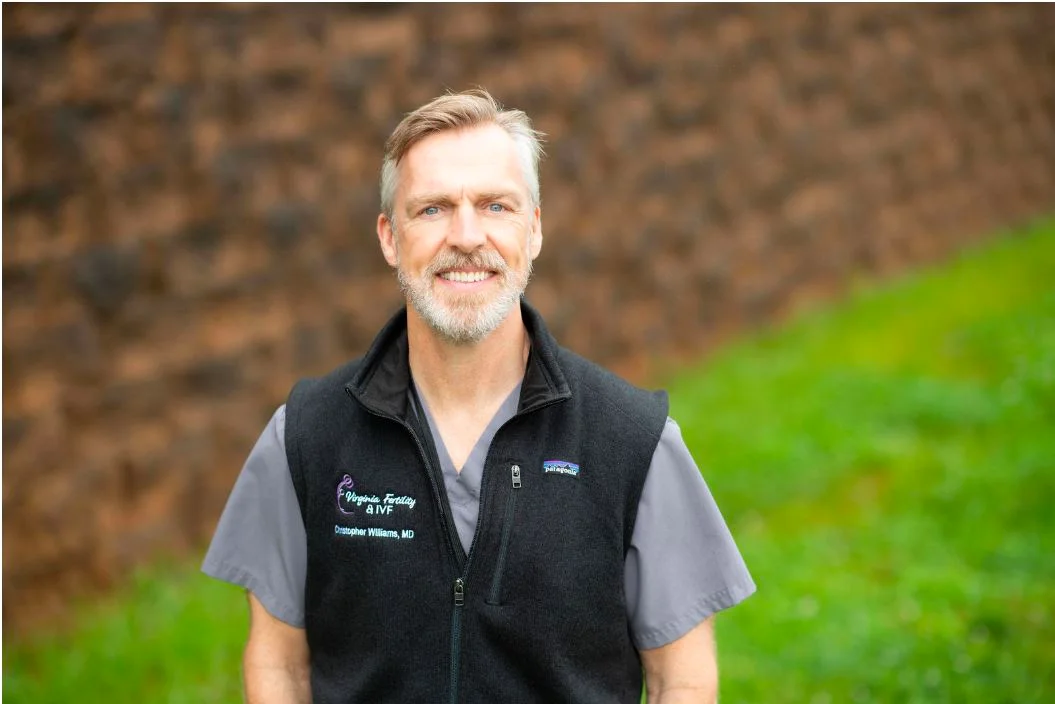
In October 2006, Christopher D. Williams opened Virginia Fertility & IVF as a physician-owned private practice in Charlottesville, and he has led it as medical director ever since. It was not a start from zero. A year earlier the physicians, manager, IVF nurses and laboratory staff of the University of Virginia Health System’s IVF program moved into a newly built laboratory at Martha Jefferson Hospital, and before that Williams had spent 2001 to 2005 on UVA’s faculty as co-director of that same program, which Dr. Bruce Bateman had founded in 1986. He is the through-line between the academic program and the clinic that replaced it.
His own training is Virginia-then-North Carolina: a biology degree at the College of William & Mary, an MD from the University of Virginia Medical School in 1994, four years of obstetrics and gynecology residency at Carolinas Medical Center in Charlotte, then selection in 1998 by the University of North Carolina at Chapel Hill for a three-year fellowship in Reproductive Endocrinology and Infertility. He has practiced reproductive endocrinology since completing that fellowship in 2001. He grew up in Reston, in northern Virginia, and is married with five children.
The research thread runs through PCOS and ovarian physiology rather than laboratory technique. He was a co-investigator on a National Institutes of Health grant assessing whether acupuncture influenced menstrual cycles in women with polycystic ovary syndrome, has held grant support from the American College of Obstetricians and Gynecologists and the Berlex Foundation, and has published research articles throughout his career. His clinic’s bio does not state a publication count, and this page does not invent one.
Clinical Expertise
- IVF program direction: as medical director he owns the stimulation-to-transfer pathway, including the practice’s default of freezing viable embryos for a later single-embryo transfer, and the reporting of the 1,114-cycle 2024 SART filing
- PCOS and ovulatory disorders: the subject of his NIH-funded work, and the endocrine diagnosis that drives most of the cycle planning in a general reproductive practice
- IUI: the practice performs more than 800 inseminations a year, with partner or donor sperm, natural or hormonally supported cycles
- PGT-A, PGT-M and PGT-SR: embryos are biopsied in the clinic’s CAP-accredited laboratory after 5-7 days of culture and sent to an outside genetics laboratory for analysis
- Male factor evaluation: semen analysis is treated as a first-line test rather than an afterthought, with ICSI and referral to a reproductive urologist when the numbers call for it
Why Choose Dr. Christopher D. Williams
He signed the numbers. Our source record lists Williams as the verifying physician on the practice’s SART 2024 clinic summary report, the filing behind every outcome figure on this site. When the age-band rates and the retrieval counts don’t line up the way a patient might want, he is the physician accountable for them.
He built the successor to an academic program. Co-directing UVA’s IVF program from 2001 to 2005, then moving the same team into a purpose-built hospital laboratory, then founding a private clinic in 2006 is a continuity most single-site practices don’t have. It also explains the practice’s temperament: academic training habits, private-practice scheduling.
Grant writer, not just grant name. NIH, ACOG and Berlex Foundation support is a specific and unusual record for a community IVF physician, and it clusters around the diagnosis — PCOS and cycle regulation — that fills most reproductive endocrinology calendars.
Twenty-five years in one market. Since 2001 he has practiced reproductive endocrinology, and since 2006 in Charlottesville. The local referral relationships, oncology contacts and laboratory continuity that come with that are not visible in a bio but decide how quickly a cycle starts.
Professional Affiliations
Fellow of the American College of Obstetricians and Gynecologists, and sub-specialty certified in Reproductive Endocrinology and Infertility. Member of the Society of Reproductive Endocrinology and Infertility. Grant support from the National Institutes of Health as a co-investigator, the American College of Obstetricians and Gynecologists, and the Berlex Foundation. Nothing further about society offices, editorial boards or awards appears in our sources for this physician.
Suitable For
- IVF patients deciding between fresh and frozen transfer: his program’s published practice is to freeze viable embryos and transfer a single embryo later, which changes how you should read both the success figures and the fee schedule
- PCOS and ovulatory infertility: the endocrine problem he has formally studied, from cycle regulation through stimulation design
- Couples where the male partner has not been tested: semen analysis is part of the workup he runs, not a referral to make later
- Patients comparing clinics on data: the physician who verified this practice’s SART report is the one who can walk you through what its age bands do and do not prove