'%20d='m0%200%2016%2011h61%2061%2061%2061%2060L47%2037h61%2061%2060%2061L16%2063h61%2061%2061%2061%2060L47%2089h61%2061%2060%2061L16%20115h61%2061%2061%2061%2060L47%20141h61%2061%2060%2061L16%20166h61%2061%2061%2061%2060L47%20192h61%2061%2060%2061L16%20218h61%2061%2061%2061%2060z'/%3e%3c/svg%3e)
About
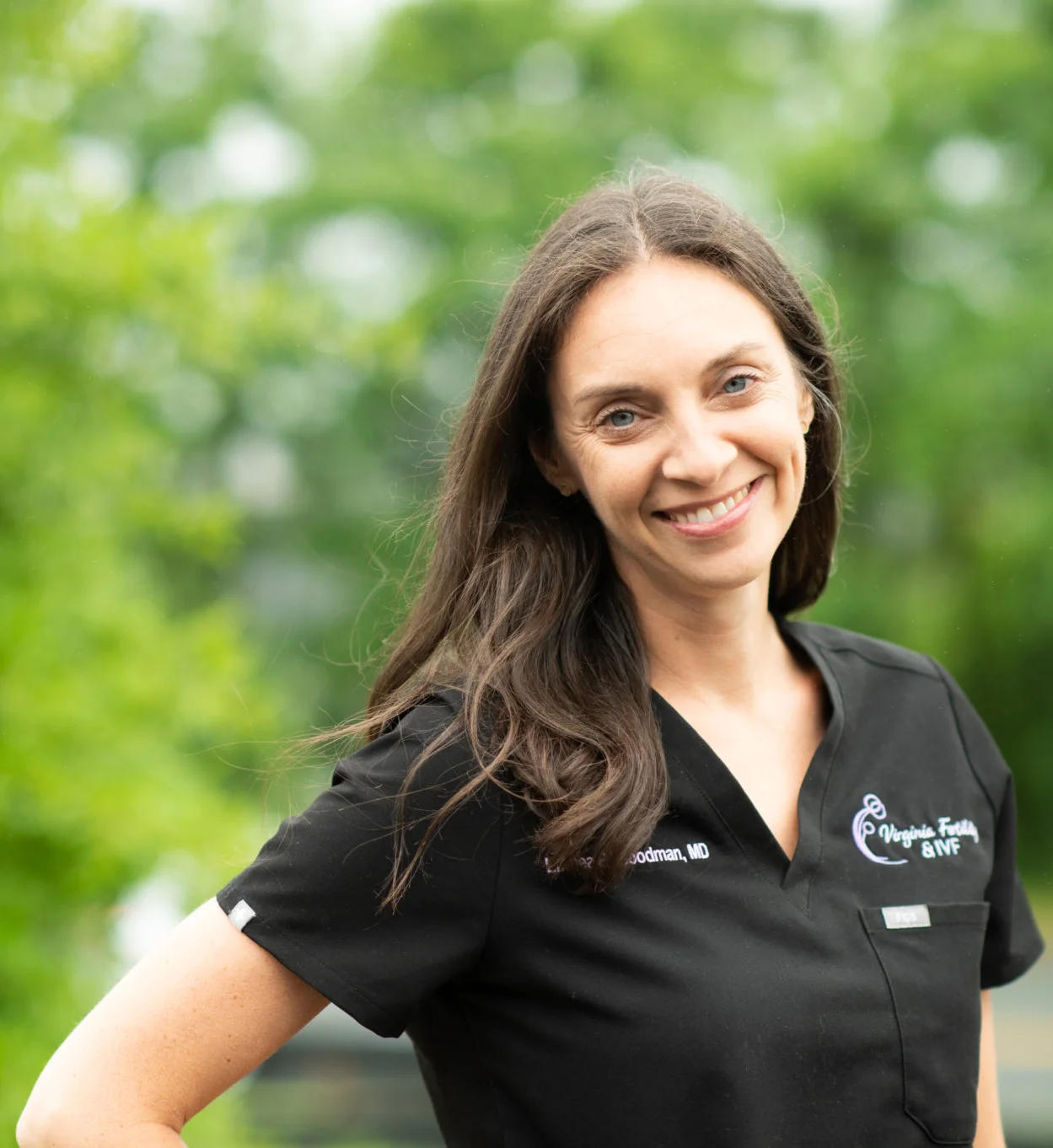
The engineering degree came first. Linnea R. Goodman, who grew up in Essex, Vermont, studied biomedical engineering with honors at Columbia University’s School of Engineering and Applied Sciences before switching to medicine — a path that still shows in her stated research area, technology applied to reproduction. She took her MD at the University of Vermont College of Medicine in 2009, with the Charles and Sylvia Schechtman Prize for Excellence in Clinical Care, then trained in obstetrics and gynecology at the University of North Carolina Hospitals, where she collected two awards that point in different directions: a Golden Tarheel Teaching Award, and an American Association of Gynecologic Laparoscopy award for minimally invasive surgery.
Her fellowship, at the Cleveland Clinic, finished in 2016 with a declared special interest in reproductive surgery. What followed was less clinical-education than operations management. She spent 2016 to 2018 as medical director of the operating room at Reproductive Medicine Associates of New Jersey, then returned to the University of North Carolina as faculty and medical director until joining Virginia Fertility & IVF. Few three-physician private practices have a physician who has been responsible for an OR schedule at a large fertility network and for a university program at the same time.
Her research is described in her clinic bio as focused on technology in medicine, reproductive surgery and optimizing reproductive outcomes, with national recognition and grant funding from multiple foundations; the foundations are not named in our sources, and no publication count or award year is claimed here. She is married with two sons, and describes her own practice goal as individualized, patient-centered care.
Clinical Expertise
- Reproductive surgery: the declared focus of her Cleveland Clinic fellowship, backed by an AAGL award for minimally invasive surgery during residency and active membership in the Society of Reproductive Surgeons. Structural findings — fibroids, polyps, uterine septum, scar tissue, endometriosis, tubal disease — arrive on her side of the practice rather than out to a general gynecologist
- IVF cycle management: stimulation, monitoring, retrieval and transfer in a program where most viable embryos are frozen and a single embryo is transferred later
- Operating-room and program leadership: two years directing an OR at a high-volume fertility network, then UNC faculty with medical director duties — scheduling, sterilization and safety discipline, which is the same territory this clinic’s REI Protect laboratory credential covers
- Reproductive outcomes and technology: her research area, and a reason she is a sensible physician to ask about laboratory practices such as embryo witnessing and monitoring
- Fertility preservation: egg, sperm and embryo freezing for patients whose fertility is threatened by medical treatment
Why Choose Dr. Linnea R. Goodman
The surgeon’s record is the differentiator. Of this practice’s three physicians, she is the one whose fellowship, residency award and society membership all sit on the operative side of reproductive endocrinology. If your workup shows a uterine cavity problem or endometriosis, the evaluation and the scope can plausibly belong to the same physician. Our sources do not list which procedures she performs at this address, so ask directly: the clinic advertises hysteroscopic surgery for structural causes of pregnancy loss, but does not name who operates.
She has run an operating room, not just used one. Medical director of the OR at Reproductive Medicine Associates of New Jersey from 2016 to 2018 is a quality-control job: turnover, sterility, anesthesia coordination, staffing. That maps onto the questions patients rarely think to ask — how embryo handling is witnessed, who checks identification, what happens when a storage tank alarm sounds.
Academic and private practice in the same résumé. UNC faculty medical director duties follow the private-network OR role, and her medical degree came from a school that awards for clinical care. It is a training and career path built around how care is delivered, not only what is prescribed.
One clarification on the title. This practice lists both Goodman and Dr. Laura P. Smith as Clinical Director and never defines the split in its published material, so the title is not by itself a reason to choose between them. What distinguishes the two records is surgery and operations management on this side, fertility preservation and ovarian research on the other.
Professional Affiliations
Fellow of the American College of Obstetricians and Gynecologists, sub-specialty certified in Reproductive Endocrinology and Infertility. Active member of the Society of Reproductive Surgeons. Residency honors include the Golden Tarheel Teaching Award and the American Association of Gynecologic Laparoscopy award for minimally invasive surgery; medical school brought the Charles and Sylvia Schechtman Prize for Excellence in Clinical Care. Her research has drawn grant funding from multiple foundations, unnamed in our sources, and no society offices or editorial roles are claimed here.
Suitable For
- Infertility with an anatomic cause: fibroids, polyps, septum, intrauterine scar tissue, endometriosis or tubal disease, where you want the physician who evaluates the cavity to be the one comfortable operating on it
- Recurrent pregnancy loss patients being offered hysteroscopy: structural correction sits alongside hormone support and IVF with PGT in this clinic’s loss-workup pathway
- IVF patients who ask about the laboratory: her stated research on technology in medicine and reproductive outcomes is the right pitch to hear embryo witnessing, vitrification and storage monitoring explained
- Patients facing medical treatment that threatens fertility: preservation counseling and cycle timing inside the practice’s 72-hour commitment for cancer-related appointments