'%20d='m0%200%2016%2011h61%2061%2061%2061%2060L47%2037h61%2061%2060%2061L16%2063h61%2061%2061%2061%2060L47%2089h61%2061%2060%2061L16%20115h61%2061%2061%2061%2060L47%20141h61%2061%2060%2061L16%20166h61%2061%2061%2061%2060L47%20192h61%2061%2060%2061L16%20218h61%2061%2061%2061%2060z'/%3e%3c/svg%3e)
About
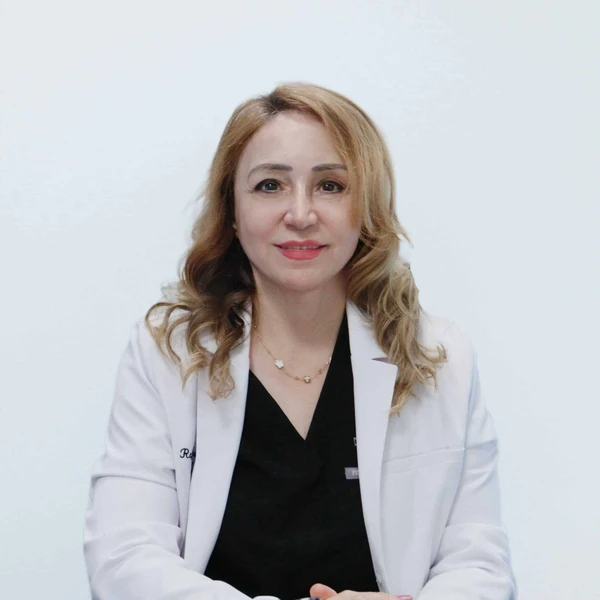
Rafif Z. Moussa has run AFMC’s clinical program as Medical Director since August 2023, and her training lineage is unusual in fertility medicine: she holds a degree from the Jones Institute for Reproductive Medicine — the institute where the first baby in the United States was born by IVF — and studied under Dr. Howard Jones, the pioneer of American IVF. She is a reproductive endocrinology and infertility (REI) specialist working across IVF, IUI, ICSI and PGD.
Her academic record starts in Syria: an M.D. from the University of Damascus Faculty of Medicine in 1983, ranked first in her class, and an M.S. from the same school in 1989. She came to the United States for the Jones Institute’s clinical embryology and andrology master’s program (2012-2014) and completed her REI fellowship at Eastern Virginia Medical School in 2016. Her research interests follow directly from the clinic floor: the impact of uterine fibroids on IVF outcomes, and how to tune ovarian stimulation protocols.
Before AFMC she led a military health system’s fertility program and directed civilian centers. She has held licenses in five states — California, Ohio, Virginia, Illinois and Indiana — and since November 2023 teaches as an assistant professor in Eastern Virginia Medical School’s reproductive clinical sciences program.
Clinical Expertise
- IVF full-cycle management: stimulation, monitoring, retrieval and transfer, with protocol choice from a documented menu — conventional, antagonist, long agonist, short fertility-preservation protocols, and regimens for poor responders.
- ICSI and PGD: micromanipulation and preimplantation genetic diagnosis listed among her core IVF skills.
- Fertility preservation and egg freezing: short stimulation protocols designed for preservation cycles.
- IUI: first-line insemination treatment.
- Hysteroscopic surgery: myomectomy, polypectomy, adhesion lysis and uterine septum resection.
- Laparoscopic and robotic gynecologic surgery: advanced adhesiolysis, myomectomy, endometriosis resection, tubal anastomosis, and Da Vinci robotic procedures.
- Reproductive imaging: TVUS, 3D TVUS, saline sonohysterography and HSG read in-house.
Why Choose Dr. Moussa
The Jones Institute trained the team that delivered America’s first IVF birth, and Dr. Moussa’s embryology-and-andrology master’s and REI fellowship there put her inside that system — a direct technical lineage rather than a course or conference credential.
She has done firsts before. Her CV records the first PGD case in Syria, completed in 2010 at Raed Fertility Center in Homs, the center she directed from 2006. Her CV also lists clinical and operative OB/GYN plus gynecologic surgical oncology practice spanning 1988-2006, well before her U.S. fellowship years, and her published research covers intrauterine fibroids versus myomectomy and IVF outcome (Jones Institute, 2015), ovarian stimulation protocol comparison (2014), noninvasive genetic testing using embryo culture media (with Pacific Reproductive Center), and the impact of military deployment on fertility treatment (Fort Irwin) — the last one making her an unusually informed option for military families.
She personally covers the chain that many clinics split across several physicians: stimulation design, retrieval, transfer, and the hysteroscopic or laparoscopic surgery a case may need in between. She consults in English and Arabic, and AFMC’s coordination team is Chinese-friendly for Mandarin-speaking patients.
Professional Affiliations
Dr. Moussa is assistant professor in Eastern Virginia Medical School’s reproductive clinical sciences program (since November 2023). Her earlier academic and hospital posts in Syria were chief of the OB/GYN department at Razi Hospital, Homs (1994-2012) and associate professor of OB/GYN at Baath University Medical School (1999-2012), and she held leadership roles in the Syrian Cancer Society and the Syrian Red Crescent health committee through 2012. Her U.S. clinical exposure includes repeated visits at Pacific Reproductive Center in Los Angeles (2004-2010) and training stints at the Cleveland Clinic (laparoscopic surgery 1998, urogenital surgery 1999) and Henry Ford Hospital (1990-1991). She authored a fertility handbook (2007) and a paper on infertility in Syria (1998). AFMC displays an ASRM organizational logo on its site.
Suitable For
Patients starting or continuing IVF. Dr. Moussa designs the stimulation herself and manages retrieval through transfer, so the person choosing your protocol is the person doing the procedure — patients in published reviews credit her monitoring and medication management directly.
Advanced maternal age and complex infertility. Poor-responder and individualized-protocol experience, plus a research record on stimulation optimization, fits 35-plus and repeated-failure cases where a standard protocol is the wrong default.
Fibroid-related infertility. Her Jones Institute research compared intrauterine fibroids and myomectomy against IVF outcomes, so patients deciding whether to operate before transfer get counseling grounded in that literature.
International and Arabic-speaking patients. She works in Arabic, and the clinic’s Chinese-friendly coordination covers Mandarin-speaking travelers; the practice also lists egg and embryo transport for cross-border care.