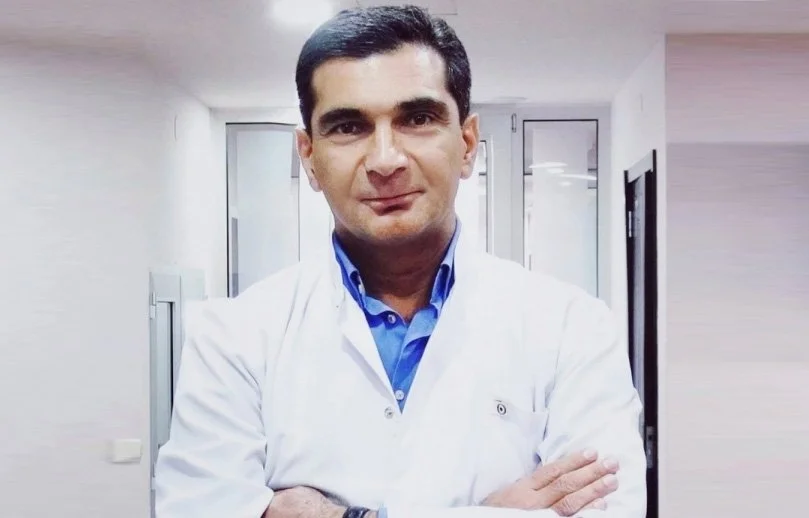

About
The line on the department door is the shortest way to describe this role: GGRC names Iva Kutivadze as Head of its IVF Department, a post he has held since 2020 while also carrying patients as a reproductologist and gynecologist. That means protocol design, laboratory scheduling and transfer timing pass through one physician rather than being negotiated between separate clinicians — the practical difference for international patients who are in Tbilisi for a fixed window.
His training is locally Georgian and his specialty certificates came early. He finished the Faculty of General Medicine at Tbilisi State Medical University in 1993, did internship, residency and then postgraduate study through the Chachava Scientific Research Institute of Perinatal Medicine and Obstetrics and Gynecology and Department No. 1 of Obstetrics and Gynecology at Tbilisi Medical Academy, and took the state specialization certificate in obstetrics and gynecology in 1998 and in reproductive medicine in 2001. Two later IVF-department qualifications, at ISIDA Clinic in Kiev in 2009 and ASSUTA Clinic in Tel Aviv in 2012, sit after that foundation.
Most of his working life ran through one institute. From 1993 to 2014 he was at the I. Zhordania Institute of Human Reproduction: in the Department of Endoscopic Surgery from 2001, heading the Department of Reproductive Immunology from 2003, and treating patients in the in vitro fertilization department from 2009. Between those posts, from 2002 to 2006, he managed the Georgian section of the MIRT project run with the University of Washington’s Swedish Hospital in Seattle. GGRC describes him as continuing scientific work alongside clinical practice, with a doctoral thesis in progress on immune triggers of first-trimester pregnancy complications.
One naming note: Georgian ივა (Iva, Ivane) is a male name and GGRC uses he/him throughout, while the Chinese page at Grapes.ART renders it as 伊娃, a form usually read as female in Chinese. That is worth knowing when looking him up.
Clinical Expertise
- IVF program management: physicians in the IVF department from 2009 at the Zhordania Institute and head of GGRC’s IVF department since 2020, so stimulation planning, retrieval, laboratory coordination and transfer all fall inside his scope.
- Male and female infertility: infertility and reproductive health are part of his stated practice interests, and the reason his 2001 reproductive medicine certificate and later IVF qualifications were taken in combination rather than separately.
- Reproductive immunology and implantation failure: eleven years heading the Department of Reproductive Immunology at the Zhordania Institute, working implantation failure and early pregnancy loss through an immunological explanation, a line his current thesis continues.
- Gynecological endoscopic surgery: nine years in the institute’s Department of Endoscopic Surgery, treating uterine cavity and pelvic disease that affects fertility, so a surgical indication and the start date of a cycle can be set in one assessment.
- First-trimester pregnancy complications: the thesis subject, and the relevant framing for recurrent early loss where no structural cause has been found.
- New diagnostic and treatment approaches in infertility: GGRC states he has developed and implemented a number of new diagnostic and treatment procedures in infertility care over many years of practice.
Why Choose Dr. Kutivadze
Department head means the schedule holds. GGRC’s own staff page titles him Head of IVF Department. Where one person owns protocol, laboratory booking and transfer timing, a cycle planned around a travel window is scheduled by the person who decides the clinical steps. For patients who cannot stay in Georgia indefinitely, that control over sequencing is worth more than a list of techniques.
Surgery and immunology in the same career, in the same building. Heading an endoscopic surgery unit and then a reproductive immunology department at one institute is an unusual pairing, and it maps onto the two threads that a repeated-failure patient usually presents at once: cavity, tubal or endometriosis disease that may need an operation, and an immunological question that needs a different kind of workup. Evaluating both in one physician avoids the situation where surgical and immunological opinions are delivered separately and neither sequence the plan.
Two IVF-department qualifications abroad, in clinics built around international patients. The 2009 qualification was taken in the IVF department of ISIDA Clinic in Kiev and the 2012 one in the IVF department of ASSUTA Clinic in Tel Aviv — both long-standing centers of the Eastern European and Israeli ART systems, where overseas patients are routine. Neither is described as a lecture course; both sit in the department where laboratory and clinical work meet.
Site management experience on a US-linked study. Running the Georgian section of the MIRT project from 2002 to 2006, with the University of Washington’s Swedish Hospital as the partner institution, is work in which enrollment criteria and data recording have to follow one protocol across sites. That discipline transfers directly to cycle quality control and to how outcomes get counted.
Professional Affiliations
He is listed as a member of ESHRE (European Society of Human Reproduction and Embryology), the Obstetrics, Gynecology and Perinatal Medicine Society of Georgia, and the Reproductive Medicine Society of Georgia. All three are memberships; GGRC’s profile carries no British or American college qualification of the MRCOG, FRCOG or AGRE type, so there is no fellowship to claim here. His formal credentials are the two state specialization certificates — obstetrics and gynecology in 1998, reproductive medicine in 2001 — plus the two overseas IVF department qualifications. The PhD is described as in progress.
Suitable For
- Immune-related infertility and recurrent pregnancy loss: eleven years heading a reproductive immunology department, with a thesis still running on the same subject, suits patients whose structural workup came back clean and who need the immunological route examined.
- Infertility that needs endoscopic surgery first: tubal disease, cavity abnormalities and endometriosis are decided before stimulation. Surgical practice in the same career means the operation and the cycle start date can be settled in one consultation.
- Combined male and female factor cases: GGRC lists treatment of infertility in both partners as a main interest, which fits cases where semen parameters and a female ovulatory or uterine factor are present at once.
- IVF protocol design and department coordination: as head of the IVF department he decides stimulation protocol, retrieval and transfer scheduling and laboratory coordination — the configuration patients need when several cycle steps must fit one trip to Georgia.
- Re-diagnosis after multiple failures: repeated failure usually needs old test results re-sorted rather than repeated. Experience spanning surgery, immunology and the laboratory bench is the background for that kind of review.