'%20d='m0%200%2016%2011h61%2061%2061%2061%2060L47%2037h61%2061%2060%2061L16%2063h61%2061%2061%2061%2060L47%2089h61%2061%2060%2061L16%20115h61%2061%2061%2061%2060L47%20141h61%2061%2060%2061L16%20166h61%2061%2061%2061%2060L47%20192h61%2061%2060%2061L16%20218h61%2061%2061%2061%2060z'/%3e%3c/svg%3e)
About
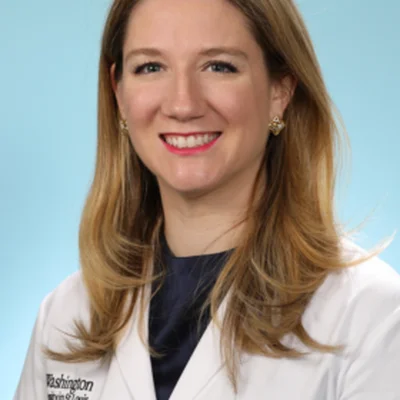
Vanderbilt molecular biology in 2013, Johns Hopkins medical degree in 2017, Johns Hopkins obstetrics and gynecology residency in 2021, Johns Hopkins reproductive endocrinology and infertility fellowship in 2024. Dr. Megan Gornet’s training ran through one institution on a continuous path, and she arrived at Washington University with both the surgical fellowship and the obstetrics-and-gynecology board certification behind it.
She holds the role the other physicians on this roster do not: the center’s Reproductive Surgeon, with the academic title Assistant Professor of Obstetrics and Gynecology, Fertility and Reproductive Medicine. The center states that its reproductive endocrinologists also use sonohysterography, hysteroscopy and laparoscopy; her distinction is that operative reproductive surgery — including robotic work — is her defined specialty rather than an adjunct, which is where a fibroid, an adhesion, a uterine septum or endometriosis sends a patient.
Her research sits in the same seam: oncofertility, how chemotherapy affects assisted reproductive technology outcomes, and what pregnancies look like after reproductive surgery. Those three questions also describe her clinical niche — patients whose cancer treatment is about to start, and patients whose surgery is being planned around a future pregnancy.
She states the surgical position directly: reproductive surgery has to be treated as an essential part of comprehensive infertility care, not an optional detour, and she considers working with patients at their most vulnerable moments the privilege of the job.
Clinical Expertise
- Operative laparoscopy and hysteroscopy, plus robotic surgery — the three approaches she lists as her surgical methods.
- Uterine and tubal pathology: fibroids, polyps, ovarian cysts, mullerian anomalies, isthmocele (the niche at a prior cesarean scar), endometriosis and scar tissue.
- General infertility, IVF and ovulation induction, so a patient operated on for one cause does not lose the medical management of the others.
- Fertility preservation and oncofertility, aligned with her research on chemotherapy’s effect on ART outcomes.
- Recurrent pregnancy loss, where uterine anatomy is part of the workup.
- Center-level surgical repertoire she works within: hysteroscopic septum incision to reduce miscarriage risk, removal of damaged tubes or hydrosalpinges before transfer, and laparoscopic treatment of endometriosis.
Why Choose Dr. Gornet
A surgeon who also manages the cycle. Her fellowship is in reproductive endocrinology and infertility, so the question of whether a fibroid or a septum should be treated operatively before transfer, or whether to move straight to IVF, is answered by one physician rather than split between two.
Research that matches your calendar. If you are facing chemotherapy, her published research interests — chemo’s impact on ART outcomes, pregnancy after reproductive surgery — are exactly the questions your preservation plan turns on.
Fellowship completed in 2024 at Johns Hopkins, the last step of a path taken end to end at one institution: residency in 2021, medical degree in 2017, after a molecular and cellular biology degree at Vanderbilt in 2013.
Certification stated precisely. Board certified in Obstetrics and Gynecology; her REI subspecialty certification is not published by the center, and this page does not claim it.
Professional Affiliations
Assistant Professor of Obstetrics and Gynecology, Fertility and Reproductive Medicine, Washington University. Board certified in Obstetrics and Gynecology. Fellowship-trained in Reproductive Endocrinology and Infertility (Johns Hopkins, 2024). Our sources list no society memberships or editorial roles for her.
Suitable For
- Patients told their infertility looks structural — fibroids, polyps, adhesions, septum, hydrosalpinx or endometriosis — and who want the surgical option priced against the IVF option
- Anyone starting chemotherapy or radiation who needs eggs, embryos or tissue preserved first, and wants the physician whose research is on what happens after
- Recurrent pregnancy loss where uterine anatomy has not yet been fully assessed
- Cesarean scar problems (isthmocele) and mullerian anomalies, both named in her clinical list
- Patients in the middle of a failed IVF pathway who may need an operation, not another protocol