'%20d='m0%200%2016%2011h61%2061%2061%2061%2060L47%2037h61%2061%2060%2061L16%2063h61%2061%2061%2061%2060L47%2089h61%2061%2060%2061L16%20115h61%2061%2061%2061%2060L47%20141h61%2061%2060%2061L16%20166h61%2061%2061%2061%2060L47%20192h61%2061%2060%2061L16%20218h61%2061%2061%2061%2060z'/%3e%3c/svg%3e)
About
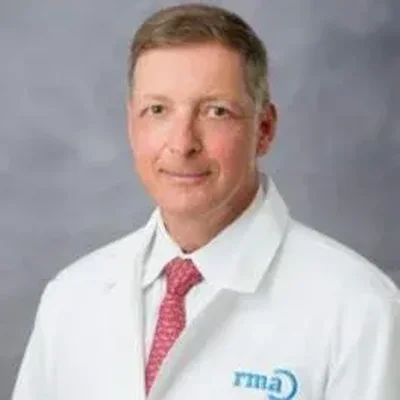
Dr. Paul Bergh was going to be a radiologist. He was already practicing imaging when he kept running into infertility patients, and the questions their scans raised pulled him into a field that barely existed as a specialty at the time. He switched. The change is visible in how he describes his own work: his listed specialties start with diagnosis, not drugs.
He then helped build the practice. Bergh is a founding partner of RMA New Jersey, and he dates the partnership back through twenty years of running it plus the seven years of working relationship before that, which he attributes to the founding group finding a balance that held. He is board-certified in reproductive endocrinology and infertility and in obstetrics and gynecology, trained at Robert Wood Johnson Medical School, Saint Barnabas Medical Center in Livingston for residency, and Mount Sinai School of Medicine for the fellowship. He teaches as Clinical Associate Professor in the Division of Reproductive Endocrinology at Rutgers-Robert Wood Johnson Medical School.
The third credential after his name — IFMCP — is functional medicine certification, and RMA’s own announcement records him as the first functional medicine-certified fertility doctor. That is a separate body of training layered on top of board certification in a surgical-obstetric specialty, not a substitute for it.
Clinical Expertise
- Diminished ovarian reserve: the first specialty he lists, and the clinical problem where the constraint is the number of eggs available rather than which medication is chosen
- Assessing embryonic competence: judging which embryos are likely to produce a pregnancy — the question that matters most when a patient has two or three embryos and not twenty
- Recurrent miscarriage: working through chromosomal, uterine, endocrine and immune contributions rather than attributing loss to bad luck
- Third-party reproduction: donor eggs, donor sperm and donor embryos, and the family-building decisions attached to those paths
- Oocyte vitrification and fertility preservation: egg and embryo freezing, listed among his areas of work
- Imaging-informed assessment: the residue of a first career in radiology, which shows up in how uterine and pelvic structure gets evaluated before a protocol is written
Why Choose Dr. Paul Bergh
He is the physician who set the standards at this clinic rather than inherited them. A founding partner’s habits shape what the lab and the protocol templates look like years later. If you are comparing clinics on embryology practice, the person who co-founded one is a reasonable source on what that clinic decided to do and why.
His three named specialties are the ones with the least consensus. Diminished reserve, embryonic competence and recurrent loss are the areas where guidelines thin out fastest. A physician who lists them as his focus is telling you where his judgment, not a checklist, does the work.
He publishes against over-testing. He wrote both a breakdown of what IVF actually costs and an article on the advantages and disadvantages of genetic testing with IVF. The second one is not the piece a clinic writes when it wants to sell PGT to everyone who walks in.
The functional medicine certification is additive, and he presents it that way. He remains a board-certified reproductive endocrinologist; IFMCP training adds metabolic and lifestyle assessment on top. For a patient who wants that layer examined, having it come from a founding partner of a high-volume IVF program is a different thing than getting it from a practice that does not run cycles.
His recognition comes from two directions. Castle Connolly Top Doctors for 2026, and continuously for the New York metro area from 2001 through 2012, plus New Jersey Monthly Top Docs over the same span — peer and editorial listings. The RESOLVE of New Jersey Zenith Award is from a patient advocacy organization, which is a separate verdict on the same physician.
Professional Affiliations
Fellow of the American College of Obstetricians and Gynecologists. He is a board-certified reproductive endocrinologist, obstetrician and gynecologist, and holds Clinical Associate Professor rank in the Division of Reproductive Endocrinology, Department of Obstetrics and Gynecology and Reproductive Sciences at Rutgers-Robert Wood Johnson Medical School, where the practice’s academic affiliation runs through the same department.
Suitable For
- Low egg count or poor response to stimulation: when reserve is diminished, each cycle start is the scarce resource, and the protocol design has to account for that before it starts
- Multiple losses or repeated failed transfers: his two named specialty areas, usually in patients who have already been tested without a clear answer coming out of it
- A small number of embryos and a decision hanging on them: embryonic competence assessment is the explicit question — which to transfer, and whether to run another retrieval first
- Egg or embryo freezing with a timeline: vitrification and fertility preservation are listed under his areas of work, including cases where the window is closing for medical reasons
- Patients who want the whole picture, not only the protocol: the functional medicine training is where sleep, metabolic and lifestyle inputs get considered — alongside standard treatment, not instead of it