'%20d='m0%200%2016%2011h61%2061%2061%2061%2060L47%2037h61%2061%2060%2061L16%2063h61%2061%2061%2061%2060L47%2089h61%2061%2060%2061L16%20115h61%2061%2061%2061%2060L47%20141h61%2061%2060%2061L16%20166h61%2061%2061%2061%2060L47%20192h61%2061%2060%2061L16%20218h61%2061%2061%2061%2060z'/%3e%3c/svg%3e)
About
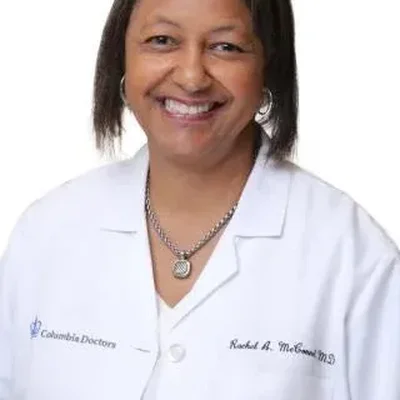
Dr. Rachel A. McConnell finished her reproductive endocrinology fellowship at the University of Southern California in 1990 and has treated infertility ever since, more than three decades of it. She joined Columbia University Fertility Center as an Assistant Professor of Obstetrics and Gynecology after running the reproductive endocrinology division at the University of Nevada School of Medicine as its chief. Her patient mix now reflects the full span of that career — first IVF cycles, donor egg cycles, and the preservation conversations that happen when a woman’s ovarian reserve is falling faster than her family plan.
Her route into the field was conventional for its era and unshowy: Louisiana State University Medical School (MD, 1984), obstetrics and gynecology residency at Tulane University Medical Center (1988), USC fellowship (1990), then academic medicine out west. What that gives a patient in New York is a physician who has watched the field’s protocols get built rather than one who learned only the current version of them — useful when a case does not respond to a standard stimulation protocol.
Public listings put her at 4.8 out of 5 across 32 patient reviews. On the money side, the center publishes one figure: egg freezing runs $8,000 per cycle, and that price does not include anesthesia or monitoring. There is no published price list for an IVF cycle — the center states that cost depends on the individual treatment plan — but it does take a wide set of insurance plans, including Aetna, Cigna, Emblem, Empire Blue Cross Blue Shield, UnitedHealthcare, Progyny and WinFertility, and it assigns financial counselors to self-pay patients who want a payment plan before treatment starts.
Clinical Expertise
- In Vitro Fertilization: Cycle management at a high-volume academic lab — stimulation, sedation retrieval, fertilization in the laboratory, five- to six-day embryo culture, then transfer or freezing
- Egg donation: Both sides of the process, from donor screening and matching through the recipient’s cycle, in a program with legal and psychological counseling attached
- Fertility preservation and egg freezing: Evidence-based preservation for patients delaying childbearing, facing chemotherapy or radiation, or carrying a family history of early menopause
- Ovulation disorders: Assessment and induction where cycles are irregular or absent, including the workup that separates endocrine causes from tubal or uterine ones
- Tubal disease and fibroids: Diagnosis by hysterosalpingogram, ultrasound, hysteroscopy or laparoscopy, with surgery or IVF as the pathway dictates
- Male-factor infertility: Managed within the same program, where semen analysis and sperm recovery technology sit alongside the IVF lab
Why Choose Dr. Rachel McConnell
Thirty-plus years in one subspecialty. Longevity in this field is a proxy for the cases that stopped being routine. She has held a division chiefship, and she now practices in a high-volume academic laboratory with time-lapse embryo monitoring and an in-house genetics workstation.
She covers the diagnoses that complicate IVF. Tubal disease, fibroids, ovulation failure and male factor are named parts of her practice, not footnotes — the combination that decides whether a couple needs stimulation and retrieval or something else first.
A division leader’s view of protocols. Running reproductive endocrinology at an academic medical school means setting treatment standards, not only following them, which tends to show in how a difficult responder is managed.
Solid patient record. 4.8 out of 5 across 32 reviews in public physician listings, at the only New York City fertility center to receive the SART Platinum Award in two consecutive years.
Professional Affiliations
American Society for Reproductive Medicine. Assistant Professor, Department of Obstetrics and Gynecology, Columbia University, practicing within Columbia University Irving Medical Center and NewYork-Presbyterian. Previously Chief of Reproductive Endocrinology at the University of Nevada School of Medicine, following fellowship training at the University of Southern California and residency at Tulane University Medical Center.
Suitable For
- Women preserving eggs as reserve declines: Preservation is a stated focus, and the center prices one cycle at $8,000 with anesthesia and monitoring billed separately
- Patients needing donor eggs: She runs egg donation cycles within the center’s Third Party Reproduction Program, which screens known donors legally and psychiatrically
- Complicated or long-standing infertility: Tubal factors, fibroids and ovulation disorders are the reasons to see a physician with this case history rather than a generalist
- Couples where the male partner also has findings: Male-factor infertility appears in her clinical scope, so both halves of the diagnosis are handled in one consultation
- Insurance-holding patients who want a plan before treatment: Financial counseling and payment plans are available for self-pay, and most major New York plans are accepted