'%20d='m0%200%2016%2011h61%2061%2061%2061%2060L47%2037h61%2061%2060%2061L16%2063h61%2061%2061%2061%2060L47%2089h61%2061%2060%2061L16%20115h61%2061%2061%2061%2060L47%20141h61%2061%2060%2061L16%20166h61%2061%2061%2061%2060L47%20192h61%2061%2060%2061L16%20218h61%2061%2061%2061%2060z'/%3e%3c/svg%3e)
About
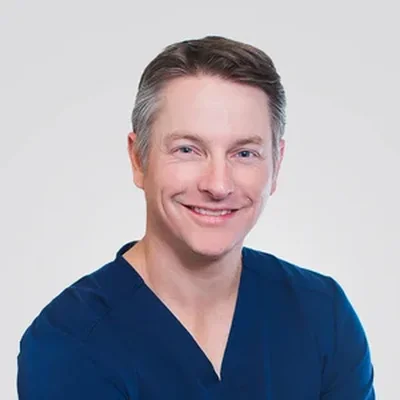
Ryan Steward has a job that covers the whole Aspire Fertility network rather than one waiting room: Director of Assisted Reproduction Technologies and Pre-Implantation Genetic Testing. That title means the lab techniques and the embryo-testing protocols used across Aspire’s Houston offices sit under his oversight, and it is a group role, not a Piney Point role. He still carries a clinical panel, seeing patients at four addresses: Piney Point, The Woodlands, Kingwood and the Women’s Clinic.
He is a native Texan, born and raised in Austin, and most of his training ran through the Texas system. A BA from the University of Texas at Austin’s Plan II Honors Liberal Arts Program, an MD from the University of Texas Health Science Center at San Antonio, then OB/GYN residency at the University of Texas Health Science Center at Houston, based at Memorial Hermann Hospital. His fellowship in Reproductive Endocrinology and Infertility took him to Duke University. He is board-certified in both Obstetrics and Gynecology and Reproductive Endocrinology and Infertility, and his residency program named him its Outstanding Resident in Reproductive Endocrinology and Infertility in 2016 and again in 2017.
His published work clusters around the things that go wrong or right in a cycle rather than around marketing: predictors of successful outcomes after IVF, ovarian hyperstimulation syndrome, uterine fibroids and pelvic imaging, in multiple peer-reviewed journals, with work presented at national research meetings. His stated interest inside fertility care is advanced reproductive technology, specifically pre-implantation genetic testing and fertility preservation.
One thing Aspire’s own pages never settle: how his role and Dr. Maya Kriseman’s divide at the Fondren Road clinic. Both are listed as this site’s specialists. What the sources do show is the difference in title and footprint, a network-wide ART and PGT directorship spanning four offices for Steward, against Kriseman’s research-heavy profile and offices elsewhere in the group. Ask which physician will run your cycle before you book, because the clinic page does not tell you.
Clinical Expertise
- IVF: full-cycle management across stimulation, retrieval, fertilization and transfer, in a clinic whose page describes an IVF lab on site
- ICSI: injected fertilization for male-factor cases and for cycles where embryos will be biopsied for PGT
- PGT-A and PGT-M: as the network’s PGT director, he covers the program from biopsy decision through result interpretation, including single-gene conditions such as cystic fibrosis, sickle cell disease, Tay-Sachs, BRCA1/2, Lynch syndrome, Huntington disease and Marfan syndrome
- Fertility Preservation: egg, embryo and sperm freezing, listed among his named interests
- Male-factor Infertility: semen analysis interpretation and treatment-path decisions with the urology side of the work
- Structural and Gynecologic Infertility: endometriosis, fibroids and pelvic imaging, which is one of his publication topics and shows up in how he evaluates a uterus before transfer
- Recurrent Pregnancy Loss: on his listed areas of specialty alongside reproductive genetics
Why Choose Dr. Ryan Steward
He writes the standard he then practices under. A directorship over assisted reproduction technology and pre-implantation genetic testing for a 14-office group is a quality-control job: protocol consistency, lab technique, biopsy and testing criteria. Patients at Piney Point get the same program the rest of Aspire runs.
Both boards, not one. Certification in Obstetrics and Gynecology plus Reproductive Endocrinology and Infertility means the surgical and gynecologic side of your workup does not get outsourced to a colleague who then hands you back.
He publishes on failure modes. Ovarian hyperstimulation syndrome and IVF outcome predictors are the unglamorous half of this field, and they are what his peer-reviewed work covers. If you are weighing a protocol that raises OHSS risk, that is the literature he works from.
Recognized twice by his own training program. Outstanding Resident in REI in 2016 and 2017, back to back, from the UT Medical School in Houston department, plus an honorable-mention clinician award at Hermann Hospital.
Four offices to choose from. Stimulation monitoring, bloodwork and transfers can shift between Piney Point, The Woodlands, Kingwood and the Women’s Clinic depending on where you live and work, since he practices at all four.
Professional Affiliations
Member of the American Society for Reproductive Medicine (ASRM). Board-certified in Obstetrics and Gynecology and in Reproductive Endocrinology and Infertility. Training: Duke University fellowship in Reproductive Endocrinology and Infertility; OB/GYN residency at the University of Texas Health Science Center at Houston, Memorial Hermann Hospital; MD from the University of Texas Health Science Center at San Antonio; BA from the University of Texas at Austin, Plan II Honors Liberal Arts Program. Awards recorded on his profile: Outstanding Resident in Reproductive Endocrinology and Infertility, University of Texas Medical School, Houston, in 2016 and 2017; Outstanding Clinician of the Month (honorable mention), UT Physicians, Hermann Hospital.
Suitable For
- Patients building a family around a known genetic condition: PGT-M is his named directorship area, and carrier screening by blood draw and oral swab is available at the first visit
- Patients weighing PGT-A before transfer: he runs the testing program, so the decision to biopsy, freeze and wait for results comes with an interpretation of what it changes about your odds
- Anyone who needs cycles standardised across offices: if you move between Piney Point, Kingwood, The Woodlands or the Women’s Clinic mid-treatment, the same protocols follow you
- Cancer patients facing treatment: fertility preservation is a stated specialty, covering egg, embryo and sperm freezing before therapy starts
- Male-factor infertility: semen analysis interpretation and the ICSI decision happen in the same consultation rather than across two clinics
- Endometriosis, fibroid and recurrent-loss histories: structural and imaging evaluation is part of his published interest set