'%20d='m0%200%2016%2011h61%2061%2061%2061%2060L47%2037h61%2061%2060%2061L16%2063h61%2061%2061%2061%2060L47%2089h61%2061%2060%2061L16%20115h61%2061%2061%2061%2060L47%20141h61%2061%2060%2061L16%20166h61%2061%2061%2061%2060L47%20192h61%2061%2060%2061L16%20218h61%2061%2061%2061%2060z'/%3e%3c/svg%3e)
About
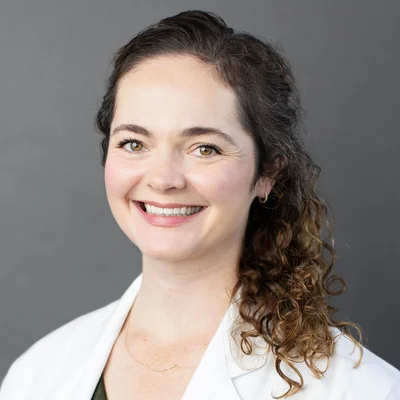
Dr. Emily Spurlin works at the intersection two fertility problems usually get split between two doctors: a uterine or pelvic condition that needs surgery, and the reproductive care that has to happen around it. Her stated specialty is minimally invasive gynecologic surgery to enhance reproductive outcomes — fixing the cavity or the tubes in a way that measurably improves what IVF or a natural cycle can then do.
She is from Tuscaloosa, studied at Wake Forest, and spent time as a clinical research coordinator at the National Institutes of Health before earning her medical degree at the University of South Alabama. She trained in Ob/Gyn at Columbia University Medical Center in New York and completed her REI fellowship at Washington University in St. Louis, earning election to Alpha Omega Alpha and the Gold Humanism Honor Society along the way.
Then she did something few reproductive endocrinologists do: she completed the Society of Reproductive Surgeons’ Surgical Scholars Track as part of its inaugural class — post-fellowship training aimed squarely at advanced reproductive surgery. At Alabama Fertility she covers the full spectrum of care: evaluation, patient education, treatment selection, and surgery.
Clinical Expertise
- Hysteroscopic surgery: polyps, submucosal fibroids, and intrauterine adhesions (Asherman syndrome) removed with maximum protection of the surrounding endometrium — the lining your embryo has to implant in
- Laparoscopic surgery: endometriosis staging and excision, adhesiolysis, and hydrosalpinx management before transfer
- IVF cycle management: evaluation through transfer, with stimulation and timing decisions informed by the surgical picture
- Surgery-plus-IVF sequencing: deciding who operates, who waits, and by how long — so a corrective procedure shortens rather than extends time to pregnancy
- Fertility evaluation and education: full workup of ovarian reserve, cavity anatomy, endocrine status, and partner semen quality before committing to a treatment path
Why Choose Dr. Spurlin
The SRS Surgical Scholars Track is the credential to notice. It is a national, application-based program that takes completed REI fellows who want serious operative training — hysteroscopic adhesiolysis, myomectomy, endometriosis excision — and Dr. Spurlin was in its first graduating cohort. In a private Alabama practice, that level of formal reproductive surgical training is uncommon.
Both of her training centers carry weight on their own: Columbia University Medical Center for residency, and Washington University in St. Louis, consistently among the country’s top REI fellowship programs. Add the NIH research-coordinator years and you get a physician comfortable reading the literature and translating it into a plan.
Patients also choose her for the combination visit: cavity problems, endometriosis, and IVF get evaluated and sequenced by one doctor. After surgery, she schedules the follow-on IVF or frozen embryo transfer herself — no referral hand-off, no re-explanation.
Professional Affiliations
Dr. Spurlin is board certified by the American Board of Obstetrics and Gynecology in Obstetrics and Gynecology and in Reproductive Endocrinology and Infertility, and a Fellow of ACOG. She is a member of the American Society for Reproductive Medicine (ASRM) and the Society of Reproductive Surgeons (SRS), and an inaugural graduate of SRS’s Surgical Scholars Track. She was elected to Alpha Omega Alpha and the Gold Humanism Honor Society during training.
Suitable For
Implantation problems rooted in the uterus — polyps, scar tissue, or submucosal fibroids blocking or irritating the cavity. Her surgical goal is always the same: correct the problem, spare the endometrium, and get to transfer quickly.
Endometriosis and pelvic adhesions — whether the complaint is pain, anatomy, or fertility (often all three). Laparoscopic staging and excision can improve both symptoms and conception odds, natural or via IVF.
Combined surgical + ART plans — patients with a correctable anatomic problem who also need IVF. One physician sequences the operation, the healing window, and the stimulation protocol.
First-time comprehensive evaluation — couples who want the whole picture (reserve, cavity, hormones, partner’s semen analysis) before anyone starts treatment, with a clear explanation of which path the data supports.