'%20d='m0%200%2016%2011h61%2061%2061%2061%2060L47%2037h61%2061%2060%2061L16%2063h61%2061%2061%2061%2060L47%2089h61%2061%2060%2061L16%20115h61%2061%2061%2061%2060L47%20141h61%2061%2060%2061L16%20166h61%2061%2061%2061%2060L47%20192h61%2061%2060%2061L16%20218h61%2061%2061%2061%2060z'/%3e%3c/svg%3e)
About
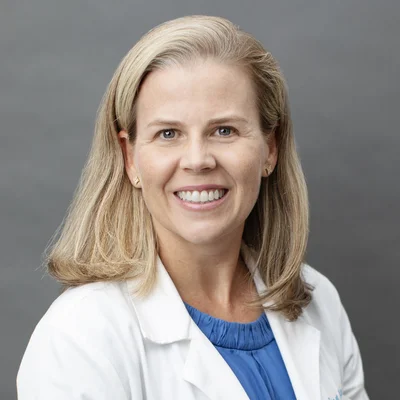
Dr. Janet Bouknight is the medical director at Alabama Fertility and one of the most credentialed reproductive specialists in Alabama. She specializes in IVF, infertility treatment, and reproductive surgery, and is known for helping patients actually understand why they are not conceiving — then mapping the shortest effective route to treatment.
She grew up in Hawaii, earned her medical degree at Harvard Medical School, and completed Ob/Gyn residency in the combined Brigham and Women’s Hospital / Massachusetts General Hospital program. At the University of Pennsylvania she finished a Reproductive Endocrinology and Infertility fellowship and, unusually, a master’s degree in clinical epidemiology (MSCE) at the same time.
She moved to Alabama in 2010 to join UAB’s faculty, where she directed the IVF and Fertility Preservation programs before joining Alabama Fertility in 2017. As medical director she oversees the practice’s clinical reporting — her name appears as director on the network’s CDC and SART submissions, including the SART 2023 report showing a 55.5% live birth rate per intended retrieval for patients under 35.
Clinical Expertise
- IVF cycle design and management: stimulation protocols matched to age, ovarian reserve, and treatment history, through retrieval and transfer
- Fertility preservation: egg and embryo freezing for medical indications (she ran UAB’s program) and for planned delay
- Reproductive endocrinology: structured evaluation of hormonal and ovulatory causes of infertility using the practice’s on-site lab
- Recurrence and failure analysis: applying clinical epidemiology training to repeated IVF failure — embryo, endometrial, and immune factors assessed systematically rather than by trial-and-error
- Reproductive surgery for patients whose infertility has a correctable anatomic cause
Why Choose Dr. Bouknight
The MSCE is the differentiator. Very few practicing REIs hold a research master’s degree from Penn on top of fellowship training, and it shows in how she handles hard cases: failed-cycle reviews are built like a differential diagnosis, weighing embryo quality, uterine receptivity, and protocol fit against published evidence before anything is changed.
She also reviews manuscripts for Fertility & Sterility, Obstetrics & Gynecology, and the American Journal of Obstetrics & Gynecology — meaning she reads the primary literature before her patients’ next cycle, not after. Her practice is anchored in outcomes data the clinic itself reports to the CDC and SART.
Before joining Alabama Fertility she directed IVF and fertility preservation at UAB, an academic program — so patients considering egg freezing for cancer treatment or age-related decline are seeing a physician who has run that service, not just consulted on it. She has won multiple patient-choice and teaching awards and was named one of B Metro’s Top Women in Medicine in 2017.
Professional Affiliations
Dr. Bouknight is board certified by ABOG in Obstetrics and Gynecology and in Reproductive Endocrinology and Infertility, and a Fellow of the American College of Obstetricians and Gynecologists (FACOG). She is an active member of the American Society for Reproductive Medicine (ASRM), the Society for Assisted Reproductive Technology (SART), and the Society of Reproductive Surgeons (SRS), and serves as a reviewer for Fertility & Sterility, Obstetrics & Gynecology, and AJOG.
Suitable For
Patients who want the plan explained by data — if you ask “why this protocol and not that one,” her epidemiology training means the answer is grounded in evidence rather than habit. Good fit for analytically minded patients and those managing conditional risks.
Egg and embryo freezing — direct program-director experience from UAB covers both oncofertility (preservation before chemotherapy or surgery) and elective preservation.
Repeated IVF failure — she is a natural referral for a structured post-mortem of failed cycles, using the practice’s own SART-tracked outcomes as a baseline.
Endocrine-driven infertility and pelvic pain — irregular cycles, ovulatory disorders, and pain conditions come in through a full reproductive endocrine workup rather than straight to a procedure.