'%20d='m0%200%2016%2011h61%2061%2061%2061%2060L47%2037h61%2061%2060%2061L16%2063h61%2061%2061%2061%2060L47%2089h61%2061%2060%2061L16%20115h61%2061%2061%2061%2060L47%20141h61%2061%2060%2061L16%20166h61%2061%2061%2061%2060L47%20192h61%2061%2060%2061L16%20218h61%2061%2061%2061%2060z'/%3e%3c/svg%3e)
About
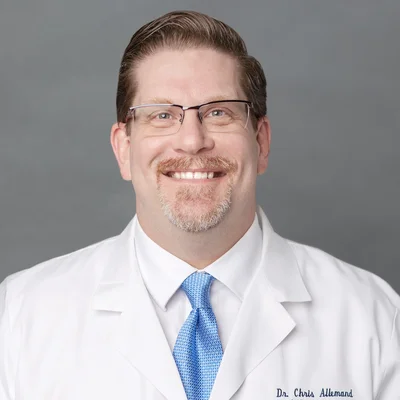
Dr. Michael Allemand is a board-certified reproductive endocrinologist with training across the full scope of infertility care: IVF, ICSI, and reproductive surgical procedures. His particular surgical focus is operative laparoscopy and hysteroscopy — the minimally invasive procedures that clear fibroids, endometriosis, and tubal disease out of the way of a successful pregnancy.
He is a Texan by way of medicine: an honors degree from Texas A&M (elected to Alpha Omega Alpha in his fourth year), residency at Scott & White Memorial Hospital where he was chief resident, and then a three-year Reproductive Endocrinology fellowship at the Mayo Clinic in Rochester, Minnesota, from 2003 to 2006 — a program with a national reputation and a very short acceptance list. He practices at Alabama Fertility.
His research track runs from the lab bench to the operating room: award-winning work on male factor infertility presented at ASRM, and published research on diagnosing and treating PCOS in Fertility & Sterility, for which he also reviews submissions.
Clinical Expertise
- IVF full-cycle management: stimulation planning by age, reserve, and history; monitoring, retrieval, and transfer with the clinic’s embryology team
- Male factor infertility and ICSI: low count, poor motility, abnormal morphology, and prior fertilization failure — deciding when ICSI, sperm selection technique, or urologic co-management is the right call
- Operative laparoscopy and hysteroscopy: endometriosis excision, fibroid removal, hydrosalpinx repair, and adhesiolysis, timed against the IVF calendar so neither surgery nor the cycle waits on the other
- PCOS care: ovulation induction and stimulation protocols that manage response and OHSS risk, informed by his own published research on the condition
- Fertility preservation: sperm freezing and cycle planning for medical indications
Why Choose Dr. Allemand
Mayo Clinic REI fellowship training is rare in private Alabama practice, and it came with a curriculum that spans IVF lab technique, reproductive surgery, and andrology — which is exactly what combined cases call for. If fibroids or endometriosis need to come out before transfer, the doctor doing the laparoscopy is also the one setting your stimulation protocol afterward.
On male factor work, his ASRM-recognized research (third prize, 2001 annual meeting) sits behind day-to-day decisions: whether a severely low count calls for ICSI with testicular sperm, whether prior total fertilization failure means assisted oocyte activation, and what the couple should realistically expect.
PCOS patients get a physician who has actually published on the diagnosis and treatment of the syndrome — and reviews for the journal that publishes it. Practically, that means individualized induction or stimulation with attention to over-response risk, not a default protocol.
Professional Affiliations
Dr. Allemand is board certified by the American Board of Obstetrics and Gynecology in both Obstetrics and Gynecology and the subspecialty of Reproductive Endocrinology/Infertility, and a Fellow of ACOG. He is a member of the American Society for Reproductive Medicine (ASRM), where he has presented research at annual meetings, and serves as an ad hoc reviewer for Fertility & Sterility.
Suitable For
Couples facing male factor infertility — low count, weak motility, abnormal morphology, or high DNA fragmentation. He builds the ICSI strategy around the specific semen profile and any prior fertilization history.
Surgery-then-IVF cases — endometriosis, fibroids, ovarian cysts, or hydrosalpinges where operating first improves the odds, and the timing between healing and stimulation matters.
PCOS and ovulatory disorders — patients who need induction or carefully titrated stimulation, including those who over-responded badly in a past cycle.
Prior fertilization failure — if a conventional IVF cycle failed to fertilize, he works the problem from both sides: the sperm, the egg activation pathway, and the ICSI technique choice.