'%20d='m0%200%2016%2011h61%2061%2061%2061%2060L47%2037h61%2061%2060%2061L16%2063h61%2061%2061%2061%2060L47%2089h61%2061%2060%2061L16%20115h61%2061%2061%2061%2060L47%20141h61%2061%2060%2061L16%20166h61%2061%2061%2061%2060L47%20192h61%2061%2060%2061L16%20218h61%2061%2061%2061%2060z'/%3e%3c/svg%3e)
About
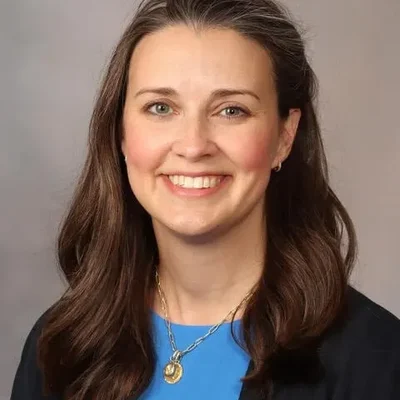
Every IVF cycle has to run through someone, and at Mayo Clinic’s Division of Reproductive Endocrinology and Infertility that someone is Dr. Ali Ainsworth — Alessandra (Ali) Ainsworth — who serves as the division’s IVF Director while practicing as an assistant professor of obstetrics and gynecology. Her named clinical interests read like the program’s own hard cases: infertility, fertility preservation, premature ovarian insufficiency, and assisted reproductive technology.
Her training ran end to end through one system: medical school at the University of Kansas, then obstetrics and gynecology residency and a reproductive endocrinology and infertility fellowship at Mayo Clinic, where she picked up a master’s degree in biomedical science along the way. She is certified by the American Board of Obstetrics and Gynecology in ob/gyn (2021) and in the REI subspecialty (2023).
Ainsworth’s research mirrors her clinical role in an unusual way — she studies what happens to patients after fertility treatment, on long-term health outcomes after infertility, and works on new models of fertility care aimed at patient experience and access to care. She teaches medical students, residents and fellows, holds the Mayo Brothers Distinguished Fellowship Award (2021), and appears in Mayo Clinic’s 2025 patient-experience results for top performance on likelihood to recommend.
Clinical Expertise
- In Vitro Fertilization: as the division’s IVF Director, oversees and performs the program’s IVF cycles — stimulation, retrieval, embryo transfer.
- ICSI and assisted reproductive technology: listed among her procedures, alongside ovulation induction and superovulation.
- Fertility preservation: egg, embryo and sperm freezing, and deferred reproduction for patients facing treatments that threaten fertility.
- Premature ovarian insufficiency and diminished ovarian reserve: a named clinical focus, from amenorrhea through primary ovarian insufficiency.
- Recurrent miscarriage: evaluation and management as a stated interest.
- Donor gamete and gestational carrier cycles: egg donation, sperm donation and gestational surrogacy appear in her interests and procedure list.
- Diagnostic work: 3D ultrasound, hysterosalpingography, sonohysterography, hysteroscopy and polypectomy, with genetic counseling when a hereditary risk is on the table.
Why Choose Dr. Ainsworth
The IVF program itself is her job. When you ask who decides how cycles get run at this division, the answer for IVF is Ainsworth — a vantage most patients never get at a clinic.
Certified twice over by the ABOG, in ob/gyn and in the REI subspecialty, on a Mayo pipeline through fellowship and a biomedical science master’s degree.
She studies the after-part of fertility care. Long-term health outcomes after infertility and access-to-care research sit behind the clinical practice, and her teaching load runs from medical students to fellows.
Patients rate her. Mayo’s own 2025 patient-experience results place her at top performance for likelihood to recommend, and her fellowship training earned the Mayo Brothers Distinguished Fellowship Award.
Professional Affiliations
Member of the American Society for Reproductive Medicine, serving on ASRM’s Membership Engagement Committee from 2026. Within Mayo Clinic she is an assistant professor in the Department of Obstetrics and Gynecology and works with the division’s students, residents and fellows.
Suitable For
- Patients planning IVF at Mayo Rochester: cycles are directed by the physician who runs the program.
- Before chemo, surgery or another fertility-threatening treatment: preservation through egg, embryo or sperm freezing.
- Low ovarian reserve or early ovarian failure: premature ovarian insufficiency is one of her named specialties.
- After repeated losses: recurrent pregnancy loss evaluation as a standing clinical interest.
- Non-traditional family building: donor egg, donor sperm and gestational carrier paths are all in her scope of practice.