'%20d='m0%200%2016%2011h61%2061%2061%2061%2060L47%2037h61%2061%2060%2061L16%2063h61%2061%2061%2061%2060L47%2089h61%2061%2060%2061L16%20115h61%2061%2061%2061%2060L47%20141h61%2061%2060%2061L16%20166h61%2061%2061%2061%2060L47%20192h61%2061%2060%2061L16%20218h61%2061%2061%2061%2060z'/%3e%3c/svg%3e)
About
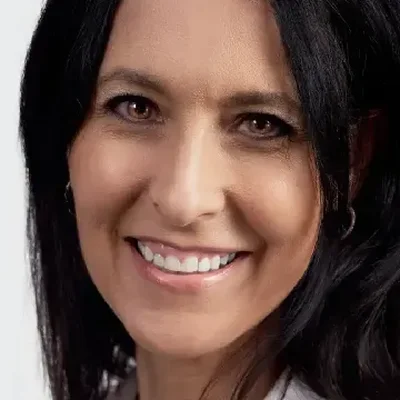
Some physicians develop an interest in recurrent pregnancy loss. Alison Peck had the problem first: she, her mother and her sister each experienced pregnancy loss on the way to becoming mothers. She went on to co-found HRC Fertility’s recurrent pregnancy loss and repeated implantation failure program, the clinical structure built to answer the question patients in her own family were asking — what exactly went wrong, and what changes next cycle.
Her training route is unusual too. She did undergraduate work at the University of Wisconsin, earned her MD at Tel Aviv University’s Sackler Faculty of Medicine, completed OB/GYN residency at Los Angeles County/USC Women’s and Children’s Hospital — where she was named Berlex Best Teaching Resident and chaired the residency ethics committee — and finished reproductive endocrinology and infertility fellowship at Albert Einstein College of Medicine/Montefiore. She has practiced in Los Angeles since 2006, and sees patients at HRC’s Encino, Westlake Village and Los Angeles offices, with affiliation to Providence Cedars-Sinai Tarzana Medical Center.
The other half of her practice is where medicine and religion collide. Peck advises patients on how IVF, IUI and egg retrieval can be sequenced around the laws of family purity and Mikvah timing, serves as a community fertility lecturer, and wrote My God Shots: They’re Everywhere, a book about injections and religious life. For observant patients who have been told a treatment calendar simply does not fit their practice, this is a physician who has already solved that puzzle many times. She consults in English.
Clinical Expertise
- Recurrent pregnancy loss and implantation failure: the program she co-founded works up euploid-transfer failures through sperm DNA assessment, uterine cavity evaluation, laboratory review and endometrial receptivity testing (ERA) to re-time the transfer
- IVF protocol optimization: conventional, mild and natural-cycle IVF, selecting the protocol to ovarian reserve rather than to a house default
- PGT-A and PGT-M: embryo chromosome screening and single-gene diagnosis, with counseling on what a result does and does not predict
- ICSI, including PICSI and Zymot sperm selection for male factor cases
- Fertility preservation and oncofertility: egg and embryo banking on the compressed timeline chemotherapy creates
- Egg freezing: the subject of her book Everything Egg Freezing: The Essential Step-by-Step Guide to Doing It Right (co-author)
- Donor eggs, third-party reproduction and gestational carriers, including same-sex female couples and single patients
- PCOS and diminished ovarian reserve: individualized dosing with hyperstimulation risk managed
- Religious infertility care: cycle timing, procedure scheduling and consent questions handled within Jewish law, and analogous constraints for other faith communities
Why Choose Dr. Peck
She built the loss program, so the workup is not outsourced. Recurrent loss patients frequently get a blood panel and a shrug. Here the evaluation is designed by a physician who founded the service: anatomic, genetic, endocrine, immune and laboratory causes get looked at together, including the embryology lab’s own handling of your embryos.
Twenty years in one metropolitan market. Practicing in Los Angeles since 2006 means she has watched protocols, PGT platforms and freezing technique change, and has treated the same families across multiple cycles and years. Pasadena Magazine Top Doctor recognition and a seat on Optum’s fertility expert panel reflect peer visibility, not paid placement.
A rare competency: faith-constrained treatment. Very few US reproductive endocrinologists can restructure a stimulation calendar around niddah and Mikvah observance without degrading the medicine. If religious law is a hard boundary for you rather than a preference, it removes a months-long negotiation.
She publishes for patients, not only for journals. Everything Egg Freezing is a step-by-step guide written for people making decisions under time pressure; the same clarity carries into a consult.
Conservative care stays conservative. She uses ovulation induction and IUI where they can work, and moves to IVF when the data says to — an important distinction in a fee-for-service environment that rewards escalation.
Professional Affiliations
Fellow of the American College of Obstetricians and Gynecologists (FACOG); Diplomate of the American Board of Obstetrics and Gynecology in both Obstetrics and Gynecology and Reproductive Endocrinology and Infertility. Member of the American Society for Reproductive Medicine and the Society for Reproductive Endocrinology and Infertility; Phi Beta Kappa. Peer-reviewed publications include work in Molecular Cytogenetics (2012), and she contributes book chapters on infertility. Annual guest speaker at Science Day, and a community fertility educator and lecturer.
Suitable For
Two or more losses, or good embryos that will not implant. The program she co-founded exists for exactly this group, and the workup includes the lab and sperm side, not just the uterus.
Patients racing a cancer treatment. Preservation cycles coordinated around the date oncology wants to start therapy.
PCOS and diminished ovarian reserve. Mild and natural-cycle protocols for patients who respond poorly or dangerously to standard stimulation.
Observant Jewish patients, and anyone whose faith sets non-negotiable scheduling limits. Retrieval and transfer days planned inside religious law, worked out with a physician who advises on it regularly.
LGBTQ+ families and donor-egg or gestational carrier paths. Third-party programs at a California practice where parentage documentation is routine.
Older patients who want a straight answer. Advanced maternal age counseling that names the real probabilities before it sells a cycle.