'%20d='m0%200%2016%2011h61%2061%2061%2061%2060L47%2037h61%2061%2060%2061L16%2063h61%2061%2061%2061%2060L47%2089h61%2061%2060%2061L16%20115h61%2061%2061%2061%2060L47%20141h61%2061%2060%2061L16%20166h61%2061%2061%2061%2060L47%20192h61%2061%2060%2061L16%20218h61%2061%2061%2061%2060z'/%3e%3c/svg%3e)
About
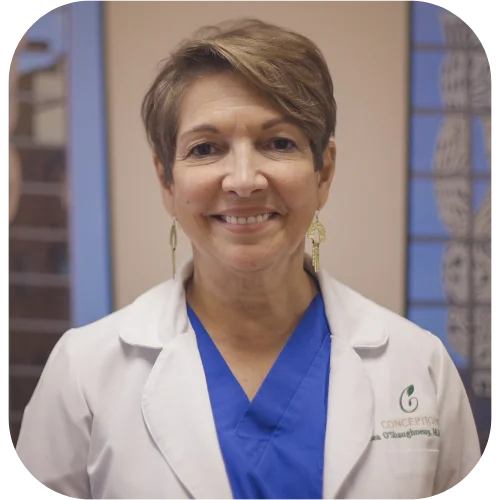
One named job sets Althea O’Shaughnessy apart on this team: she runs the donor egg program at Conceptions. That covers the practice’s in-house fresh egg donation and embryo donation services plus its work with outside agencies for fresh and frozen donor eggs, so a recipient using donated eggs here is routed through her. She has said of the other side of that transaction that donating eggs is “a very personal and profound gift,” and the donor criteria the practice publishes — ages 19 to 33, BMI 19 to 29, non-smoker, living within two hours of one of its offices, compensation up to $7,500 per donation, six donations maximum — are hers to administer.
She is a New York native who trained almost entirely on the east coast: Trinity College in Hartford for her bachelor’s degree, the University of Rochester School of Medicine & Dentistry for her medical degree, obstetrics and gynecology residency at the University of Connecticut Health Center, then a reproductive endocrinology fellowship back in New York at Downstate Medical Center. Before Colorado she practiced at Mount Sinai Hospital, the Cooper Center for IVF in New Jersey and the Sher Institute for Reproductive Medicine in New York — three fertility-heavy institutions whose case mix explains why third-party reproduction is her lane rather than an add-on service.
Her reputation inside the practice rests on how she talks to patients. “I believe in a straightforward, no-nonsense approach in patient care. Patients entering treatment are fearful enough. Truth is a great remedy for fear.”
Clinical Expertise
- Donor egg IVF: screening, matching and cycle management for recipients, in-house fresh donation programs and agency-sourced frozen donor eggs
- Third-party reproduction broadly: donor sperm and donor embryo pathways, and coordination with gestational carriers for patients who cannot carry a pregnancy, same-sex male couples and single fathers by choice
- IVF with individually built protocols: she states the practice’s approach as improving an individual patient’s chance “based on science and not try to fit the patient in a box based on protocols”
- Diminished ovarian reserve and advanced maternal age, the groups most likely to need donor gametes, handled as one continuum with the practice’s own-egg results
- Consent and counseling: her first visit is explicitly built around how much a patient can absorb and how comfortable they are, before any stimulation decision
Why Choose Dr. Althea O’Shaughnessy
Program ownership, not referral. She is not one of several physicians who occasionally see a donor case; the donor egg program is hers, which usually means she has seen the matching, screening and legal paperwork stages more times than a generalist in the same group.
Three east-coast fertility institutions before this one. Mount Sinai, the Cooper Center for IVF and the Sher Institute are high-volume practices with third-party programs of long standing. The habits she brought to Colorado came from that environment.
Her first-visit method is documented, and it is unusual. She says she measures two things in a new patient: comfort level, and how much education that person can take in. Her stated aim is a patient who knows they can stop, change or shift direction at any point — “the patient knows they are in the driver’s seat.”
She will tell you the bad number. The clinic’s own advice to patients comparing centers is that delivery rates for your age band should sit at or above the national average; she applies that honestly rather than selling the highest figure on the website.
Professional Affiliations
American Society for Reproductive Medicine; Society for Reproductive Endocrinology and Infertility; American College of Obstetricians and Gynecologists. Her practice sits inside a SART-reporting center that also holds a Colorado state gamete license, the permit that governs donor egg handling and storage.
The material reviewed documents her Downstate reproductive endocrinology fellowship and ACOG fellowship; it does not quote an individual REI certificate number.
Suitable For
- Recipients using donor eggs, whether through this practice’s in-house program or an agency’s frozen donor offering
- Same-sex male couples and single fathers planning a gestational carrier path, where donor eggs are usually step one
- Patients who distrust cheerleading: her style is disclosure over comfort, which suits people who want the odds stated
- Anyone told to accept a standard protocol: she is the physician on this team who says openly that the protocol should follow the patient
- Donor-conception families who want a physician fluent in the paperwork: matching, screening and consent are part of her program role