'%20d='m0%200%2016%2011h61%2061%2061%2061%2060L47%2037h61%2061%2060%2061L16%2063h61%2061%2061%2061%2060L47%2089h61%2061%2060%2061L16%20115h61%2061%2061%2061%2060L47%20141h61%2061%2060%2061L16%20166h61%2061%2061%2061%2060L47%20192h61%2061%2060%2061L16%20218h61%2061%2061%2061%2060z'/%3e%3c/svg%3e)
About
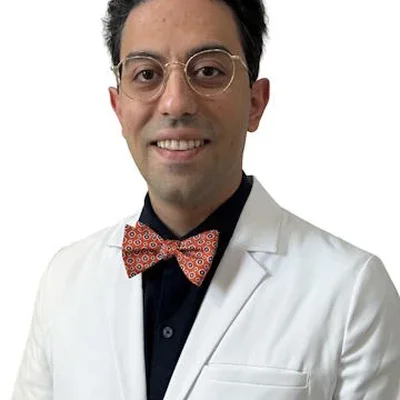
Arian Khorshid studied biomedical engineering at the University of Virginia, graduated high distinction, and then did not go to med school. He spent a year in AmeriCorps teaching sexual education to middle and high school students in Colorado and volunteering as a doula with refugee families — the kind of year that tends to decide a career rather than decorate it. Medical school followed at the University of Colorado, then residency and REI fellowship at Stanford, where he received the 2022 Society for Reproductive Endocrinology and Infertility Resident Award for Excellence in REI, a national honor.
His research program is unusually economics-flavored for a reproductive endocrinologist. He holds NIH funding for work on how biological aging affects fertility and pregnancy loss, and publishes on the cost-effectiveness of IVF strategies and on artificial intelligence applied to reproductive medicine. He also lobbies — specifically — for broader insurance coverage of IVF in California, which is the same argument made in a legislative chamber rather than a journal.
That combination is why his clinical interests cluster around patients facing a countdown: recurrent pregnancy loss, age-related decline in egg quality, fertility preservation for cancer patients and for LGBTQ+ family builders, and elective egg freezing. He practices in the Bay Area at HRC’s Foster City Silicon Valley office beginning fall 2026, and consults in English and Farsi.
Clinical Expertise
- IVF cost-effectiveness counseling: comparing protocol strategies, PGT use and number-of-cycle decisions on dollars-per-live-birth rather than per-cycle price
- Recurrent pregnancy loss: evaluation of genetic, anatomic, endocrine and uterine causes, with the biological-aging framework his NIH-funded research applies
- Age-related fertility decline and diminished ovarian reserve: realistic, evidence-based timelines and protocol choices for patients over 37
- Fertility preservation and oncofertility: egg, embryo and tissue-banking pathways coordinated with oncology or a transition timeline
- Egg freezing: stimulation design, vitrification and a frank discussion of what frozen eggs predict
- LGBTQ+ family building: reciprocal IVF, donor gametes and gestational carrier cycles under California’s parentage framework
- AI-assisted embryo selection: he researches time-lapse and machine-learning embryo assessment, so patients using those tools at HRC get a physician who understands their limits
Why Choose Dr. Khorshid
He does the money question as scholarship. Most physicians will tell you a treatment is recommended; few have published on whether it is worth the cost. Khorshid’s research agenda is explicitly about IVF cost-effectiveness, and he works in a network that sells multi-cycle packages — which is precisely where that analysis protects you.
An NIH grant on aging and reproduction. His funded work is on the mechanism connecting biological aging to fertility and miscarriage. For patients over 37, that is the exact variable driving their prognosis.
Pre-med school service year that still shows. AmeriCorps sex education teaching and doula work with refugee families is why his stated commitments include insurance access and patient education, not just laboratory technique.
Stanford pipeline, SREI recognition. Residency and fellowship at Stanford, with the national SREI excellence award during training — the standard marker that a subspecialty program noticed him early.
Policy work you can benefit from. He advocates for expanded California IVF coverage. That means he reads benefit documents closely and knows which criteria plans use to deny treatment.
Farsi-speaking consultations, new Bay Area seat. HRC’s Foster City office opened recently, so new-patient availability is better than at its saturated Southern California campuses.
Professional Affiliations
Fellow of the American College of Obstetricians and Gynecologists (FACOG); member of the American Society for Reproductive Medicine and the Society for Reproductive Endocrinology and Infertility. 2022 SREI Resident Award for Excellence in Reproductive Endocrinology and Infertility. NIH-funded research on biological aging, fertility and pregnancy loss; publications on IVF cost-effectiveness and artificial intelligence in reproductive medicine. Active in California advocacy for insurance coverage of fertility treatment.
Suitable For
Patients over 37 who want numbers, not optimism. His research is on aging and reproduction; the conversation covers probabilities, time windows and how many cycles a given reserve realistically buys.
Recurrent pregnancy loss. Structured evaluation framed by NIH-funded work on the same subject.
LGBTQ+ family builders. Reciprocal IVF, donor gamete and gestational carrier paths, in a state with clear parentage statutes, with California coverage rules understood.
Cancer patients and elective egg freezers. Preservation planning that treats cost and timing as clinical variables.
Anyone paying out of pocket. A physician who publishes on cost-effectiveness is a person you can ask “is this add-on worth it?” and get a straight answer.