'%20d='m0%200%2016%2011h61%2061%2061%2061%2060L47%2037h61%2061%2060%2061L16%2063h61%2061%2061%2061%2060L47%2089h61%2061%2060%2061L16%20115h61%2061%2061%2061%2060L47%20141h61%2061%2060%2061L16%20166h61%2061%2061%2061%2060L47%20192h61%2061%2060%2061L16%20218h61%2061%2061%2061%2060z'/%3e%3c/svg%3e)
About
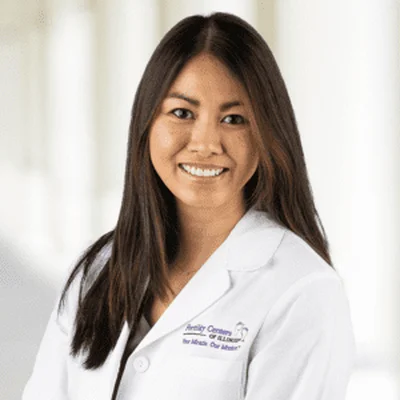
In 2024, a paper in F&S Science asked whether early endometriosis is a seed problem or a soil problem — and answered with data that the stromal cell origin drives cellular invasion and coupling more than the mesothelial cell origin does. The first author is Dr. Arlene Go, a reproductive endocrinologist at Fertility Centers of Illinois. Mechanism research like that is not decoration on a clinic profile: it is the reasoning a physician brings when deciding whether an endometriosis patient benefits from surgery, from stimulation, or from not losing time on either.
She is board-certified in Obstetrics and Gynecology by the American Board of Obstetrics and Gynecology and practices as a reproductive endocrinologist. She earned her medical degree at Michigan State College of Human Medicine, completed OB/GYN residency at Saint Joseph Hospital in Denver, Colorado, and did her Reproductive Endocrinology and Infertility fellowship at the University of Texas Health Science Center in San Antonio. An Alpha Omega Alpha Honor Society member, she says she trained with some of the leaders in endometriosis research and is drawn to patients with what she calls an often overlooked and under-recognized silent disease.
Her other two focus areas come from biography rather than the laboratory. She has experienced miscarriage herself, which she cites as why recurrent pregnancy loss attracts her — she wants to be a light for people walking that road. And she describes herself as someone who was education- and career-focused for the majority of her life, which is why she says she truly values the technology of fertility preservation and enjoys helping patients pursue it for whatever reason they need it. She also co-authored a 2024 Journal of Adolescent and Young Adult Oncology paper proposing a standardized Reproductive Endocrinology and Infertility consultation for pediatric and adolescent oncology patients — moving the fertility conversation to before cancer treatment begins.
At FCI she sees patients at the Chicago and Mokena campuses, with privileges at Advocate Masonic, Advocate Lutheran and Advocate Christ. Her stated approach is that each patient’s plan should be tailored to their specific circumstances and goals. Asked what she likes about the work, she says it is helping patients take control and build families when and how they choose. (Something people don’t know about her: a brief stint as a hand model for Starbucks.)
Clinical Expertise
- Endometriosis: Both a research line and a clinical focus — how early lesions establish and invade, and what that means for evaluating pain, staging disease, and deciding the order of surgery and assisted reproduction.
- Recurrent pregnancy loss: Evaluation and management after repeated losses, an area she is drawn to personally and describes as a road patients should not have to walk without explanation.
- Fertility preservation: Egg and embryo freezing for patients postponing parenthood for training, career or medical reasons, including the honest conversation about what preservation can and cannot guarantee.
- Oncofertility consultation in young patients: Co-author of a standardized REI consult pathway for pediatric and adolescent oncology patients, so fertility options are discussed before gonadotoxic therapy starts.
- Reproductive endocrinology and hormone pathways: She describes herself as thriving in the basic science of reproductive endocrinology and hormone pathways — the interpretive skill behind irregular cycles, ovulatory problems and stimulation responses.
Why Choose Dr. Go
She publishes on the mechanism, not just the outcome. The 2024 F&S Science paper she first-authored tests a biological hypothesis about where endometriosis invasion starts. A physician who has done that work reads a pelvic finding differently than one who only reads clinic summaries.
Endometriosis research training is her stated background. She says plainly that she trained with leaders in endometriosis research — a disease whose patients commonly spend years having pain and infertility dismissed. That training is the reason the population is her focus.
She works at the oncology-fertility boundary. The 2024 Journal of Adolescent and Young Adult Oncology paper addresses a real gap: young cancer patients frequently never get a fertility consult before treatment. Proposing a standardized pathway is a concrete piece of infrastructure, not a statement of interest.
Board-certified in OB/GYN, practicing as an endocrinologist. ABOG certification in Obstetrics and Gynecology plus REI fellowship training at the University of Texas Health Science Center in San Antonio means she can manage the underlying gynecologic disease and the fertility plan without a handoff.
Her reasons for these patient groups are personal and stated. Miscarriage she has lived through; fertility preservation she has used her own life trajectory to understand. Patients in either group are getting a physician with a position, not a neutral assignment.
She treats the vulnerability, not only the case. She says patients invite a physician into the most vulnerable time of their lives, which is the greatest privilege, and that she is proudest of the lifelong relationships built through her practice — with patients, colleagues and the whole care team.
Professional Affiliations
ABOG Board Certified Obstetrician/Gynecologist. Alpha Omega Alpha Honor Society. Peer-reviewed publications include first-author work in F&S Science (Volume 5, Issue 4, 2024, 395-403; DOI 10.1016/j.xfss.2024.08.001) on stromal versus mesothelial cell origin in early endometriosis, and co-authored work in the Journal of Adolescent and Young Adult Oncology (2024, vol. 13:4, 614-621) on standardized REI consultation for pediatric and adolescent oncology patients. Hospital privileges at Advocate Masonic, Advocate Lutheran and Advocate Christ.
Suitable For
- Endometriosis with infertility: Research training and a first-author mechanism paper in the same disease, useful when the question is whether to operate, stimulate, or both and in what order.
- Repeated pregnancy loss: A named long-term area, with a systematic approach to evaluation and to the next pregnancy.
- Egg freezing during training or career-building: She describes making this exact trade-off herself, and values preservation technology for whatever reason a patient needs it.
- A child or teenager about to start cancer treatment: She helped write the standardized fertility-consult pathway for this population.
- Complicated, overlapping cases: Her stated method is a plan tailored to each patient’s circumstances and goals rather than a standing protocol.
- Patients who want a doctor who reads the literature herself: Basic science and hormone pathways are what she says she loves about the specialty.