'%20d='m0%200%2016%2011h61%2061%2061%2061%2060L47%2037h61%2061%2060%2061L16%2063h61%2061%2061%2061%2060L47%2089h61%2061%2060%2061L16%20115h61%2061%2061%2061%2060L47%20141h61%2061%2060%2061L16%20166h61%2061%2061%2061%2060L47%20192h61%2061%2060%2061L16%20218h61%2061%2061%2061%2060z'/%3e%3c/svg%3e)
About
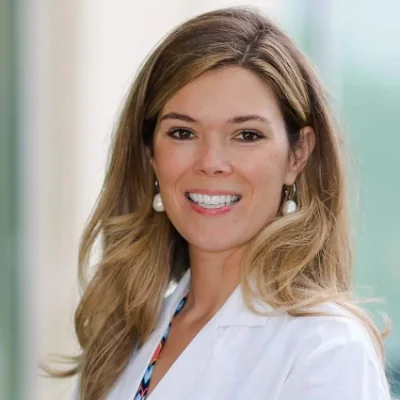
The study Brianna Schumacher, M.D. published as first author asks a question that decides whether a stimulation cycle starts on Tuesday or waits two days: on what combination of cycle day, estradiol level and lead follicle size should a clinic hand a patient the GnRH antagonist? She and her co-authors took 27,790 IVF cycles apart to find the optimal start criterion, and the work appeared in Fertility and Sterility (2018;109(4):633-637) under the name she published under then, Lyttle Schumacher.
That is the unusual part of her profile - a REI who also holds a master’s in clinical research and who wrote herself into the protocol literature rather than only reading it. The credential path runs Medical College of Wisconsin (medical degree), OB/GYN residency at the University of Massachusetts Medical School, then the University of North Carolina at Chapel Hill for both the REI fellowship and the clinical research master’s, with a stint as a clinical instructor in gynecology at UNC along the way. Her practice profile lists board certification in Obstetrics and Gynecology and in Reproductive Endocrinology and Infertility. She joined Shady Grove Fertility in 2018.
The practice also describes her as an advocate for two positions that patients usually have to ask for: diagnosing infertility early rather than after a year of guessing, and freezing eggs to keep future family-building options open. Her own first-author work supports the second - a cost-effectiveness analysis of oocyte cryopreservation in cancer patients facing gonadotoxic treatment, high-risk versus low-risk regimens compared (Human Reproduction, 2017;32(10):2049-2055) - and a later accepted paper asks whether anti-Müllerian hormone is a risk factor for miscarriage in naturally conceived pregnancies (Fertility and Sterility, accepted January 2018).
Her stated approach in consultation is to build a plan with the couple, including the option of stopping: “Whether it’s trying again, moving to a different treatment, or deciding that a couple wants to take a break to breathe and reassess - I’m here to help guide them through the process.” She is Canadian, and says so herself; she has a husband and children, and lists tea, snowstorms and chasing tadpoles among the trades of her free time.
Clinical Expertise
- IVF and stimulation protocol decisions: the start-criteria study is about the first reversible decision in a cycle - when to add the antagonist - and it is the kind of question her appointments answer with a reason rather than a habit
- Egg freezing: named by the practice as one of her advocacy and clinical focuses, from ovarian reserve counseling through retrieval and vitrification
- Fertility preservation before cancer treatment: her Human Reproduction cost-effectiveness analysis compared egg freezing for patients scheduled for high-risk and low-risk gonadotoxic therapy, the literature that oncology-reproductive medicine coordination actually leans on
- Ovarian reserve and AMH interpretation: first-author analysis of AMH as a miscarriage risk factor in naturally conceived pregnancies, which is the other side of the “my reserve is low, so what?” conversation
- Recurrent miscarriage and early pregnancy: her ASRM Early Pregnancy Special Interest Group prize paper sits in this area, alongside the AMH-miscarriage work
- PCOS and general female infertility: listed among her practice areas, covering ovulation disorders and the standard infertility workup
- Endometriosis and its cancer-risk literature: co-author of two reviews on the links between endometriosis and ovarian cancer (International Journal of Women’s Health, 2015; Minerva Ginecol, 2014) - relevant when an endometriosis patient asks whether surgery changes her ovarian reserve or her risk
- Older bench work: first-author studies on immune regulation in preterm birth (AJOG, 2009) and transcription factor expression in the developing fetal endocrine pancreas (Diabetologia, 2007), plus an infertility chapter in The 5-Minute Clinical Consult, 2013 edition
Why Choose Dr. Schumacher
She has run the numbers on a decision she makes every week. Very few fertility patients can ask their physician which study they wrote about cycle-start timing and get a direct answer. She holds a clinical research master’s and published on precisely the protocol question that determines how many injection days a cycle costs.
A teaching award three years running. UMass Memorial OB/Gyn residency teaching award in 2012, 2013 and 2014, plus a best oral research presentation at the MA-ACOF annual meeting (2014) and a Pacific Coast Reproductive Society research scholarship for its 2016 meeting. Repetition from residents is a different signal from a single honor.
Recognition from general medicine lists as well as regional ones: Philadelphia Magazine Top Doctor (2026), Castle Connolly Top Doctor (2025, 2026), Suburban Life Magazine Top Physician (2024, 2025). One inconsistency worth recording rather than smoothing over: her biography paragraph credits the ASRM Early Pregnancy Special Interest Group prize paper as 2017, while her awards list dates the same award 2018; the practice does not reconcile the two.
She publishes under a prior name, so a patient or referring physician searching the literature should look for Lyttle and Lyttle Schumacher as well as Schumacher - otherwise her main body of research is easy to miss.
She is one of the practice’s named advocates for freezing eggs before the question becomes urgent, which matters for patients who want a physician who will discuss elective preservation without assuming they have already decided. Her profile carries practice-selected patient testimonials; our sources did not capture independent review text for her, so none is used here.
Professional Affiliations
Board certified in Obstetrics and Gynecology and in Reproductive Endocrinology and Infertility, as labeled at the top of her profile; certification years are not published. She is listed as a member of the American Society for Reproductive Medicine, the American College of Obstetrics and Gynecologists, the American Medical Association, the New England Fertility Society and the Pacific Coast Reproductive Society, and as an in-training member of the Society for Gynecologic Investigation. The practice states she has held “a variety of leadership roles” within ASRM, the New England Fertility Society, the Pacific Coast Society, ACOG and the AMA, without naming the positions or terms.
Suitable For
- Women planning to delay childbearing who want egg freezing discussed with data - how many eggs, at what age, with what cost-effectiveness evidence
- Patients about to start gonadotoxic cancer therapy, where the time window between oncology and reproduction is the whole problem, and where her own published comparison of high-risk and low-risk regimens applies
- Anyone holding an AMH or ovarian reserve result and wanting to know whether it predicts difficulty conceiving, miscarriage, or nothing at all
- IVF patients who want to know why their cycle start moved, since that is literally the subject of her first-author paper
- Recurrent miscarriage and early pregnancy questions, the area of her ASRM prize paper and her AMH work
- Patients who want permission to pause treatment and reassess, an option she puts on the table in her own description of her approach
Two scope notes. Her profile’s location bar lists Newark, DE alongside Chesterbrook, PA, while her biography says she sees patients in SGF’s Chesterbrook, PA location - confirm the office when booking. And no physician-level outcome data exists for her in our sources: the success rates shown on this clinic’s page are SART 2023 figures reported for the registry entity “Shady Grove Fertility | Chesterbrook” (ClinicPKID 2029, SART number 0317), which pools cycles from several Pennsylvania offices, is not specific to Chesterbrook, and does not break out results by doctor. Her 2018 start-criteria study analyzed 27,790 IVF cycles from research data, not from this office’s patients.