'%20d='m0%200%2016%2011h61%2061%2061%2061%2060L47%2037h61%2061%2060%2061L16%2063h61%2061%2061%2061%2060L47%2089h61%2061%2060%2061L16%20115h61%2061%2061%2061%2060L47%20141h61%2061%2060%2061L16%20166h61%2061%2061%2061%2060L47%20192h61%2061%2060%2061L16%20218h61%2061%2061%2061%2060z'/%3e%3c/svg%3e)
About
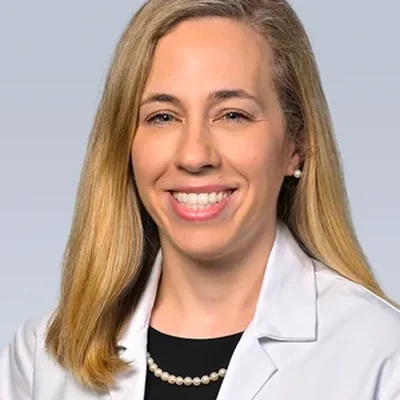
A vial of donor sperm costs a few hundred dollars, and the number changes who gets chosen. Caitlin Elizabeth Martin has published on exactly that: how the price list at a sperm bank shapes which donors patients select, which makes her one of very few physicians at a US academic fertility center studying the money side of donor conception rather than only the medicine. The rest of her research sits in the same access territory — whether telemedicine can carry an IVF patient through monitoring and consultation, and how fertility preservation actually gets delivered when an oncology schedule leaves no slack.
Her own route was a straight line through Emory: medical school, then obstetrics and gynecology residency at Emory University Hospital, then a fellowship in reproductive endocrinology and infertility at Barnes-Jewish Hospital with Washington University in St. Louis. Certified in obstetrics and gynecology in 2021, she joined Penn as a clinical assistant professor and is the newest physician on the division’s eleven-doctor staff, which means the protocols she trained on are the ones currently in use. Penn recognized her teaching of residents and medical students with a clinical excellence award — the kind of honor that comes from evaluations, not publications.
Clinically she covers the everyday spine of the practice: infertility evaluation, IVF and ICSI, IUI including donor sperm cycles, ovulation induction, PCOS management, egg and embryo freezing, and preservation referrals for patients about to start cancer treatment. She sees patients at the Radnor office on the Main Line, where her telemedicine interest pays off directly — a monitoring visit or medication adjustment that can happen by video is one less weekday spent in traffic. Her stated approach is individualized rather than one-protocol-fits-all, and patients who want the reasoning behind a dose tend to get it.
Clinical Expertise
- IVF cycle management — stimulation, monitoring, retrieval and transfer, with remote follow-up where the cycle allows it
- Fertility preservation — egg and embryo freezing for elective reasons, and time-boxed banking for patients starting chemotherapy or radiation
- Donor sperm and IUI — cycle planning for single patients and same-sex couples, including how much of the process can be handled off-site
- PCOS and ovulatory dysfunction — induction choice and dose adjustment based on prior response
- Female infertility evaluation — ovarian reserve testing, cavity imaging, semen analysis for the partner, and a written plan before prescriptions
- Patient-doctor communication — teaching award recognition, and a practice style built around explaining the protocol
Why Choose Dr. Martin
She has studied what your budget decides. Donor-sperm pricing research is an odd line on a reproductive endocrinologist’s CV and a useful one for anyone choosing between banks, tiers and shipping costs.
Telemedicine that she has researched, not just offered. Monitoring visits, medication questions and result reviews by video are a stated research interest, so remote care is treated as a clinical decision rather than a scheduling convenience.
Current training, current protocols. Residency at Emory and REI fellowship at Barnes-Jewish/Washington University, then faculty at Penn — the stimulation habits she learned are the ones in use now.
Radnor address. For Delaware County and Main Line patients, monitoring appointments do not have to mean a daily trip into Philadelphia.
A teacher’s patience. The clinical teaching excellence award reflects how she handles the repeated question, which is most of what a first cycle consists of.
Professional Affiliations
American Society for Reproductive Medicine; American College of Obstetricians and Gynecologists; American Society of Andrology. Board-certified in Obstetrics and Gynecology (2021), fellowship-trained in reproductive endocrinology and infertility at Barnes-Jewish Hospital / Washington University. She practices at a SART member clinic, so her cycles appear in the national reporting tables rather than in clinic-authored statistics.
Suitable For
Patients starting their first infertility workup, who want testing finished and explained before anyone injects.
Women banking eggs or embryos, whether the deadline is medical or personal.
Single patients and lesbian couples planning donor-sperm IUI or IVF, including those weighing banks and costs.
PCOS patients who responded badly to a standard dose elsewhere.
Busy or remote patients who would rather do half their monitoring from home and ask questions by video.
Cancer patients needing a preservation plan built around a treatment start date.