'%3e%3cpath%20fill='red'%20d='M0%200h720v480H0z'/%3e%3cpath%20fill='%23000095'%20d='M0%200h360v240H0z'/%3e%3cg%20fill='%23fff'%3e%3cpath%20d='m154%20126.9-2.5%209.6%209.4%202.6-1.8-7.1zm46.9%205.1-1.8%207.1%209.4-2.6-2.5-9.6zm-41.8-24-5.1%205.1%201.9%206.9z'/%3e%3cpath%20d='m155.9%20120-1.9%206.9%205.1%205.1z'/%3e%3cpath%20d='m154%20113.1-6.9%206.9%206.9%206.9%201.9-6.9zm14%2027.8%205.1%205.1%206.9-1.9zm18.9%205.1%209.6%202.5%202.6-9.4-7.1%201.8z'/%3e%3cpath%20d='m192%20140.9%207.1-1.8%201.8-7.1zm-31.1-1.8%202.6%209.4%209.6-2.5-5.1-5.1zm19.1%205%206.9%201.9%205.1-5.1z'/%3e%3cpath%20d='m173.1%20146%206.9%206.9%206.9-6.9-6.9-1.9zm-12.2-45.1-9.4%202.6%202.5%209.6%205.1-5.1zm-1.8%2031.1%201.8%207.1%207.1%201.8zm45-12%201.9-6.9-5.1-5.1z'/%3e%3cpath%20d='m168%2099.1-7.1%201.8-1.8%207.1zm32.9%208.9-1.8-7.1-7.1-1.8zm5.1%2018.9%206.9-6.9-6.9-6.9-1.9%206.9z'/%3e%3cpath%20d='m200.9%20108-8.9-8.9-12-3.2-12%203.2-8.9%208.9-3.2%2012%203.2%2012%208.9%208.9%2012%203.2%2012-3.2%208.9-8.9%203.2-12z'/%3e%3cpath%20d='m200.9%20132%205.1-5.1-1.9-6.9zm5.1-18.9%202.5-9.6-9.4-2.6%201.8%207.1zm-6.9-12.2-2.6-9.4-9.6%202.5%205.1%205.1zm-26-6.9-9.6-2.5-2.6%209.4%207.1-1.8zm6.9%201.9-6.9-1.9-5.1%205.1z'/%3e%3cpath%20d='m186.9%2094-6.9-6.9-6.9%206.9%206.9%201.9z'/%3e%3cpath%20d='m192%2099.1-5.1-5.1-6.9%201.9zM173.1%20146l-9.6%202.5%204.5%2016.6%2012-12.2zm-5.1%2019.1%2012%2044.9%2012-44.9-12-12.2zm-7.1-26-9.4-2.6-4.4%2016.4%2016.4-4.4z'/%3e%3cpath%20d='m147.1%20152.9-12%2045.1%2032.9-32.9-4.5-16.6zm-12-20.9L102%20165.1l45.1-12.2%204.4-16.4z'/%3e%3cpath%20d='m154%20126.9-6.9-6.9-12%2012%2016.4%204.5zm0-13.8-2.5-9.6-16.4%204.5%2012%2012z'/%3e%3cpath%20d='M135.1%20108%2090%20120l45.1%2012%2012-12zm90%2024-16.6%204.5%204.4%2016.4%2045.1%2012.2z'/%3e%3cpath%20d='m199.1%20139.1-2.6%209.4%2016.4%204.4-4.4-16.4zm-12.2%206.9-6.9%206.9%2012%2012.2%204.5-16.6zm19.1-19.1%202.5%209.6%2016.6-4.5-12.2-12z'/%3e%3cpath%20d='m192%20165.1%2033.1%2032.9-12.2-45.1-16.4-4.4zm7.1-64.2%209.4%202.6%204.4-16.4-16.4%204.4z'/%3e%3cpath%20d='M225.1%20108%20258%2075.1l-45.1%2012-4.4%2016.4zm-12.2-20.9L225.1%2042%20192%2075.1l4.5%2016.4zm12.2%2044.9%2044.9-12-44.9-12-12.2%2012z'/%3e%3cpath%20d='m206%20113.1%206.9%206.9%2012.2-12-16.6-4.5zm-38-38L135.1%2042l12%2045.1%2016.4%204.4z'/%3e%3cpath%20d='m160.9%20100.9%202.6-9.4-16.4-4.4%204.4%2016.4z'/%3e%3cpath%20d='m147.1%2087.1-45.1-12%2033.1%2032.9%2016.4-4.5zm39.8%206.9%209.6-2.5-4.5-16.4-12%2012z'/%3e%3cpath%20d='M192%2075.1%20180%2030l-12%2045.1%2012%2012z'/%3e%3cpath%20d='m173.1%2094%206.9-6.9-12-12-4.5%2016.4z'/%3e%3c/g%3e%3ccircle%20cx='180'%20cy='120'%20r='51.1'%20fill='%23000095'/%3e%3ccircle%20cx='180'%20cy='120'%20r='45.1'%20fill='%23fff'/%3e%3c/g%3e%3c/svg%3e)
About
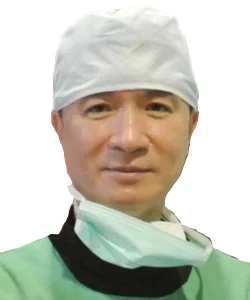
Dr. Cheng-Chieh Chiang is the lead physician of Jiang OB-GYN Clinic, a practice that carries his surname and dates its own opening to September 1994. Before that he spent four years (1990-1994) at National Taiwan University Hospital’s Hsinchu branch as an attending physician in obstetrics and gynecology and, at the same time, the physician in charge of that hospital’s IVF center — a role that covers laboratory workflow and cycle management, not only clinic hours. He remains a concurrent attending physician at NTU Hospital and its Hsinchu branch while running the clinic’s ART program.
His training path is straight-line academic medicine: NTU College of Medicine 1984, the same year he passed the Taiwan physician licensing examination and the US FMGEMS qualifying examination, then residency and chief residency in obstetrics and gynecology at NTU Hospital from 1986 to 1990. On top of general OB-GYN board certification he subspecialized twice over — perinatology and maternal-fetal medicine — which is why the same physician handles both the stimulation cycle and the pregnancy that follows.
His scope spans the whole reproductive timeline rather than one stage of it: premarital and preconception check-ups, infertility work-up and ART, antenatal care, delivery, and postpartum follow-up. Under Taiwan’s Artificial Reproduction Act, ART institutions must designate an approved surgeon-in-charge to perform cycles, and he holds that registered role at this clinic.
Clinical Expertise
- Infertility work-up and treatment decision-making: evaluation of both partners — ovulation, semen quality, tubal and uterine factors — followed by a choice between insemination and IVF, run as the institution’s approved ART physician
- IVF and ICSI: individualized stimulation protocols, monitoring, retrieval, embryo culture and transfer; ICSI where male factor limits fertilization
- Preimplantation testing (PGS/PGD): embryo chromosome and gene screening for recurrent pregnancy loss, advanced maternal age and known hereditary risk
- Donor egg, donor sperm and egg freezing: gamete donation and fertility-preservation cycles operated inside the legal framework of the Artificial Reproduction Act, with sperm banking for cycle planning
- Perinatology and maternal-fetal medicine: surveillance and management of high-risk pregnancy, fetal assessment, continuing care after a transfer succeeds
- Gynecologic endoscopic surgery: laparoscopic and hysteroscopic treatment of endometriosis, tubal and uterine cavity disease before starting a cycle
- Obstetric ultrasound: first-trimester nuchal translucency screening and higher-level fetal ultrasound, certified by the Taiwan Society of Perinatology
Why Choose Dr. Cheng-Chieh Chiang
He ran a hospital IVF center before the clinic opened. Leading the test-tube baby center at NTU Hospital’s Hsinchu branch from 1990 to 1994 meant responsibility for how cycles were organized end to end — stimulation, retrieval, laboratory handling, transfer — not just seeing patients. Center-level operating experience from an academic hospital is uncommon among physicians in community practices in Taiwan.
The legal designation that matters for ART in Taiwan. Licensed reproductive institutions must have an approved surgeon-in-charge of procedures, recognized by the National Health Administration. His registration in that role is the compliance signal overseas patients should look for when judging a Taiwan fertility clinic, because it is the physician whose approval covers the cycle itself.
Three board credentials, one physician. OB-GYN plus perinatology plus maternal-fetal medicine means the fertility phase and the obstetric phase do not require a hand-off. Patients who conceive here are not referred out for the pregnancy; monitoring, complications and delivery stay within the same practice, which also runs its own ultrasound service.
Screening done in-house. As a certified ultrasound physician for obstetric applications and a Taiwan Society of Perinatology-approved nuchal translucency screener, he performs early Down-syndrome screening on site instead of sending the patient to another institution — which removes waiting time during the weeks when a first-trimester scan is actually meaningful.
International standards as the reference frame. He belongs to ASRM, ESHRE and AAGL, and holds an elected supervisory post in a PCOS society. Membership is not a clinical outcome, but it shows which guidelines his judgment is calibrated against — and PCOS is the stimulation population where protocol risk is highest.
Four decades of local practice. Licensed since 1984, he has practiced through the entire period in which Taiwan’s ART rules were written, from an unregulated field to the 2007 Artificial Reproduction Act. That first-hand knowledge of what the current system permits and blocks shapes how overseas cases are planned.
Credentials
Dr. Chiang is a Taiwan certified specialist in obstetrics and gynecology with subspecialty certification in perinatology and in maternal-fetal medicine, and is certified in gynecologic endoscopy and minimally invasive surgery. He is registered with the National Health Administration as the approved surgeon-in-charge of this assisted-reproduction institution, is an authorized nuchal translucency screener under the Taiwan Society of Perinatology, holds a medical-ultrasound specialist credential from the Chinese Institute of Medical Ultrasound, serves as a consultant physician to the Taiwan Endometriosis Association, and holds certificates for eugenics-health-care practice and for sports anti-doping consultation. His training was at NTU College of Medicine (1984) followed by residency and chief residency at NTU Hospital (1986-1990); no further training milestones are published.
Suitable For
Couples who need IVF: cycles are run by the physician registered as the institution’s surgeon-in-charge, and the clinic offers donor egg, donor sperm, egg freezing and sperm banking under the same roof, so switching technique — for example from own-egg IVF to donor-egg treatment after a poor response — does not require changing institutions.
Advanced maternal age and ovarian reserve assessment: at 38 or older the binding constraint is how few stimulation attempts are worth doing. Four decades of OB-GYN practice plus hospital IVF-center leadership make the trade-off between protocol intensity and expected yield a concrete, conservative conversation rather than an optimistic one.
PCOS with infertility: polycystic ovary syndrome is where overstimulation and inconsistent response happen most often. His elected supervisory role in a PCOS society reflects long-standing attention to endocrine preparation and stimulation-risk control, not just egg numbers.
Endometriosis-associated infertility: as a consultant physician to the endometriosis association who is also board-certified in gynecologic endoscopy, he can judge whether pelvic disease should be operated before a cycle rather than transferring embryos into an unfavorable environment.
High-risk pregnancy and pregnancy preservation: perinatology and maternal-fetal medicine certification means the physician who got you pregnant can also manage a complicated one, including threatened preterm labor and the clinic’s dedicated tocolysis service.
Gynecologic endoscopic surgery: tubal, uterine cavity and endometriosis disease is often the correctable part of an infertility picture; assessment and minimally invasive surgery happen in the same practice, so diagnosis and treatment do not fall months apart across two institutions.