'%20d='m0%200%2016%2011h61%2061%2061%2061%2060L47%2037h61%2061%2060%2061L16%2063h61%2061%2061%2061%2060L47%2089h61%2061%2060%2061L16%20115h61%2061%2061%2061%2060L47%20141h61%2061%2060%2061L16%20166h61%2061%2061%2061%2060L47%20192h61%2061%2060%2061L16%20218h61%2061%2061%2061%2060z'/%3e%3c/svg%3e)
About
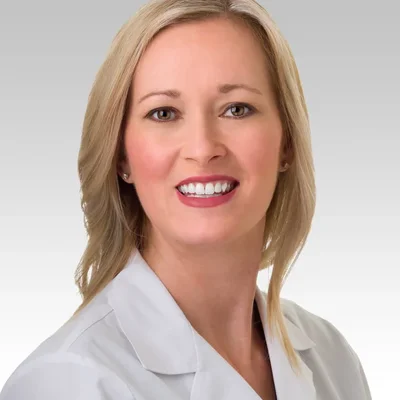
Christina Boots, MD did nearly all of her training inside Chicago. Loyola University for the bachelor’s degree in 2005 and the medical degree at Stritch School of Medicine in 2009, then Ob/Gyn residency at the University of Chicago. She left for one thing only — REI subspecialty fellowship at Washington University in St. Louis, finished in 2016 — and came back to Northwestern for a master’s in clinical investigation in 2018. She is now an associate professor at the Feinberg School of Medicine and one of twelve physicians at the Center for Fertility and Reproductive Medicine.
That master’s is worth pausing on. Clinical investigation is the discipline of designing studies that measure what happens to patients, and it is unusual for a practicing clinician to add it after fellowship rather than during training. It fits the way she describes her own practice: “I am able to provide excellent care using evidence-based medicine, state-of-the-art technology and a kind heart.”
The other half of her statement of purpose is about the patients themselves. “I have been inspired by women for as long as I can remember,” she writes, “and I am honored to share in the joys and struggles of their reproductive journey.” In a general REI practice — stimulation, retrieval, transfer, the cycles that do not work — that matters more than it sounds, because most of the job is deciding what to do next with someone who has already been disappointed.
Clinical Expertise
- IVF cycle management: stimulation design, monitoring, trigger and transfer decisions, including re-worked protocols after a failed cycle
- ICSI and PGT-A, with embryo biopsy performed in the center’s in-house laboratory
- Ovulatory disorders, including PCOS: ovulation induction and letrozole or gonadotropin strategies, with the metabolic evaluation that goes with them
- Egg freezing and fertility preservation, for medical and planned-delay indications
- Diagnostic workup: ovarian reserve testing (AMH, antral follicle count, FSH, day-3 estradiol), HSG and saline sonohysterogram, semen analysis interpreted in the same building
- Evidence appraisal: the clinical investigation training she added after fellowship is aimed exactly at deciding which published protocol changes are worth adopting
Why Choose Dr. Christina Boots
She stayed close to home and went deep. Loyola, University of Chicago, Washington University, Northwestern: a pipeline that ends with a physician who knows the Chicago referral landscape, the labs and the hospitals, rather than arriving for a two-year stint.
A researcher’s credential on a clinician’s CV. An MS in clinical investigation taken after subspecialty training, at an institution whose reproductive research programs are funded by NIH and the Gates Foundation.
Generalist range in a specialist center. She covers IVF, ICSI, PGT-A, ovulation induction and preservation, which means most patients do not have to be handed to a colleague mid-treatment.
She says the quiet part plainly. Her own description of practice pairs evidence-based medicine and technology with “a kind heart” — an unusual thing to find written by a physician rather than a marketing department.
Professional Affiliations
Certified in Reproductive Endocrinology and Infertility by the American Board of Obstetrics and Gynecology. Associate Professor, Department of Obstetrics and Gynecology, Northwestern University Feinberg School of Medicine, holding a master’s in clinical investigation from the same institution. Practices in a Society for Assisted Reproductive Technology member clinic reporting outcomes to SART and the CDC, and is active in the academic reproductive medicine community, including the American Society for Reproductive Medicine.
Suitable For
- PCOS and ovulatory dysfunction, especially patients transitioning from ovulation induction and IUI to IVF
- Second and third IVF cycles, where the previous protocol needs to be argued about rather than repeated
- Egg freezing and fertility preservation for patients planning later, or facing treatment that threatens ovarian function
- Patients who want the evidence for a recommendation explained — which lab, which protocol, what the data actually show
- Chicago-area patients who would rather not travel for monitoring appointments that start early in the morning