'%20d='m0%200%2016%2011h61%2061%2061%2061%2060L47%2037h61%2061%2060%2061L16%2063h61%2061%2061%2061%2060L47%2089h61%2061%2060%2061L16%20115h61%2061%2061%2061%2060L47%20141h61%2061%2060%2061L16%20166h61%2061%2061%2061%2060L47%20192h61%2061%2060%2061L16%20218h61%2061%2061%2061%2060z'/%3e%3c/svg%3e)
About
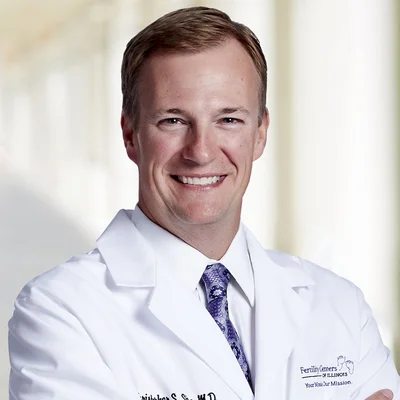
The usual route into reproductive endocrinology runs residency, then fellowship, then a fertility center. Dr. Christopher Sipe went the other way around. After his OB/GYN residency at Northwestern University’s Prentice Women’s Hospital he opened an independent obstetric and gynecology practice and ran it — during which Consumers’ Research Council of America named him to its list of America’s Top Obstetricians and Gynecologists (2008-2013) — and only afterward completed a fellowship in Reproductive Endocrinology and Infertility at the University of Iowa. He holds a medical degree from Vanderbilt University.
Independent gynecologic practice before subspecializing is a different kind of exposure than three years of fellowship alone. Menstrual irregularity, ovulatory failure and unexplained infertility arrived in his clinic as ordinary complaints, long before he had a laboratory and an embryology team behind him. His clinical expertise at FCI is listed as infertility, menstrual irregularities and Polycystic Ovary Syndrome, and the surgical half of his practice is specific: hysteroscopy for uterine anomalies and other uterine pathology.
He is also President of Fertility Centers of Illinois, which puts him in the room where the clinic’s protocols, laboratory investments and referral standards get set. He publishes and presents at national and international forums on improving a couple’s fertility. As first author he reported in Fertility and Sterility on using gonadotropins with hCG activity versus FSH alone in PCOS patients undergoing IVF — a controlled-response question, which is the correct frame for PCOS stimulation where the risk is overstimulation, not under-response. Meike Uhler, his FCI colleague, is a co-author on that work.
Asked why he chose reproductive medicine, he answers that family matters enormously to him, so helping people get past infertility is the ultimate career, and the field’s technology means something new to learn every day. What he says he is proudest of in practice is offering science-based individualized care that recognizes every couple is different. He sees patients at FCI’s Chicago and Hinsdale campuses. His published work appears in Fertility and Sterility, and he was named a Castle Connolly Top Doctor in 2026.
Clinical Expertise
- Polycystic Ovary Syndrome: Both his named clinical expertise and his first-author research topic — stimulation in PCOS aims for a controlled response, because hyperstimulation is the failure mode that matters.
- Exercise-induced and hypothalamic amenorrhea: He lists these alongside PCOS as his ovulatory-disorder focus. Both are central suppression of the hypothalamic-pituitary-ovarian axis from energy deficit or stress, and neither responds well to being treated like PCOS.
- Menstrual irregularities and ovulatory evaluation: Assessing whether an irregular or absent cycle originates in the hypothalamic-pituitary axis, the ovary, or the uterus, before choosing between lifestyle change, ovulation induction or IVF.
- Hysteroscopic surgery: Diagnosis and treatment through the cervix with a camera — polyps, intrauterine adhesions, septate and other anomalous uteri — the cavity conditions that determine whether a transferred embryo can implant.
- IVF and general infertility care: Cycle management from evaluation and stimulation through retrieval and transfer, with individualized protocols rather than a standing one.
Why Choose Dr. Sipe
He practiced general OB/GYN before becoming a fertility subspecialist. Independent practice came first, and the fellowship at Iowa came after. Patients with longstanding irregular cycles or unexplained findings benefit from a physician who spent years managing them without an IVF lab as the default answer.
He is the clinic’s President. FCI’s President is a physician who sets standards rather than only follows them, which matters on questions like monitoring schedules, single-embryo-transfer policy, and what the laboratory is expected to do.
He studied the PCOS stimulation question himself. His first-author Fertility and Sterility work compared gonadotropins with hCG activity against FSH-only protocols for controlled ovarian response in PCOS patients. For a diagnosis where dosing error causes OHSS, the physician who published on dose strategy is the right one to set yours.
Hysteroscopy is his declared surgical specialty. Rather than outsourcing cavity assessment, he evaluates and treats uterine anomalies and pathology himself — worth knowing when an ultrasound has flagged a polyp, adhesions or a septum and a transfer is being planned.
Peer-recognized across two lists. Consumers’ Research Council of America named him to America’s Top Obstetricians and Gynecologists over 2008-2013, and Castle Connolly in 2026 — peer nomination and credential checks spanning nearly two decades of practice.
Patients describe the consultation the same way he does. He calls his offer science-based individualized care that recognizes every couple is different; a patient reviewing him describes him as encouraging, patient and understanding, with confidence that their chances are at their highest under his and the FCI team’s care.
Professional Affiliations
Medical degree from Vanderbilt University; residency at Northwestern University’s Prentice Women’s Hospital; fellowship in Reproductive Endocrinology and Infertility at the University of Iowa. President of Fertility Centers of Illinois. Recognized by Consumers’ Research Council of America among America’s Top Obstetricians and Gynecologists (“Best Doctors,” 2008-2013) and named a Castle Connolly Top Doctor in 2026. First-author publication in Fertility and Sterility (2008, vol. 90, supplement 1) on gonadotropins with hCG activity in PCOS IVF cycles, with co-authors including Marcia Hilse, Meike Uhler, Meredith Martin-Johnson and Kelli Sasada. He maintains surgical privileges at 900 North Michigan Surgery Center, Advocate Good Samaritan, Advocate Illinois Masonic, Advocate Lutheran General, Alexian Brothers Medical Center, Ambulatory SurgiCenter Downers Grove, Hinsdale Surgical Center, Loyola Ambulatory Surgery Center Oakbrook, Northshore Skokie, Evanston, Glenbrook and Highland Park, and St. Alexius Medical Center.
Suitable For
- PCOS patients worried about overstimulation: His first-author research is on controlling ovarian response in PCOS cycles, the exact risk a stimulation protocol has to manage.
- Amenorrhea from training, low weight or stress: He names exercise-induced and hypothalamic amenorrhea as special interests — cases where the axis is suppressed rather than the ovary failing.
- Long-standing irregular cycles: Menstrual irregularity is listed expertise, and he came up through general gynecology before subspecializing.
- Anyone told a polyp, adhesion or uterine anomaly may be blocking implantation: Hysteroscopy is his declared surgical focus, so cavity assessment and treatment sit with the physician planning the transfer.
- Patients who want the dosing rationale explained: He states his practice as individualized, science-based care, and has published on protocol comparison.
- Couples wanting one physician from evaluation through transfer: He handles assessment, stimulation, surgery and cycle management in a single line of care.