'%20d='m0%200%2016%2011h61%2061%2061%2061%2060L47%2037h61%2061%2060%2061L16%2063h61%2061%2061%2061%2060L47%2089h61%2061%2060%2061L16%20115h61%2061%2061%2061%2060L47%20141h61%2061%2060%2061L16%20166h61%2061%2061%2061%2060L47%20192h61%2061%2060%2061L16%20218h61%2061%2061%2061%2060z'/%3e%3c/svg%3e)
About
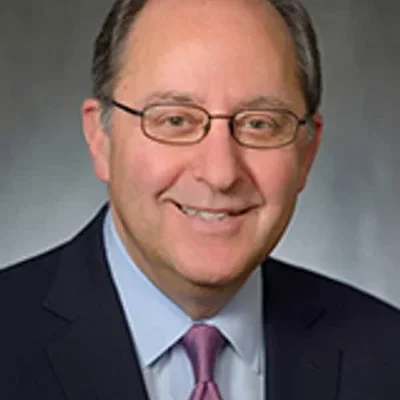
The question Christos Coutifaris has worked on since the 1980s is the one IVF patients find hardest to accept: a normal embryo, placed correctly, that does not attach. His laboratory work on endometrial biology — the molecular signals that make the uterine lining receptive for a window of days, and what goes wrong when it does not — is the basis of his international reputation, and NIH has funded that line of research continuously enough that it spans his whole career. He holds the Celso-Ramon Garcia Professorship in Obstetrics and Gynecology at the Perelman School of Medicine, an endowed chair inside Penn’s obstetrics and gynecology department.
He is also one of a small group of specialists who never left. MD and PhD from Penn in the early 1980s, residency at the Hospital of the University of Pennsylvania, REI fellowship at Penn, and clinical practice at the same institution since board certification in obstetrics and gynecology in 1988 — close to four decades of cycles at the center where he trained. He has watched nearly every part of assisted reproduction become routine: ICSI, blastocyst culture, embryo freezing, genetic testing of embryos.
That dual career draws recognition beyond the clinic: an honorary membership in an international reproductive medicine society for contributions to reproductive biology, and an outstanding mentor award for the graduate students and fellows who trained in his laboratory and went on to academic jobs of their own. He speaks Greek and French with patients as comfortably as English.
Clinical Expertise
- Reproductive endocrinology with a laboratory behind it — implantation failure, endometrial receptivity and luteal phase support are treated as mechanistic problems, not just bad luck
- IVF and ICSI — full cycle management, including injected fertilization for male factor and surgical sperm retrieval cases
- Recurrent pregnancy loss — evaluation across uterine, endocrine, genetic and placental causes
- Endometriosis and uterine fibroids — how cavity distortion and inflammatory environment affect transfer outcomes
- Donor egg pathways — counseling when the uterus, not the egg, is the limiting factor
- Egg, embryo and sperm banking — fertility preservation for both partners, an ability reflected in his listed procedures
- PCOS and ovulatory disorders — induction and stimulation strategy in high-responders
Why Choose Dr. Coutifaris
He studies the exact failure most clinics cannot explain. Implantation is his research subject, so a patient with two or three good transfers and no pregnancy sees a physician who has read — and written — the primary literature on why lining receptivity goes wrong.
Four decades of continuity. Board-certified in 1988, practicing at the same institution throughout, at a center that reports its cycles to SART rather than to a brochure.
An MD/PhD who still runs cycles. Basic scientists frequently leave the clinic; he never did, which is why the bench work and the stimulation protocols inform each other.
Mentorship as a credential. An outstanding mentor award plus NIH study-section service (NICHD Special Emphasis Panel) means the people training in his division are being taught by someone graded on it.
Greek and French consultations, useful for Philadelphia’s Hellenic community and for international patients.
Professional Affiliations
American Society for Reproductive Medicine; Fellow of the American College of Obstetricians and Gynecologists; Society for Reproductive Endocrinology and Infertility; Society for the Study of Reproduction; Society for Assisted Reproductive Technology; AGOS; Philadelphia Reproductive Endocrinology Society; Philadelphia Obstetrical and Gynecological Society; Hellenic Medical Society of Philadelphia. He has served on an NIH/NICHD Special Emphasis Panel, reviewing grant applications, and holds honorary membership in an international reproductive medicine society.
Suitable For
Patients with repeated implantation failure, where the embryo grade looked fine and nobody can say why it did not take.
Recurrent pregnancy loss, particularly when a uterine or luteal factor is suspected.
Couples facing male factor infertility who need ICSI and a physician comfortable managing both partners.
Endometriosis and fibroid-related infertility, where cavity and environment both matter.
Patients considering donor eggs later in life, who want the receptivity question framed honestly before spending on a cycle.
Greek- or French-speaking patients, and international families who would rather not translate symptoms.