'%20d='m0%200%2016%2011h61%2061%2061%2061%2060L47%2037h61%2061%2060%2061L16%2063h61%2061%2061%2061%2060L47%2089h61%2061%2060%2061L16%20115h61%2061%2061%2061%2060L47%20141h61%2061%2060%2061L16%20166h61%2061%2061%2061%2060L47%20192h61%2061%2060%2061L16%20218h61%2061%2061%2061%2060z'/%3e%3c/svg%3e)
About
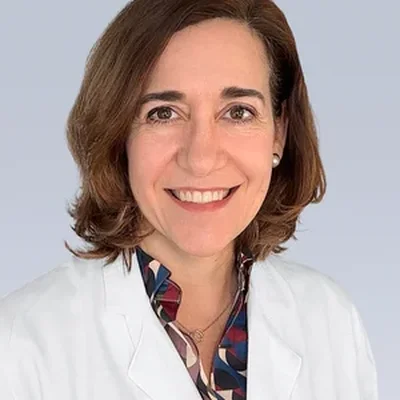
Clarisa Gracia’s name sits at the top of Penn Fertility Care’s SART record as both medical director and practice director, which makes her the physician legally accountable for the numbers on this clinic’s page — 2,061 cycles in 2023 and a 57.7% live birth rate per intended retrieval for patients under 35. She is also chief of the Division of Reproductive Endocrinology and Infertility at the Perelman School of Medicine, the role that sets clinical standards for the eleven-physician group, and she holds the Nancy and Richard Wolfson Professorship in Obstetrics and Gynecology.
The subspecialty she is known for nationally is preserving fertility rather than restoring it. She directs the program that banks eggs, embryos and ovarian tissue for patients about to start chemotherapy or pelvic radiation, work that runs on a clock: oncology treatment schedules rarely wait. Her NIH-funded research follows the same population from a different angle — how ovarian function and hormones change through the menopause transition in cancer survivors, a group most menopause research excludes. She trained as a clinical epidemiologist at Penn and holds an MSCE, so her publications are designed as cohort and trial work, not case series.
Buffalo MD in the 1990s, residency at the Hospital of the University of Pennsylvania, then Penn for REI fellowship and the epidemiology master’s; board-certified in obstetrics and gynecology since 2006. She consults in Spanish and French as well as English. Within Penn she is attached to the adult Turner syndrome program, the telomere biology disorders program and the LGBTQ health program — three patient groups where fertility questions arrive early and repeatedly. One limit on this page worth stating: the research file for her is a stub, so the registry facts (medical and practice director, clinic number 0094) are independently checkable, while the program attachments and committee lines come from the practice’s own record and still need verification against a collected profile.
Clinical Expertise
- Fertility preservation — egg, embryo and ovarian tissue freezing, timed against a chemotherapy start date; ovarian tissue cryopreservation is on the clinic’s registered SART service list
- IVF cycle direction — stimulation design, trigger timing, retrieval and transfer oversight across the division, as the physician named on the registry report
- Premature ovarian insufficiency — risk assessment and counseling for genetic and chromosomal causes, including Turner syndrome, where ovarian failure can begin in the teens
- Reproductive aging and menopause — hormone therapy decisions for survivors whose menopause arrived because of treatment, not time
- PCOS and ovulatory disorders — from metformin and letrozole induction through a full IVF pathway
- Third-party reproduction — donor egg, donor embryo and gestational carrier cycles for patients with no realistic chance with their own eggs
Why Choose Dr. Gracia
She signs the report. Choosing a clinic usually means trusting a marketing page. With Gracia you are reading outcomes the division chief personally attested to SART, including her own patients’ cycles.
Time-critical preservation. Cancer patients get one window before gonadotoxic treatment. Her program is built around same-week decisions, and it can freeze tissue as well as eggs and embryos, which matters when there is no time for a two-week stimulation.
She reads the literature in its original design. An MSCE in clinical epidemiology plus NIH funding means a treatment recommendation you hear from her comes with an understanding of how good the evidence behind it actually is.
Program-level reach. Turner syndrome, telomere biology disorders, LGBTQ family building — these are populations with specific reproductive risks, and she is on the teams that manage them.
Spanish or French consultation, without an interpreter in the room.
Professional Affiliations
American Society for Reproductive Medicine, including committee service; American College of Obstetricians and Gynecologists; Society for Reproductive Endocrinology and Infertility; The Endocrine Society; AGOS; American Board of Obstetrics and Gynecology; Philadelphia Reproductive Endocrinology Society. Board-certified in Obstetrics and Gynecology since 2006, with subspecialty training in reproductive endocrinology and infertility at Penn.
Suitable For
Anyone starting cancer treatment who still wants a biological child. Preservation is her program, and the referral path to medical oncology inside Penn Medicine is internal.
Patients told their ovarian reserve is low for their age, or carrying a genetic condition such as Turner syndrome that predicts early failure.
Women navigating treatment-induced menopause, who need hormone therapy advice from someone who studies that exact transition.
PCOS patients whose cycles have not responded to first-line induction.
LGBTQ+ patients starting a donor egg or gestational carrier path who want a division chief who has already run the paperwork and the protocol.