'%20d='m0%200%2016%2011h61%2061%2061%2061%2060L47%2037h61%2061%2060%2061L16%2063h61%2061%2061%2061%2060L47%2089h61%2061%2060%2061L16%20115h61%2061%2061%2061%2060L47%20141h61%2061%2060%2061L16%20166h61%2061%2061%2061%2060L47%20192h61%2061%2060%2061L16%20218h61%2061%2061%2061%2060z'/%3e%3c/svg%3e)
About
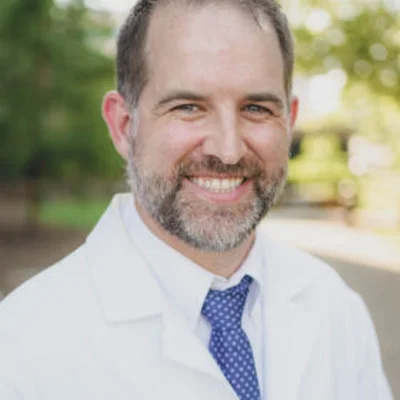
Most infertility care plans send the male half of a couple to a different building. Dr. Dane Johnson is the reason that does not have to happen here: he is the urologist embedded in the Washington University fertility team, listed by the center as board-certified in urology and as its male factor infertility specialist. That distinction matters when you read provider directories. He is not a reproductive endocrinologist and does not run egg retrievals, and the center books him on a separate urology line rather than through the fertility center’s main number.
His route into the subspecialty came during general urology training, where he found himself drawn to treating infertility and helping couples conceive. Fellowship training then concentrated on sexual health: erectile dysfunction and problems with ejaculation. He still practices the full urologic range, from kidney stones and stone pain to kidney and prostate cancer.
His clinical interests as published are vasectomy reversal, varicocele, testicular pain and the penile curvature of Peyronie’s disease. Male infertility treatment in his hands means reversals, testicular biopsies and varicocele repair. In medical school, he writes, watching how physicians explained treatment to couples struggling to conceive taught him to hunt down the points where patients get confused and to teach the reasoning behind a plan.
Clinical Expertise
- Vasectomy reversal, performed as an outpatient procedure. The center’s own counseling is blunt that reversal success falls the longer it has been since the vasectomy, and that the intended carrier’s age has to enter the decision — both partners should also meet a reproductive endocrinology specialist before scheduling.
- Varicocele repair for enlarged scrotal veins that depress sperm production and quality. The center cites about a 67% improvement rate in sperm counts within six months of surgery, and states that surgery is not supported for a varicocele that cannot be felt on examination.
- Testicular biopsy and sperm retrieval. The center’s sperm retrieval options include micro-epididymal sperm aspiration (MESA), percutaneous aspiration (PESA) and testicular sperm extraction (TESE); sperm obtained surgically can only be used with IVF and ICSI.
- Ejaculation and erectile disorders, his fellowship focus, including ejaculatory problems that block at-home conception or sample collection.
- Peyronie’s disease and testicular pain, both listed among his clinical interests.
- General urology: kidney stones, stone pain, and complex oncologic work such as kidney and prostate cancer.
Why Choose Dr. Johnson
Diagnosis and surgery in the same visit cycle. A man whose semen analysis points to obstruction or a varicocele sees the surgeon who can fix it inside the same practice that will run the couple’s IVF cycle — no outside referral, no duplicated workup, no report faxing.
He will tell you when surgery is the wrong answer. His unit’s published position is that no data supports operating on an undetectable varicocele, and that reversal odds depend on the interval since vasectomy and the female partner’s age. Those are inconvenient things for a surgeon to say first.
Sperm banking before it is urgent. The andrology lab he works alongside banks sperm for fertility preservation, before chemotherapy or gender-affirming hormone therapy, or as a backup for patients who travel or have trouble producing a sample on demand. Frozen sperm stays viable for more than 20 years, per the center’s materials.
A private problem treated as such. He writes that every patient in this space wants help with something intensely personal, and that his approach starts with removing confusion about what a treatment is for.
Professional Affiliations
Board-certified urologist and male factor infertility specialist, as listed by the Washington University Fertility and Reproductive Medicine Center, whose team page names him the practice’s urologist while the other physicians are listed as reproductive endocrinologists or as a reproductive surgeon. Our sources list no named societies or committee posts for him.
Suitable For
- Men considering vasectomy reversal, particularly where the reversal interval and partner age need weighing against going straight to IVF with retrieval
- Couples with low count, poor motility or a diagnosed varicocele
- Azoospermia and the IVF-ICSI pathway, where surgical retrieval is the route to usable sperm
- Erectile dysfunction or ejaculation problems that stand between a couple and pregnancy
- Transgender patients and cancer patients banking sperm before hormone therapy or gonadotoxic treatment