'%20d='m0%200%2016%2011h61%2061%2061%2061%2060L47%2037h61%2061%2060%2061L16%2063h61%2061%2061%2061%2060L47%2089h61%2061%2060%2061L16%20115h61%2061%2061%2061%2060L47%20141h61%2061%2060%2061L16%20166h61%2061%2061%2061%2060L47%20192h61%2061%2060%2061L16%20218h61%2061%2061%2061%2060z'/%3e%3c/svg%3e)
About
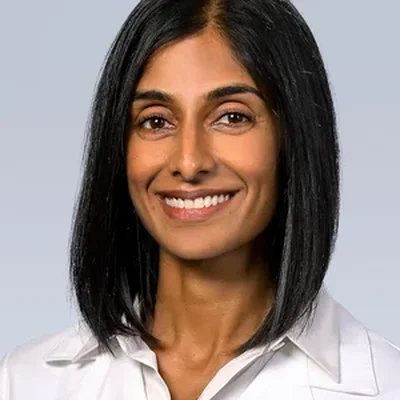
Divya Shah helps write the examination every obstetrician and gynecologist in the country has to pass. She sits on the American Board of Obstetrics and Gynecology’s certifying examination development committee, the group that drafts and vets the questions on the board test — a seat that goes to physicians trusted to define what counts as competent practice. That job connects to her other title: associate dean for medical education at Penn, where she is responsible for how students and residents are taught, and where she earned a master’s in medical education, a degree almost none of her colleagues in private practice hold.
The clinical practice is broad rather than narrow. IVF and ICSI cycles, ovulation induction, intrauterine insemination with donor sperm, egg and embryo freezing, ovarian tissue freezing, and the minimally invasive surgery that supports them — hysteroscopic and laparoscopic treatment of endometriosis and fibroids, tracked through her AAGL membership. She was certified in obstetrics and gynecology in 2011 after an MD at Columbia, residency at the University of Michigan Hospitals, and an REI fellowship at Massachusetts General Hospital and Brigham and Women’s Hospital, then stayed for the Penn faculty track, reaching professor in the years since.
Research runs along the education and equity axis rather than the bench: how fertility care is taught, how reproductive health disparities shape who gets treated, and how PCOS guidelines actually reach clinics. Her published work on disparities is the reason patients worried about cost and access tend to find a receptive audience in her exam rooms. She works out of Penn Fertility Care’s Radnor office on the Main Line, and she is explicit about providing affirming care for LGBTQ+ patients, from donor-sperm insemination to fertility preservation.
Clinical Expertise
- IVF and ICSI — stimulation design, monitoring, retrieval and transfer, with the teaching habits of someone who explains each step to residents twice a year
- Fertility preservation — elective egg and embryo freezing, plus urgent banking before chemotherapy or radiation
- Ovarian tissue freezing — on the division’s registered service list, and the option when a stimulation cycle cannot be scheduled
- Minimally invasive gynecologic surgery — hysteroscopy and laparoscopy for endometriosis, fibroids and cavity problems, AAGL-trained practice
- IUI and donor sperm insemination — the first-line path for single patients and same-sex couples
- PCOS and ovulatory disorders — induction with monitoring, metabolic follow-up
- Reproductive health disparities — a stated research area, which shows up as willingness to build a plan around insurance limits rather than around an ideal protocol
Why Choose Dr. Shah
She helps set the specialty’s standard of knowledge. An ABOG exam committee seat is not an honorary listing; it is a role in deciding what a board-certified physician is expected to know.
A teacher by training. An MME means the explanation you get is designed for a learner, not improvised — dose, purpose, what the ultrasound is measuring, and why the trigger date moved.
Surgeon and scientist in one schedule. Preservation cases, stimulated cycles and operative hysteroscopy in the same practice means the plan does not fragment across three physicians.
Suburban address. Radnor serves patients from the Main Line and Delaware County who would otherwise monitor at University City six mornings a week.
LGBTQ+ affirming practice, documented in her profile rather than implied.
Professional Affiliations
American Society for Reproductive Medicine; American College of Obstetricians and Gynecologists; Society for Reproductive Endocrinology and Infertility; American Association of Gynecologic Laparoscopists; Association of Professors of Gynecology and Obstetrics; AGOS; SRS. Board-certified in Obstetrics and Gynecology since 2011, REI fellowship trained at Massachusetts General Hospital and Brigham and Women’s Hospital, with a master’s in medical education from Penn. Committee member for the American Board of Obstetrics and Gynecology’s certifying examination.
Suitable For
Patients who want the protocol walked through, not just prescribed — the associate dean for medical education tends to answer the follow-up question.
Women freezing eggs or embryos, whether the deadline is a chemotherapy start date or a career plan.
Endometriosis and fibroid patients who may need a laparoscopic or hysteroscopic procedure before IVF.
LGBTQ+ patients and donor-sperm families starting a build-out plan for a first or second parent.
Couples working inside an insurance limit, where a disparities researcher is comfortable discussing what is realistically covered.
Main Line and Delaware County residents who need frequent monitoring without a Philadelphia commute.