'%20d='m0%200%2016%2011h61%2061%2061%2061%2060L47%2037h61%2061%2060%2061L16%2063h61%2061%2061%2061%2060L47%2089h61%2061%2060%2061L16%20115h61%2061%2061%2061%2060L47%20141h61%2061%2060%2061L16%20166h61%2061%2061%2061%2060L47%20192h61%2061%2060%2061L16%20218h61%2061%2061%2061%2060z'/%3e%3c/svg%3e)
About
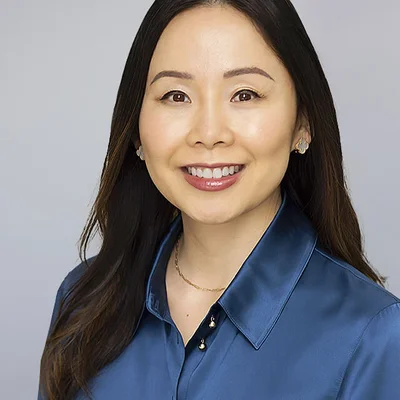
Evelyn Mok-Lin writes the questions other reproductive endocrinologists sit for. She is a national examiner for the American Board of Obstetrics and Gynecology, the body whose certification nearly every IVF patient in the United States is relying on without knowing who checks it. That role sits on top of a full clinical panel at UCSF, where she also serves as medical director of the Center for Reproductive Health.
Her own training ran through three of the country’s heavier programs: medical school at the Icahn School of Medicine at Mount Sinai (2006), obstetrics and gynecology residency at Brigham and Women’s Hospital and Massachusetts General Hospital, the Harvard teaching hospitals, finishing in 2010, then reproductive endocrinology and infertility fellowship at New York-Presbyterian/Weill Cornell Medical Center in 2013. She holds ABOG certification in both obstetrics-gynecology and the REI subspecialty, and carries the academic title of professor in UCSF’s Department of Obstetrics, Gynecology and Reproductive Sciences.
The two areas she has built named practice around are the ones most clinics list as a bullet and rarely staff properly: oncofertility — reproductive care for patients newly diagnosed with cancer and for survivors — and LGBTQIA+ reproductive health, including fertility preservation for transgender youth and adults. Her research goes the same direction as the clinic: optimizing fertility preservation and IVF technique, and tracking how environmental and genetic factors erode ovarian reserve or push menopause earlier. She sees patients in English, in proficient Cantonese, and in conversational Mandarin.
Clinical Expertise
- Infertility evaluation and treatment: ovarian reserve and hormonal workup, ovulation induction, IUI, IVF and ICSI, with the stimulation protocol adjusted to the diagnosis rather than a default recipe
- Recurrent pregnancy loss: structured evaluation of why pregnancies are starting and stopping, before another cycle is attempted
- Endometriosis, fibroids, ovarian cysts and pelvic pain: medical management and minimally invasive gynecologic surgery, performed by the same physician who runs the fertility plan
- Oncofertility: urgent egg, embryo and ovarian tissue preservation coordinated around chemo, radiation or surgery start dates, where the clock is measured in days
- Transgender fertility preservation: gamete banking before hormone transition or gonadal surgery, for adults and for adolescents with their families
- Irregular periods, abnormal uterine bleeding, PCOS and menopause: the everyday endocrine problems that drive many infertility presentations
- IVF optimization: research-side interest in getting more usable embryos out of a stimulation, which matters most for diminished reserve
Why Choose Dr. Evelyn Mok-Lin
She is on the board that certifies her subspecialty. Being a national examiner for ABOG means she is graded on the standard rather than merely holding it — a credential no clinic brochure can inflate.
She runs the center. As medical director she sets the protocols, staffing and case review across the whole UCSF program, so the physician who plans your cycle is the physician accountable for how cycles are planned there.
Oncology and transgender preservation are real clinics, not a referral. Patients facing cancer treatment or gamete banking before transition usually get routed to a program that sees a handful of these a year. Mok-Lin’s named interests and her research program are in exactly that space, and UCSF can handle urgent cases the same week treatment is scheduled to start.
She operates medically and surgically. Minimally invasive gynecologic surgery is part of her practice, so endometriosis or fibroid disease found during a fertility workup does not automatically mean a second surgeon.
Language. Cantonese-proficient and conversational Mandarin appointments are available, which changes what a patient can report about symptoms, not just what the consent form says.
Professional Affiliations
Medical Director, UCSF Center for Reproductive Health. Professor, Department of Obstetrics, Gynecology and Reproductive Sciences, University of California San Francisco. Board certified by the American Board of Obstetrics and Gynecology in Obstetrics and Gynecology and in Reproductive Endocrinology and Infertility; national examiner for the same board. MD, Icahn School of Medicine at Mount Sinai, 2006; residency in obstetrics and gynecology at Brigham and Women’s Hospital and Massachusetts General Hospital, 2010; REI fellowship at New York-Presbyterian/Weill Cornell Medical Center, 2013.
Suitable For
- Patients starting cancer treatment who need eggs, embryos or ovarian tissue banked before therapy begins — the cases where timing outranks everything else
- Transgender adults and adolescents considering gamete preservation before hormone therapy or surgery
- Second and third losses: recurrent pregnancy loss workup rather than another attempt without answers
- Endometriosis or fibroids with infertility, where surgery and fertility planning have to be sequenced
- Diminished ovarian reserve and early menopause, including patients whose environment or family history is the likely driver
- PCOS, irregular or heavy bleeding, and menopause transition care
- Cantonese- and Mandarin-speaking patients who want the consultation in their own language