'%20d='m0%200%2016%2011h61%2061%2061%2061%2060L47%2037h61%2061%2060%2061L16%2063h61%2061%2061%2061%2060L47%2089h61%2061%2060%2061L16%20115h61%2061%2061%2061%2060L47%20141h61%2061%2060%2061L16%20166h61%2061%2061%2061%2060L47%20192h61%2061%2060%2061L16%20218h61%2061%2061%2061%2060z'/%3e%3c/svg%3e)
About
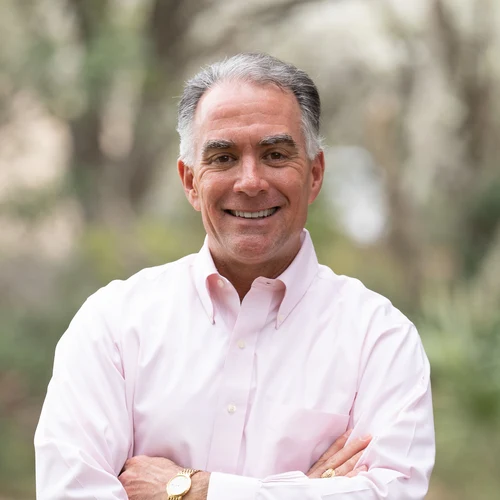
South Carolina’s first, second and third live births from frozen eggs all happened on one physician’s watch, in 2011 and 2012. Dr. John Schnorr has since built the practice where those cycles ran: he founded Coastal Fertility Specialists in 2012 and still serves as its Medical Director, with more than 25 years of reproductive endocrinology practice in the Charleston area.
He trained at the Jones Institute for Reproductive Medicine in Norfolk, Virginia, a program with a long-standing international reputation in IVF, after an OB/GYN residency at the University of Virginia and medical school at the University of Arizona. He is board-certified by the American Board of Obstetrics and Gynecology in both Reproductive Endocrinology and Infertility and Obstetrics and Gynecology, and is a Fellow of the American College of Obstetricians and Gynecologists.
Academically he runs the Reproductive Endocrine Division of the MUSC Department of Obstetrics and Gynecology, which is also the university-side identity of the clinic’s physician group. His research started in ovarian tissue cryopreservation and transplantation, work aimed at keeping malignant disease from causing premature ovarian failure; it won the ASRM’s highest honor, the General Program Prize Paper, at the society’s San Diego meeting in October 2000 and was published in Human Reproduction in January 2002. He has kept that program going at MUSC while publishing on GnRH oral antagonists, low-dose hCG in IVF, egg donation, embryo cryopreservation and medical ethics.
The project he is best known for operationally is Cycle Clarity, an FDA-approved artificial intelligence platform he created that performs a 3D ultrasound of the ovary and measures every developing follicle in roughly 20 seconds instead of a 10-minute scan, in a standardized format the whole clinical team can read. It is used at fertility centers across the country on tens of thousands of patients a year, and at CFS an automated follicular report is emailed to the patient after each scan. Schnorr and his wife Susan, married 33 years, went through infertility themselves while completing their family.
Clinical Expertise
- Egg freezing and fertility preservation: the state’s first three live births from oocyte cryopreservation, plus an ovarian tissue transplantation program and ongoing oocyte cryopreservation research at MUSC
- Individualized IVF stimulation: protocols adjusted to age, ovarian reserve and diagnosis, including adjunctive agents such as testosterone for egg number and growth hormone for egg quality
- Ovarian tissue cryopreservation and transplantation: the research area that earned the ASRM General Program Prize Paper, focused on preserving fertility before cancer treatment
- Monitoring and follicle assessment: Cycle Clarity 3D ultrasound with per-follicle measurement, 24/7 physician review of the full scan record, and an emailed folliculogram after every visit
- Donor egg treatment and PGT: practice-wide experience covering more than 15,000 IVF and donor egg cycles among the clinic’s physicians
Why Choose Dr. John Schnorr
He built the lab, not just the practice. CFS concentrated all of its embryology in one Mount Pleasant laboratory, developed with high-complexity lab director Kathy Miller, HCLD, so the cycles he runs and the culture conditions behind them answer to the same roof.
Twenty-plus years of the same peer recognition. “Best Doctors in America” listings every year since 2002 are peer-sourced rather than patient-sourced.
He writes the literature he practices from. Publications in Human Reproduction and elsewhere on ovarian tissue transplantation, embryo freezing, egg donation, GnRH antagonists, low-dose hCG and AI follicle measurement, and he still presents regularly.
He has been on the other side of the wait. He and his wife faced infertility while trying to complete their family, a fact he states on his own clinic biography.
Professional Affiliations
Fellow of the American College of Obstetricians and Gynecologists; certified by the American Board of Obstetrics and Gynecology in Reproductive Endocrinology and Infertility and in Obstetrics and Gynecology. He is Division Director of Reproductive Endocrinology in the MUSC Department of Obstetrics and Gynecology, the university-side role his clinic group fills in, and he received the 2003 APGO Excellence in Resident Training Award for teaching. The American Society for Reproductive Medicine gave him its General Program Prize Paper, its top paper award, in 2000. His practice reports cycles to SART, which audits results before publishing them, and to the CDC.
Suitable For
- Patients planning egg freezing, especially before gonadotoxic cancer treatment, where ovarian tissue cryopreservation is an option
- Women over 35 whose protocol needs adjusting for diminished reserve rather than a standard stimulation recipe
- Complex or repeated IVF cycles, where a full standardized folliculogram changes the dose decisions mid-cycle
- Donor egg and PGT cases, the two areas where the clinic’s cycle volume is highest
- A second opinion after seeing another reproductive endocrinologist, which CFS provides at no charge