'%20d='m0%200%2016%2011h61%2061%2061%2061%2060L47%2037h61%2061%2060%2061L16%2063h61%2061%2061%2061%2060L47%2089h61%2061%2060%2061L16%20115h61%2061%2061%2061%2060L47%20141h61%2061%2060%2061L16%20166h61%2061%2061%2061%2060L47%20192h61%2061%2060%2061L16%20218h61%2061%2061%2061%2060z'/%3e%3c/svg%3e)
About
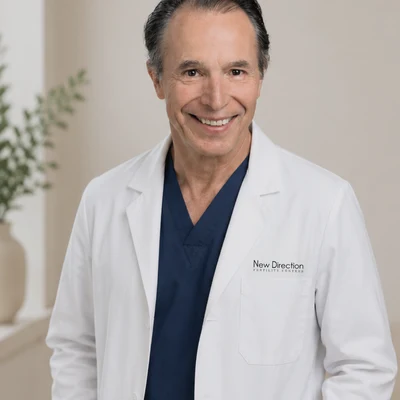
Most IVF patients meet a reproductive endocrinologist who hands genetic questions to a counselor. Mark Johnson is the exception on this staff: after his reproductive endocrinology fellowship at the Medical College of Georgia he was selected as a Research Fellow at the National Institutes of Health, and during those four years, 1989 to 1993, he completed the NIH Clinical Fellowship in Medical Genetics. He is board-certified in Obstetrics and Gynecology with subspecialty certification in Reproductive Endocrinology and Infertility, and separately certified in the specialty of Medical Genetics. The two certifications are the reason he is the physician who explains what a carrier screening result, a mosaic PGT-A report or a balanced translocation actually means for your cycle.
His training and early career ran through academic centers: Stanford University School of Medicine, where he was an Assistant Professor in the Division of Reproductive Endocrinology and Infertility from 1993 to 1996, then UCLA Harbor Medical Center as Assistant Professor and Chief of the Division of Reproductive Endocrinology in the Department of Obstetrics and Gynecology from 1996 to 1998. Before medicine he earned a B.S. at the United States Air Force Academy in 1974 and an M.D. at Tulane University School of Medicine in 1978, trained in obstetrics and gynecology, and served as an Air Force obstetrician-gynecologist from 1982 to 1987.
Johnson has practiced reproductive medicine in the Phoenix metro area since 2000 and taught as a Clinical Associate Professor of the University of Arizona College of Medicine on the obstetrics and gynecology residency faculty at Banner University Medical Center Phoenix from 2003 to 2014. At New Direction he sees patients in Gilbert, where the clinic lists his clinical focus as reproductive genetics and complex family-building decisions — which test to order, what a result actually means, and what it changes about the plan.
Clinical Expertise
- IVF cycle management with a genetics lens: stimulation, retrieval and transfer planning for patients whose decisions hinge on genetic information rather than on embryo appearance alone
- PGT-A, PGT-SR and PGT-M: screening embryos for chromosome number, testing embryos affected by structural rearrangements such as translocations and inversions, and diagnostic testing for single-gene conditions carried by the parents
- Genetic counseling inside the fertility visit: interpretation of carrier screening, chromosome studies and testing results, including how mosaicism and embryo grading limit what a biopsy can promise
- Complex family building: reproductive options for patients using donor gametes or a gestational carrier, where genetic and legal questions arrive together
- Reproductive medicine in patients over 38: how age changes what testing can and cannot add, in a practice that publishes a testing-focused education library on exactly that question
- Egg, embryo and sperm freezing: preservation planning with honest numbers about what frozen eggs from a given age and ovarian reserve are likely to yield
Why Choose Dr. Johnson
One of very few physicians on an IVF staff who holds a Medical Genetics certification. The clinic’s own site lists his credentials as reproductive endocrinology and infertility, obstetrics and gynecology, and medical genetics. You are not asking a third party to translate your embryo report.
Academic reproductive medicine before private practice. Assistant professor at Stanford for three years (1993-1996), then chief of the reproductive endocrinology division at UCLA Harbor for two (1996-1998). Ambiguous testing data is the material those divisions worked in.
Twenty-five-plus years in the same valley. He has practiced reproductive medicine in Phoenix since 2000, taught University of Arizona residents from 2003 to 2014, and was elected by peers to lead the Arizona Section of ACOG (2008-2011) after serving as Vice Chair (2005-2007) and as President of the Phoenix OB/GYN Society (2004-2005).
A commitment to explaining, not upselling. The practice he works for states its standard as telling patients what is proven, what is optional, what is experimental, and what is not worth the cost — the honest framing PGT decisions need, since the clinic’s own podcast library includes an episode titled “The PGT-A Controversy”.
Professional Affiliations
American College of Obstetricians and Gynecologists, including elected service as Vice Chair (2005-2007) and Chair (2008-2011) of the Arizona Section. Past President of the Phoenix OB/GYN Society (2004-2005), the local society his colleagues lead; Dr. Amols, New Direction’s founder, is also a Past President. Faculty appointment: Clinical Associate Professor, University of Arizona College of Medicine, attached to the OB/GYN residency at Banner University Medical Center Phoenix, 2003-2014. Our sources do not list memberships in reproductive or genetics societies for him individually, and name no publication count or award beyond the offices above.
Suitable For
- Anyone holding a genetic test result they do not fully understand: carrier screening, karyotype, or a prior embryo biopsy report — the question this physician was trained twice over to answer
- Families with an inherited condition: cystic fibrosis, sickle cell disease, Tay-Sachs or another single-gene disorder where PGT-M is on the table
- Structural chromosome problems: a balanced translocation or inversion in either partner, where PGT-SR decides which embryos to transfer
- Patients deciding whether to test embryos at all: including the age, mosaic and grading caveats a brochure skips
- Second opinions on testing already ordered elsewhere: particularly when a clinic proposed more testing than you can explain the point of
- Family-building paths that stack genetic questions on top of legal ones: donor gametes, gestational carriers and reciprocal IVF are offered at this practice, and each of them raises inheritance-screening and disclosure questions he is credentialed twice over to answer