'%20d='m0%200%2016%2011h61%2061%2061%2061%2060L47%2037h61%2061%2060%2061L16%2063h61%2061%2061%2061%2060L47%2089h61%2061%2060%2061L16%20115h61%2061%2061%2061%2060L47%20141h61%2061%2060%2061L16%20166h61%2061%2061%2061%2060L47%20192h61%2061%2060%2061L16%20218h61%2061%2061%2061%2060z'/%3e%3c/svg%3e)


About New Direction Fertility Centers - Gilbert
Gilbert is the practice’s full-service clinic, and it is still the one that does everything: consultations, monitoring, egg retrievals, transfers, reproductive surgery and the embryology laboratory all sit at 1760 E Pecos Road, Suite 532. Weekend cycle care runs when a cycle needs it, so monitoring does not stop because it is Saturday. Founder Dr. Mark Amols, a reproductive endocrinologist who went through infertility and IVF himself, divides his practice between Gilbert, Scottsdale and Las Vegas. The clinic’s Gilbert page names three physicians — Amols, Seth Derman and Mark Johnson — and ProIVF carries a full profile for each of them. Google reviews average 4.6 across 183 ratings.
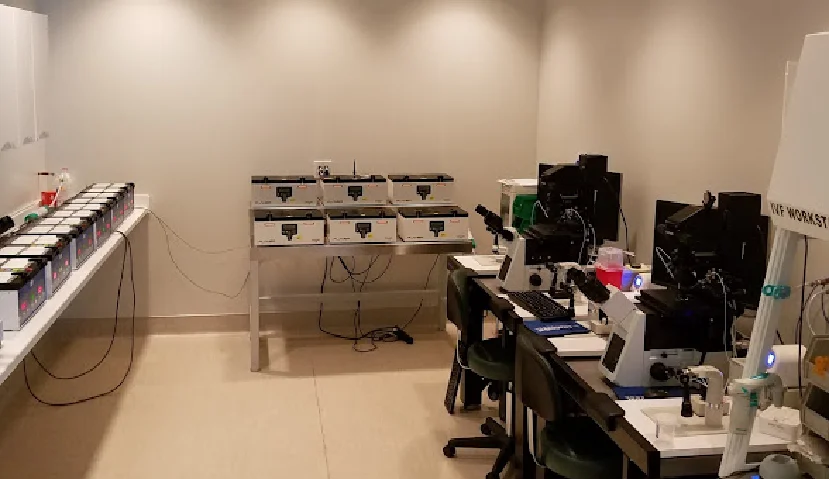
Two things define how this practice competes. First, price: self-pay packages are printed on the website before anyone calls, and the clinic says it does not bolt on the “facility fees” and “coordination fees” it attributes to other centers. Second, the lab environment: air is scrubbed by a LifeAire Aire~IVF system with in-line filtration of the oxygen, nitrogen and CO2 that feed the incubators, and embryos are cultured in benchtop units — an Astec EC10 offers ten separate micro-chambers so one patient’s embryos can stay in their own bay. ZyMōt microfluidic chips handle sperm preparation for IUI and ICSI. This is a clinic that has decided air quality and incubator stability are the variables worth paying for.
What the registry actually says. SART collects results by registered clinic, and New Direction files one institutional report (clinic ID 2001177, SART #0971) registered to the Gilbert laboratory; the Scottsdale, Avondale and Henderson offices have no separate SART entries in our sources. So read the figures below as the reporting unit’s results, not as Gilbert-address-only results. SART 2024 Preliminary, cumulative live birth per intended retrieval across all embryo transfers: 54.5% under 35 (224 retrievals), 42.3% at 35-37 (130), 17.0% at 38-40 (106), and 10.6% at 41 and over (133 — a cycle-weighted merge of the 41-42 row at 14.9% and the over-42 row at 5.1%). The same report lists 1,622 cycles for the 2024 preliminary year; our sources do not break that volume down by office, and the 932-cycle national figure printed next to it on this page is a blended benchmark rather than a same-year per-clinic average, so no multiple of it is drawn here.
Two cautions before you compare the chart. The national row on this page is the SART 2023 national summary (53.2 / 39.9 / 26.2 / 9.4) — a different reporting year, and preliminary-year clinic data like the 2024 figures above tends to sit low because late-reported deliveries are not yet counted. The two bars are not a like-for-like pairing, and the 38-40 band shows why: 17.0% for the clinic against 26.2% in the national row. The clinic’s own FAQ claims pregnancy rates above the national average; that claim is the clinic’s marketing, not something these two mismatched rows establish. Also, the fresh-transfer and frozen-transfer splits for this unit are null on this page — we have no fresh-versus-frozen breakdown in our sources, and the clinic does not publish age-specific rates on its own site either.
Accreditations & Awards
- SART member clinic with every cycle filed to SART and the CDC under one institutional report (clinic ID 2001177, SART #0971). That filing is the reason age-band numbers exist publicly for this practice and can be pulled independently
- CLIA-listed laboratory as recorded in the clinic data on this page. Our sources show no certificate number, and no CAP accreditation, JCI seal or ASRM laboratory program listing for this practice — ask to see the certificate at your consult, since it is the document that governs how your eggs, sperm and embryos are handled
- LifeAire Aire
IVF air purification plus AireLifeLine gas filtration. Clinic materials describe the system as neutralizing up to 99.99% of airborne biological and chemical contaminants in a single pass, call it verified by US Homeland Security, and cite a manufacturer multi-center study of 5,319 IVF cycles showing an average 14.9 percentage-point improvement in ongoing pregnancy rates after installation. Those are vendor and clinic claims, not registry data - Single-patient incubation: benchtop Astec EC10 chambers, with the clinic reporting that its incubators return to equilibrium in about three minutes after opening, versus 15-20 minutes to nearly two hours for the large shared units it contrasts them with
- Physician recognition: Dr. Johnson is a Past Chair of the Arizona Section of ACOG (2008-2011) and Past President of the Phoenix OB/GYN Society; Dr. Derman has been named a Castle Connolly Top Regional Doctor in Reproductive Endocrinology every year since 2015 and by Inside Jersey Magazine; Dr. Amols is a Past President of the Phoenix OB/GYN Society and a former member of ASRM’s Technology Committee
- Taco Bout Fertility Tuesday, the practice’s patient-education podcast, with 12 episodes in its library, including “The PGT-A Controversy” and “Is My Embryo Really Mine? How IVF Labs Prevent Mix-Ups”
Why Choose New Direction Fertility Centers - Gilbert
- Prices you can read before you call: IVF at $6,500, IUI at $1,000, egg freezing at $2,500 and IVF with PGT-A at $9,700 are published self-pay package prices, with an online calculator that lets you add anesthesia, ICSI, medication estimates, testing and storage
- A real lab at the address you visit: the practice describes Gilbert as a full-service clinic and IVF laboratory, while Avondale is a satellite for consultations and monitoring and the La Jolla, California office is an outside monitoring partner that New Direction does not operate. Procedures, IVF included, happen here rather than at a shared central lab, and the clinic says it does not compromise a cycle because it is the weekend
- Culture conditions as the differentiator: filtered lab air, filtered inlet gases, and a dedicated incubator bay per patient whenever possible, which is the mechanism the clinic argues for its embryo quality claims
- A board-certified geneticist on the physician team: Dr. Johnson holds certification in Medical Genetics alongside his reproductive credentials, so carrier screening results, PGT-A mosaicism questions and PGT-M decisions get interpreted by a physician trained in that specialty rather than passed to a counselor
- Sperm preparation without repeated centrifugation: ZyMōt separation devices are used for IUI and ICSI, chosen for lower DNA fragmentation and less mechanical handling
- Physicians stay in the cycle: the practice states that its doctors perform procedures, oversee treatment decisions and take part in monitoring and ultrasound care, and in-person consultations remain available next to telemedicine
- Worth knowing before you choose it: embryology runs on monthly batch calendars rather than rolling starts — the clinic performs one stimulation and retrieval group per month with fixed start and cutoff dates — and our sources document no time-lapse embryo imaging and no named PGT platform or vendor
IVF & Fertility Services
- Fertility evaluation: personal and family history, day-3 FSH and estradiol, AMH, antral follicle count, HSG or saline sonohysterogram for tubes and uterine cavity, thyroid and prolactin, vitamin D, genetic carrier screening, and semen analysis
- In Vitro Fertilization (IVF): injectable stimulation with blood work and ultrasound monitoring, transvaginal retrieval under anesthesia, fertilization, embryo culture, and transfer, with assisted hatching included in the published IVF package
- ICSI (Intracytoplasmic Sperm Injection): single-sperm injection for male factor infertility or prior fertilization failure, priced separately at $600
- PGT-A, PGT-SR and PGT-M: day-5 or day-6 blastocyst biopsy at the clinic, with chromosome-number screening for aneuploidy, testing for structural rearrangements such as translocations and inversions, and single-gene disorder testing for conditions like cystic fibrosis, sickle cell disease or Tay-Sachs. Genetic analysis is billed directly to a third-party laboratory; the clinic cites NGS and CGH as the assay types used
- Intrauterine Insemination (IUI): ovulation tracking with or without oral or injectable medication, washed sperm placed in the uterus, partner or donor sperm
- Egg, embryo and sperm freezing: vitrification for elective preservation and for medical indications, with one year of storage bundled into the IVF and egg-freezing packages
- Frozen embryo transfer (FET): programmed cycles using estrogen and progesterone, sometimes with oral contraception for lining timing, run by dedicated FET nurses and coordinators
- IVC with the InvoCell “BabyPOD” device: fertilization and early embryo development inside a capsule placed in the vaginal cavity, offered as an alternative to conventional lab culture for selected patients
- Reproductive surgery: hysteroscopy, laparoscopy, myomectomy, and sperm retrieval procedures including TESE, PESA and MESA
- Reproductive endocrinology: PCOS, thyroid disorders and abnormal uterine bleeding managed within the practice
- Donor and LGBTQ+ family building: donor eggs (published six-egg and eight-egg packages), donor sperm, donated embryos, gestational carrier coordination and reciprocal IVF
- Second opinions and treatment planning for patients arriving with a long prior history
Fees & Packages
Prices below are the clinic’s published self-pay package figures; Arizona insurance coverage is plan-by-plan, and a financial counselor verifies benefits at the initial consultation.
| Package | Published price | What the clinic includes |
|---|---|---|
| IUI | $1,000 | All ultrasounds and blood work, cycle teaching, injection teaching, the insemination |
| IVF | $6,500 | All ultrasounds and blood work, cycle and injection teaching, retrieval, assisted hatching, embryo freezing, thawing, transfer, one year of storage |
| IVF with PGT-A | $9,700 | Everything in the IVF package plus embryo biopsy and PGS testing, up to eight samples |
| Egg freezing | $2,500 | All ultrasounds and blood work, cycle and injection teaching, retrieval, egg freezing |
Not in those numbers, per the clinic’s own exclusion list: all pre-treatment testing including the oral-contraception start visit, obstetric visits after a positive test, ICSI ($600), anesthesia for IVF procedures ($500), long-term storage of embryos, eggs or sperm ($600, $400 and $300 respectively), PGD testing paid directly to the third-party laboratory, and all medications. The online calculator frames medication at $1,500-$4,000 (a $2,750 midpoint), PGT-A at $3,200 for up to eight embryos with $200 per additional embryo, and $600 per extra storage year after the first. The calculator also lists a frozen embryo transfer package (thaw and transfer) and donor egg packages without printed prices in the material captured here — get those numbers in writing from the financial team. The clinic says it accepts most insurance plans and that each patient is assigned a financial counselor; our sources name no financing partner or installment program, so ask directly if you need one.
Patient Journey
- Consultation, by telemedicine or in person. Share your history and what you have already tried; the practice replies to its contact form and confirms which visits and procedures run through Gilbert
- Workup before treatment: hormone panels and ovarian reserve testing, uterine and tubal imaging, carrier screening where indicated, and semen analysis, with the financial counselor verifying coverage in parallel
- Plan and deposit: your protocol is set by the physician, and the clinic says the cycle calendar is issued once the IVF deposit is paid and a protocol exists
- Cycle start on a fixed calendar: you message the team on cycle day one, including weekends, begin oral contraception on day three, and stay on it a minimum of 21 days — sometimes up to five weeks with breaks — because New Direction runs one stimulation and retrieval group per month with its own start and cutoff dates. Stimulation brings frequent monitoring appointments, and the clinic expects most patients to keep working through it
- Retrieval: an ultrasound-guided transvaginal procedure under anesthesia that the clinic describes as 20 minutes at most, with the partner providing a sample the same morning. Expect cramping for two to five days and bloating for up to two weeks, and a return to normal activity the next day. Your period arrives roughly 10-14 days later, which starts the transfer cycle
- Transfer: the earliest frozen transfers happen six to eight weeks after retrieval, on preset monthly transfer dates, after estrogen and progesterone prepare the lining. Pregnancy is confirmed by blood test about two weeks after transfer
- After a positive test: follow-up continues until a fetal heartbeat is confirmed, then care moves to an obstetric provider. Unused embryos stay in cryostorage under the disposition agreement you signed
Local Legal Framework
Arizona regulates assisted reproduction through Title 25 of the Arizona Revised Statutes and through contract, not through a single comprehensive ART statute, and our sources do not reproduce the statutory text. Practical consequences:
- Gestational carriers: Arizona recognizes gestational carrier arrangements under Title 25, and compensated programs are structured as written agreements. Parentage orders for intended parents — who is named, and whether the order issues before or after birth — turn on current Arizona procedure and on the facts of your case, so retain an Arizona reproductive-law attorney before any transfer, not after
- Egg, sperm and embryo donation: permitted, and performed here, on written donation agreements that set out medical screening, compensation terms, disclosure and parentage before treatment
- Embryo testing: PGT-A, PGT-SR and PGT-M are available with standard informed consent, with no additional Arizona restriction recorded in our sources
- Stored embryos: no Arizona statute in our sources fixes their legal status. What controls is the reproductive and disposition consent signed when the embryos are created — storage terms, who decides after separation or death, and whether unused embryos are donated, kept or discarded
- Insurance: Arizona coverage obligations are not addressed in our sources. Coverage turns on your employer’s plan, which is why the clinic’s financial counselor verifies benefits at the first visit
Location
- Address: 1760 E Pecos Rd #532, Gilbert, AZ 85295
- Phone: (480) 351-8222