
About
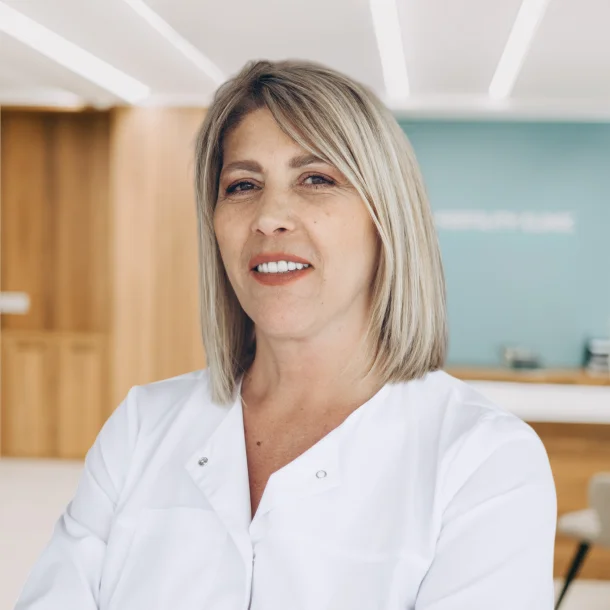
Male factor contributes to a substantial share of infertility cases, and in most clinics the male partner spends the shortest time in the building. Dr. Nana Darsavelidze is one of the urologists on European Fertility Clinic’s roster who keeps that appointment from being a formality: she has practiced urology for more than twenty years, having taken her urology specialization at the Saratov State Medical Institute in 1999 and completed her internship in the urology department of Saratov’s 3rd City Clinical Hospital the following year.
Saratov’s medical school and its hospital system were, in the Soviet and post-Soviet period, one of the main training grounds for Russian-language urological practice, and a 1999-2000 internship there means she was formed in a hospital department rather than an outpatient course. That distinction shows in the routine work of a fertility clinic’s urology slot: assessment of the urinary tract and male genital tract, identification of the conditions that show up in a semen analysis as low count or poor motility, and treatment decisions that do not require an operating theatre.
Her role inside a reproductive center is defined by sequence rather than by procedure. Before a couple is committed to a cycle, the male side needs its own findings — and where the answer is a urological condition rather than an assisted reproduction problem, the clinic’s plan changes. She is the physician who makes that call on the male partner, in a roster where most members are gynecologists, sonographers and embryologists.
Clinical Expertise
- Male urinary and genital tract assessment: Clinical examination of the urinary tract and male reproductive organs as part of an infertility workup.
- Male factor infertility investigation: Urological evaluation behind abnormal semen findings, distinguishing treatable causes from those requiring assisted reproduction.
- Varicocele and scrotal conditions: Assessment of the commonest correctable male finding in fertility practice, with referral decisions where surgery is the andrologist’s role.
- Urological infection and inflammation: Diagnosis and treatment of urinary and genital tract infections that affect semen quality and the timing of a cycle.
- Ongoing urological care during treatment: Management of pre-existing urinary conditions across the months of a fertility plan, when medication and fluid changes matter.
- Post-treatment urological follow-up: Continued care for the male partner after a cycle concludes.
Why Choose Dr. Nana Darsavelidze
Twenty years in one specialty. Urology is not a subject a physician picks up from a textbook before a fertility consult. Her whole practice, since a 1999 specialization degree and a hospital internship, sits in it.
The male partner gets a specialist, not a questionnaire. Where a clinic’s default is to hand the man a sample cup and a form, an on-site urologist produces an examination and a diagnosis, which is what changes the plan.
Hospital-trained rather than course-trained. Her internship was completed inside Saratov’s 3rd City Clinical Hospital urology department. Inpatient urological training is why she can judge which findings need action and which do not.
Sequencing saves the couple a wasted cycle. A treatable urological cause found before stimulation is money and time kept; found after two failed transfers, it is a year lost. She is the physician positioned to find it early.
Professional Affiliations
Urology specialization, Saratov State Medical Institute (1999); internship in urology, Saratov 3rd City Clinical Hospital (1999-2000). More than 20 years of urological practice, currently at European Fertility Clinic, Tbilisi, where Georgian urologists practice under Ministry of Health registration.
Suitable For
- Couples whose workup has not yet looked properly at the male side, or where a semen analysis has come back abnormal without explanation.
- Men with known or suspected varicocele, scrotal or urinary tract conditions being weighed against a fertility plan.
- Recurrent or chronic urological infection, which affects both semen quality and cycle timing.
- Male partners on long-term medication that bears on fertility, who need that reviewed by a urologist rather than assumed.
- Anyone needing urological follow-up during or after assisted reproduction in the same clinic where the cycle runs.