'%20d='m0%200%2016%2011h61%2061%2061%2061%2060L47%2037h61%2061%2060%2061L16%2063h61%2061%2061%2061%2060L47%2089h61%2061%2060%2061L16%20115h61%2061%2061%2061%2060L47%20141h61%2061%2060%2061L16%20166h61%2061%2061%2061%2060L47%20192h61%2061%2060%2061L16%20218h61%2061%2061%2061%2060z'/%3e%3c/svg%3e)
About
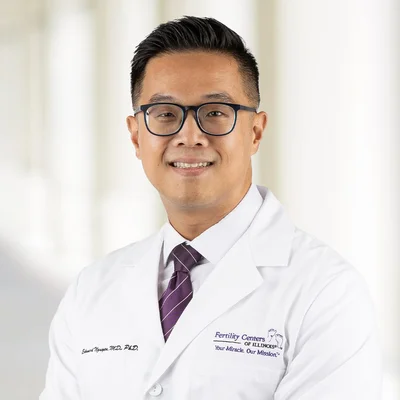
Most patients who need both an operation and an IVF cycle get two doctors — a surgeon who clears up the pelvis and a reproductive endocrinologist who then tries to get them pregnant, with the handoff eating weeks. Dr. Edward Nguyen is the exception on FCI’s roster: he is a minimally invasive gynecologic surgeon (MIGS) and a reproductive endocrinologist, and he says the thing he is proudest of in practice is that he can treat patients who need surgery himself while also offering any assisted reproductive technology.
That dual track took two fellowships to build. He earned his medical degree and a doctorate in cell biology from the University of Oklahoma, completed OB/GYN residency at the University of Iowa, spent two years in the Minimally Invasive and Advanced Pelvic Surgery fellowship at the University of Washington, and finished with a Reproductive Endocrinology and Infertility fellowship at Stanford University. He is board-certified in both Obstetrics and Gynecology and REI. His research during the Oklahoma years — recognized with American Society of Andrology trainee awards in 2012 and 2013 and the OUHSC College of Medicine Dean’s Award for Outstanding Research — was in cell biology, which is the discipline behind embryo culture decisions he now makes clinically.
At FCI he concentrates on improving surgical outcomes with techniques that reduce or eliminate incisions, so recovery is shorter and the pelvis is handled gently. His stated clinical interests are reproductive surgery, oncofertility, fertility preservation and endometriosis. He sees patients at FCI’s Chicago on Kingsbury and Chicago on Chestnut locations, with virtual appointments available for follow-up.
The training years also produced two Resident Teacher of the Year awards at Iowa (2017, 2019), a 2022 Stanford Nightingale Excellence Award nomination, and a 2023 Society for Reproductive Investigation President’s Plenary Award. Outside medicine he was once a professional photographer shooting weddings, engagements and sporting events.
Clinical Expertise
- Minimally invasive gynecologic surgery: Advanced pelvic surgery entered through the smallest possible access, aimed at reducing or eliminating incisions — shorter recovery, less adhesion formation, less damage to ovarian and uterine function.
- Endometriosis: Lesion assessment and surgical management, then the question every endometriosis patient actually faces — whether to try naturally afterward or go straight into a stimulated cycle, and when.
- Oncofertility and fertility preservation: Organizing egg or embryo freezing inside the narrow window before chemotherapy, radiation or pelvic surgery, which requires a surgeon and a reproductive endocrinologist in the same plan.
- IVF and the full range of assisted reproduction: Stimulation, retrieval and transfer sit inside the same treatment plan as any surgery he performs, so sequencing decisions are not negotiated between two practices.
- Extended embryo culture and blastocyst selection: First-author work comparing blastulation and blastocyst quality on day 5 versus day 6 of culture — the decision of whether to keep an embryo developing another day or freeze it as it is.
- Pregnancy hormone profiles after IVF: Co-author of a Fertility and Sterility study on how body weight affects early hormone levels in singleton pregnancies that delivered after IVF.
Why Choose Dr. Nguyen
One physician owns the surgery and the cycle. His own description of what he is proudest of is that he can operate and also provide any assisted reproductive technology. For a woman told she needs her endometriosis or fibroids addressed before transferring an embryo, that removes the referral gap where treatment stalls.
A Ph.D. in cell biology next to the M.D. He holds both degrees from the University of Oklahoma and was still publishing laboratory research on andrology and reproductive biology while training clinically. Embryology is applied cell biology, and it shows in his first-author work on blastulation timing.
Two fellowships pointed in different directions. The University of Washington fellowship was two years of minimally invasive and advanced pelvic surgery; Stanford’s was Reproductive Endocrinology and Infertility. Very few clinicians complete both, and the combination is what makes the sequencing decision — operate first, or stimulate first — something he can answer from both sides.
He publishes on the exact decision made before every transfer. Journal of Assisted Reproduction and Genetics (2021) and Fertility and Sterility (2019) both carry his day-5 versus day-6 blastulation work. Ask which embryo to transfer and after how many days of culture, and you are asking about data he generated.
Recognized by a research society and by his students. The 2023 Society for Reproductive Investigation President’s Plenary Award, a 2022 Stanford Nightingale Excellence nomination, and Resident Teacher of the Year at Iowa twice indicate someone who teaches as well as treats.
Two Chicago campuses and a virtual option. FCI names his locations explicitly — Chicago on Kingsbury and Chicago on Chestnut — and offers virtual appointments, which cuts monitoring trips for patients with work or childcare constraints.
Professional Affiliations
Board-certified in Obstetrics and Gynecology and in Reproductive Endocrinology and Infertility. Society for Reproductive Investigation (2023 President’s Plenary Award); American Society of Andrology (2012 and 2013 trainee and travel awards). His published work includes first-author studies in Journal of Assisted Reproduction and Genetics and Fertility and Sterility on extended embryo culture, and a 2018 Fertility and Sterility paper on body weight and early hormone levels in IVF singleton pregnancies that resulted in delivery. He holds hospital privileges at Advocate Masonic and Advocate Lutheran.
Suitable For
- Endometriosis patients caught between surgery and a cycle: He evaluates the surgical indication and then runs the subsequent IVF, so the timing question is decided once rather than twice.
- Women starting cancer treatment: Oncofertility and fertility preservation are named interests, and preservation before therapy is a scheduling problem a surgeon-endocrinologist can compress.
- Fibroids, adhesions or uterine pathology in someone who wants to conceive: His stated focus is techniques that minimize incisions and preserve function — the operation is judged partly by what it leaves intact.
- Patients who don’t want to explain their history twice: One physician across surgery and ART keeps the record, the plan and the decision-making in a single thread.
- Poor responders and anyone choosing between embryos: Day-5 versus day-6 culture is his own research area, useful when egg numbers are low and every embryo gets scrutinized.