'%20d='m0%200%2016%2011h61%2061%2061%2061%2060L47%2037h61%2061%2060%2061L16%2063h61%2061%2061%2061%2060L47%2089h61%2061%2060%2061L16%20115h61%2061%2061%2061%2060L47%20141h61%2061%2060%2061L16%20166h61%2061%2061%2061%2060L47%20192h61%2061%2060%2061L16%20218h61%2061%2061%2061%2060z'/%3e%3c/svg%3e)
About
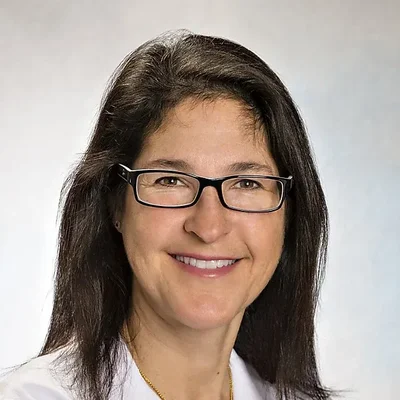
The training program that converts obstetrician-gynecologists into reproductive endocrinologists at Brigham and Women’s Hospital is directed by Elizabeth S. Ginsburg, MD. Fellowship directorship is an unusual job to hold and it shapes how she practices: she is responsible for what the next generation of REI physicians at one of the country’s larger hospital-based fertility programs is taught, and she is on the side of the table that designs the protocols they learn. She took her own position at Brigham the same route, completing internship, residency and her reproductive endocrinology and infertility fellowship there after medical school at Mount Sinai.
Her listed clinical interests run across the parts of the center’s menu that involve timing and risk rather than surgery: IVF and assisted reproductive technology generally, infertility, polycystic ovarian syndrome, fertility after cancer treatment, and LGBTQ+ health. On the oncology side she is the physician a patient sees before chemotherapy, radiation or gonadotoxic surgery, when the question is how to bank eggs or embryos quickly without delaying cancer care by an avoidable amount.
She is also the investigator credited with running the center’s Thrive-IVF trial, which tests NT100, an investigational medication, in women aged 21 to 38 who have had three or more failed IVF transfers of good-quality embryos. Study participants receive the trial’s tests, procedures and medication at no cost plus $1,000 toward embryo storage, which makes that population a specific reason to seek her out rather than a footnote. Ginsburg holds faculty rank at Harvard Medical School.
Clinical Expertise
- IVF and assisted reproductive technology: Stimulation protocol design through monitoring to day-3 or day-5 transfer, including cases where a prior cycle responded poorly.
- Fertility preservation on an oncology clock: Egg and embryo freezing arranged around imminent chemotherapy, radiation or pelvic surgery, with the ovarian-reserve testing that determines what is realistically bankable in the window available.
- PCOS and ovulation disorders: Ovulation induction and IVF for anovulatory infertility, including hyperstimulation-risk management, which is the main hazard in PCOS stimulation.
- PGT-A embryo genetic screening: Aneuploidy testing on day-5 or day-6 blastocysts, coordinated with the center’s genetic counselors.
- LGBTQ+ family building: Reciprocal and third-party reproduction pathways for same-sex couples and single patients; the center opens every service regardless of gender or sexual orientation.
- Repeated IVF failure: Trial-eligible evaluation for patients with good-quality embryos and no implantation.
Why Choose Dr. Elizabeth Ginsburg
She directs the fellowship. Patients at teaching programs sometimes worry that trainees dilute attending attention. The reverse is at least as true for the physician who runs the training: protocol decisions here are made by someone whose job is to know what the evidence says and to defend it in front of the fellows in the room.
Preservation before cancer treatment is a named interest, not an incidental service. Timing is the whole problem in oncofertility — a random-start stimulation cycle has to fit between a diagnosis and a first chemo infusion — and this is the physician whose profile lists that intersection.
She leads the trial for the hardest IVF group. Women under 39 with repeated failures of good-quality embryo transfers are, at many clinics, counseled toward donor eggs. At Brigham that group has an open study with paid procedures and a storage credit, and Ginsburg is the credited investigator.
One institution, start to finish. Internship, residency and fellowship at Brigham and Women’s means she practices inside the system whose labs, anesthesia and inpatient backup she uses.
Professional Affiliations
Harvard Medical School faculty and a Brigham and Women’s Hospital obstetrics and gynecology department member, working inside a Center for Infertility and Reproductive Surgery that holds Society for Assisted Reproductive Technology membership and reports cycles annually to the CDC, and that displays the American Society for Reproductive Medicine’s Center of Nursing Excellence designation. She is certified by the American Board of Obstetrics and Gynecology in obstetrics and gynecology, with certification dates recorded in 1992 and 1994, and completed her reproductive endocrinology and infertility subspecialty fellowship at Brigham and Women’s Hospital from 1989 to 1991 after residency there. Her department holds the Harvard Medical School teaching site for that subspecialty, whose directorship she occupies.
Suitable For
- Patients about to start cancer treatment: If chemotherapy, radiation or pelvic surgery is scheduled, preservation cycles have to be planned around it. This is her listed focus area.
- Women with PCOS trying to conceive: Ovulation induction and IVF where hyperstimulation risk drives protocol choice.
- Couples facing repeated IVF failure with good embryos: The Thrive-IVF eligibility window is age 21-38 with three or more failed transfers, at least two fresh.
- Egg freezers evaluating their reserve: Ovarian reserve testing, ultrasound and a realistic conversation about how many viable eggs a single cycle yields.
- Single patients and LGBTQ+ couples: Full access to donor egg, donor sperm and gestational carrier pathways, with a dedicated donor and carrier administrative team behind the cycle.