'%20d='m0%200%2016%2011h61%2061%2061%2061%2060L47%2037h61%2061%2060%2061L16%2063h61%2061%2061%2061%2060L47%2089h61%2061%2060%2061L16%20115h61%2061%2061%2061%2060L47%20141h61%2061%2060%2061L16%20166h61%2061%2061%2061%2060L47%20192h61%2061%2060%2061L16%20218h61%2061%2061%2061%2060z'/%3e%3c/svg%3e)
About
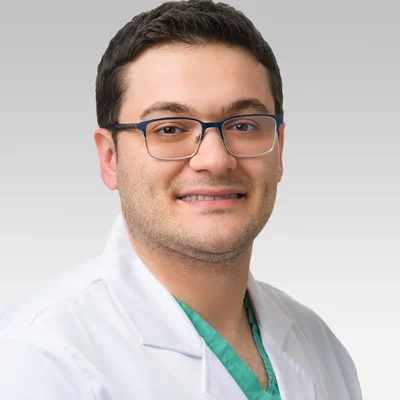
Most fertility physicians never spend a day in the embryology lab. Elnur Babayev, MD earned a master’s degree in clinical embryology at the University of Oxford in 2012, one year after his medical degree at Istanbul University, and then took a research fellowship in reproductive biology at Yale in 2015. He came to Northwestern for Ob/Gyn residency at the McGaw Medical Center (2019) and stayed for the REI fellowship (2022), and now practices as an assistant professor at the center on Erie Street.
That route — embryology first, medicine second — shapes what he spends his day doing. His declared interests sit at the boundary between the operating room and the lab: fertility-sparing surgery, uterine fibroids, endometriosis, and the biology of embryo implantation. Those are the same problems, in different clothing: a uterus that will not carry, tissue that will not attach, an ovary that has to be operated on without losing its egg supply.
He is direct about how he wants decisions made. “My goal is to provide evidence-based care with detailed discussion of risks and benefits of each intervention,” he writes. “I strive to elucidate the patient’s values to understand what is more important to them, and guide them in shared decision-making.” In practice that means the question “surgery first or IVF first?” gets answered out loud, with the trade-offs named, rather than resolved by default.
Clinical Expertise
- Fertility-sparing surgery: myomectomy and endometriosis excision planned around preserving the uterus, ovarian reserve and future pregnancy, not just removing disease
- Reproductive surgery: laparoscopic and hysteroscopic treatment of fibroids, polyps, adhesions and uterine pathology in patients still trying to conceive
- Uterine fibroids: evaluation of whether a fibroid is actually the cause of an infertility or miscarriage problem, and whether it should be removed before transfer
- Endometriosis: medical and surgical management, including when operating helps pregnancy chances and when it delays them
- Embryo implantation: the research side of recurrent implantation failure — why a morphologically good embryo does not attach
- IVF cycle management: stimulation, ICSI, PGT-A embryo screening and transfer within a SART-reporting academic program
Why Choose Dr. Elnur Babayev
One physician for the surgical and the IVF decision. At many practices a fibroid case gets bounced from REI to a gynecologic surgeon and back. Babayev’s stated specialty is fertility-sparing surgery inside a fertility center, so the person advising on surgery is the person who will run your stimulation.
He reads embryos, not just patient charts. A clinical embryology degree from Oxford is rare among practicing physicians and useful when the question is lab-side: culture conditions, biopsy timing, why a cohort arrested.
Research that maps onto your diagnosis. His work covers implantation biology, fibroids and endometriosis — the three conditions behind a large share of second and third cycles.
He commits to shared decision-making in writing. Risks and benefits of each intervention, discussed before scheduling anything, with your own priorities driving the choice.
Professional Affiliations
Trained and certified in Reproductive Endocrinology and Infertility, the joint subspecialty of the American Board of Obstetrics and Gynecology; the center’s physicians are board-certified and its cycles reported through the Society for Assisted Reproductive Technology. Faculty of the Department of Obstetrics and Gynecology at Northwestern University Feinberg School of Medicine, where residency and fellowship training in REI run through the same clinic he practices in. Active in the academic reproductive medicine societies, including the American Society for Reproductive Medicine and the Society for Reproductive Investigation, whose membership is drawn from the research community he trained in at Yale and Oxford.
Suitable For
- Fibroids plus infertility or recurrent loss, especially patients who want to know whether the fibroid is really the cause before agreeing to surgery
- Endometriosis patients deciding between excision and another retrieval, where the timing question matters more than the technique
- Repeated implantation failure after good-looking embryos, where the lab and the lining both need a second opinion
- Patients facing gonadotoxic cancer treatment who need egg, embryo or tissue preservation arranged quickly, and may need surgery afterward
- Anyone who wants the risks of each option spelled out before committing to a protocol