'%20d='m0%200%2016%2011h61%2061%2061%2061%2060L47%2037h61%2061%2060%2061L16%2063h61%2061%2061%2061%2060L47%2089h61%2061%2060%2061L16%20115h61%2061%2061%2061%2060L47%20141h61%2061%2060%2061L16%20166h61%2061%2061%2061%2060L47%20192h61%2061%2060%2061L16%20218h61%2061%2061%2061%2060z'/%3e%3c/svg%3e)
About
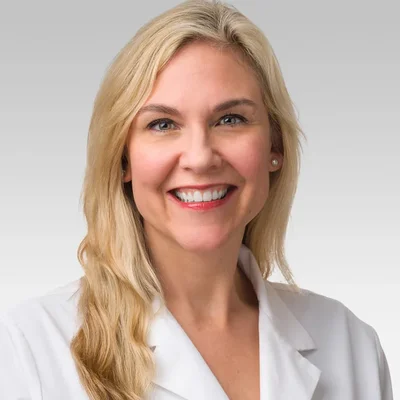
Emily Jungheim, MD holds the title that covers an entire division: Chief of Reproductive Endocrinology and Infertility at Northwestern, and professor at the Feinberg School of Medicine. That makes her responsible for the clinical service, the fellows training on it, and the research programs run out of it — in a center that reported 3,355 ART cycles in SART’s 2023 final data.
She trained locally and then left, the way most academic physicians do: an MD from Loyola University Chicago’s Stritch School of Medicine in 1997, Ob/Gyn residency at Duke University completed in 2005, and subspecialty fellowship training in 2008 through the Washington University / Barnes-Jewish / St. Louis Children’s consortium, the joint St. Louis REI program. Then back to Chicago as faculty.
Her stated reason for staying in the subspecialty is about stakes rather than science: “The opportunity to work with individuals in achieving some of life’s biggest goals is a true privilege.” In a division that handles ovulatory dysfunction, tubal and uterine disease, donor programs and fertility preservation alongside standard IVF, that range is the job description.
Clinical Expertise
- IVF program oversight and cycle management across a large academic practice, including protocols for patients who have failed stimulation elsewhere
- Ovulatory disorders, including PCOS: ovulation induction, metformin and letrozole strategies, and the metabolic work-up that belongs with them
- ICSI and PGT-A, coordinated with the center’s in-house embryology and andrology laboratory
- Reproductive endocrinology: thyroid, prolactin and adrenal contributions to anovulation and infertility; ovarian reserve assessment
- Third-party reproduction and family building for LGBTQ+ patients, within a center that states openness regardless of gender, orientation or marital status
- Division leadership: setting clinical standards for the REI fellows and residents rotating through the Erie Street clinic
Why Choose Dr. Emily Jungheim
She is the chief of the division. Not a rotating title — the REI division at Northwestern, its clinical service and its training program, sits with her. Protocols used by the center’s fellows are approved by the person who may end up reviewing your case.
Duke residency and the St. Louis consortium fellowship, two of the better-known pipelines into academic REI, after a Chicago medical degree.
A high-volume lab behind the consultation. More than 3,300 reported cycles a year, an on-site embryology lab with time-lapse incubation and laser biopsy, and a recurrent pregnancy loss clinic — the referral options exist inside the same department.
She teaches the subspecialty, which means the literature review is part of her week, not something she reads about in a newsletter.
Professional Affiliations
Chief, Division of Reproductive Endocrinology and Infertility, Department of Obstetrics and Gynecology, Northwestern University Feinberg School of Medicine. Certified in Reproductive Endocrinology and Infertility by the American Board of Obstetrics and Gynecology. Her clinic reports to the Society for Assisted Reproductive Technology and the CDC, and the division’s faculty participate in the national reproductive medicine societies, including the American Society for Reproductive Medicine and the Society for Reproductive Investigation.
Suitable For
- PCOS and other ovulatory disorders, particularly patients whose cycles have not responded to simple ovulation induction
- Complex reproductive endocrine cases referred in from elsewhere, where diagnosis rather than another protocol is the missing piece
- Patients who want division-level oversight of an IVF cycle in an academic center
- Second opinions before a donor egg, gestational carrier or preservation decision, where the answer is not always treatment
- Physicians and fellows evaluating Northwestern’s REI program, since the chief is the person who designs the training