'%20d='m0%200%2016%2011h61%2061%2061%2061%2060L47%2037h61%2061%2060%2061L16%2063h61%2061%2061%2061%2060L47%2089h61%2061%2060%2061L16%20115h61%2061%2061%2061%2060L47%20141h61%2061%2060%2061L16%20166h61%2061%2061%2061%2060L47%20192h61%2061%2060%2061L16%20218h61%2061%2061%2061%2060z'/%3e%3c/svg%3e)
About
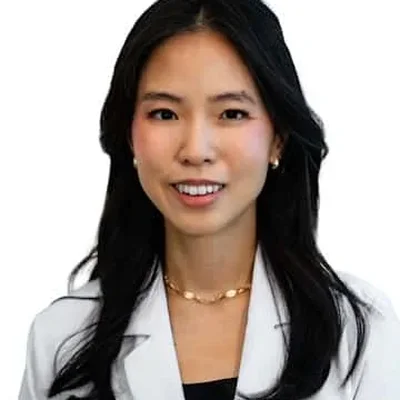
The award Esther Chung took in 2025 was not for a new laboratory technique. The Pacific Coast Reproductive Society gave her its Excellence in Training Award for research on a stubborn administrative problem: what it costs to do IVF and egg freezing, and how to bring that number down. She also holds the Suheil and Lisa Muasher Award for Excellence in Reproductive Endocrinology and Infertility, one of the field’s recognized honors for trainees, and a Hammond Research Day Award. She has turned the affordability thread into outside work with fertility-technology startups, and into patient education on social media, where she explains cycle mechanics to people who will never read the journals.
Her route into reproductive medicine was set during medical school at Harvard, where an REI sub-internship at Brigham and Women’s Hospital put her in a fertility clinic early; she had already graduated summa cum laude in neuroscience from Harvard College as a John Harvard Scholar and Phi Beta Kappa inductee. She completed OB/GYN residency at Duke University as administrative chief resident for health and well-being — the portfolio covering resident and staff welfare, scheduling and system design — collecting teaching and research distinction awards along the way, then did her REI fellowship at Stanford.
She publishes in Obstetrics & Gynecology, Fertility & Sterility, the American Journal of Obstetrics and Gynecology and Ultrasound in Obstetrics & Gynecology, and presents at ASRM and PCRS meetings. Her clinical focus is oncofertility and fertility preservation — banking eggs or embryos before gonadotoxic therapy — alongside machine-learning and AI applications to reproductive care. She also works on diversity and equity in medical leadership, an active rather than honorary commitment in a specialty where trainees watch who gets promoted. She sees patients at HRC’s Fullerton and Newport Beach offices, consults in English and Korean, and holds conversational Spanish.
Clinical Expertise
- Egg freezing and oocyte cryopreservation: stimulation design, vitrification and cycle-count counseling framed around cost per usable embryo rather than price per cycle
- Oncofertility and fertility preservation: urgent-start protocols for patients about to begin chemotherapy or radiation, coordinated with the treating oncologist
- IVF cycle management: individualized antagonist protocols with monitoring at HRC’s Fullerton and Newport Beach campuses, supported by the Orange County laboratory established in 2000
- Diminished ovarian reserve and advanced maternal age: realistic expectations, cumulative-cycle strategy and honest arithmetic about spending per live birth
- AI and machine learning in reproductive care: time-lapse and algorithmic embryo assessment, interpreted by a physician who researches the field
- Patient self-education: she publishes explainer content on how cycles work, which is unusually useful before an informed-consent conversation about stimulation and retrieval
Why Choose Dr. Chung
Cost is one of her research subjects. Egg freezing is sold as insurance; whether it is worth buying depends on age, reserve, number of cycles and vitrification survival. She has published on precisely that calculation, and won a society award for it.
Oncofertility runs on speed. Preservation before cancer treatment has to happen inside a two-week window, with an urgent-start protocol and a lab that can execute it. She practices at campuses with in-house embryology laboratories, which removes the shipping delay that costs patients time.
Harvard-to-Stanford training with administrative experience attached. Summa cum laude at Harvard College, Harvard Medical School, Duke residency as administrative chief resident for health and well-being, Stanford fellowship. The chief-resident role is a hint about how she runs a clinic day: systems, not improvisation.
Korean-language visits. Full fluency in Korean, plus conversational Spanish, in a Fullerton service area with a large Korean-American population — a real advantage when consent forms and risk discussions are the substance of the appointment.
She reads the AI tools critically. clinics now market algorithmic embryo selection heavily. A physician publishing on machine learning in reproductive medicine is better placed to say what such a score adds, and what it does not.
Professional Affiliations
Board-certified by the American Board of Obstetrics and Gynecology in Obstetrics and Gynecology and in Reproductive Endocrinology and Infertility; Fellow of the American College of Obstetricians and Gynecologists (FACOG). Member of the American Society for Reproductive Medicine and the Pacific Coast Reproductive Society, where she received the 2025 Excellence in Training Award. Suheil and Lisa Muasher Award for Excellence in REI; Hammond Research Day Award. Publications in Obstetrics & Gynecology, Fertility & Sterility, AJOG and Ultrasound in Obstetrics & Gynecology, with presentations at national meetings. Active in equity and diversity initiatives in academic medicine and in fertility-technology ventures aimed at access and affordability.
Suitable For
Patients facing chemotherapy or radiation. Preservation cycles designed around an oncology start date, with a physician whose clinical focus is oncofertility.
Women considering egg freezing who want the economics spelled out. How many cycles, how many eggs, what survival rates mean for future odds — the exact subject of her award-winning research.
Korean-speaking patients in northern Orange County. Visits, consent and counseling in Korean at the Fullerton office.
Patients already using AI or app-based fertility tools. Interpretation of algorithmic embryo scoring from someone who studies the technology rather than resells it.
Self-educators. If you arrive with questions from her published explainers, they get answered at the same level rather than deflected.