'%20d='m0%200%2016%2011h61%2061%2061%2061%2060L47%2037h61%2061%2060%2061L16%2063h61%2061%2061%2061%2060L47%2089h61%2061%2060%2061L16%20115h61%2061%2061%2061%2060L47%20141h61%2061%2060%2061L16%20166h61%2061%2061%2061%2060L47%20192h61%2061%2060%2061L16%20218h61%2061%2061%2061%2060z'/%3e%3c/svg%3e)
About
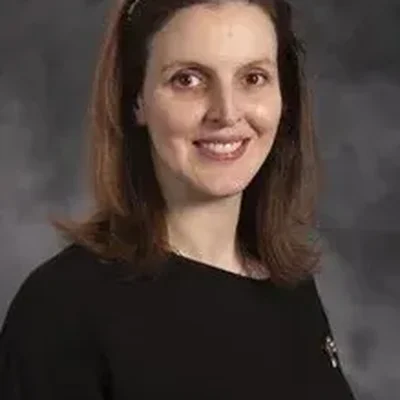
Most patients arrive at a reproductive endocrinologist with a question about the medication: what does a stimulation cycle actually do to the eggs it produces? Dr. Evelina Manvelyan’s research program at Duke is built on that question, alongside a second one with a wider frame — how environmental exposures affect fertility. That is an unusual pair of interests to sit next to a clinical panel, and it changes the tenor of a consultation. The answers are not settled in the literature, which is precisely why a physician who works on the question is the person you want deciding your protocol.
Her training path is longer on the map than most. MD from Yerevan State Medical University in Armenia (2010), obstetrics and gynecology residency training there through 2014, then US residency training recorded as SouthShore University Hospital / New York (2018-2022), and a reproductive endocrinology and infertility fellowship at Cleveland Medical Center / Case Western Reserve University in 2025. Duke made her an assistant professor the same year. Four training posts across two countries, and the through-line is reproductive medicine.
Clinically, she is listed at Duke Fertility Center for endometriosis-related and fibroid-related infertility, egg freezing and fertility preservation, donor egg cycles, and inclusive care for LGBTQ+ patients building families — the diagnoses where the argument about whether to operate, stimulate, freeze, or transfer first is genuinely individual.
Clinical Expertise
- Endometriosis-associated infertility: staging the disease’s effect on ovarian reserve and pelvic anatomy, then sequencing surgery, stimulation and transfer accordingly
- Uterine fibroids and the cavity: evaluating whether fibroids are the reason a cycle fails, and what has to be treated before an embryo goes back
- In Vitro Fertilization: stimulation design, monitoring, retrieval and transfer, with medication choice informed by her own research area
- Egg freezing and fertility preservation: elective and medically indicated preservation, including planning around cancer treatment
- Donor egg cycles: management of recipient cycles inside Duke’s screened donor program
- Oocyte and embryo quality: the specific research question of whether stimulation protocols and environmental exposures change what the lab ends up with
Why Choose Dr. Evelina Manvelyan
She studies the drugs she prescribes. Fertility medication effects on egg and embryo quality is a named research interest, not a line on a CV. A patient asking “will high-dose stimulation hurt my eggs?” is asking her the question she works on.
Environmental fertility exposure is part of her clinical frame. Patients with occupational chemical exposure, or who simply want a rational answer about plastics and fertility, get a physician who treats the topic as research-grade rather than as folklore.
Endometriosis and fibroids are stated expertise. Two of the most common structural causes of infertility appear explicitly in her profile, and both are decisions about sequencing rather than about technology.
Faculty at Duke since 2025 with a Case Western fellowship. A newly appointed academic specialist at a center where the division chief and a program director also teach means consults happen in a department that reads the literature, not a franchise protocol.
Professional Affiliations
Assistant Professor at Duke University since 2025. Fellowship training in reproductive endocrinology and infertility at Cleveland Medical Center / Case Western Reserve University (2025), after obstetrics and gynecology residency in New York and earlier residency training at Yerevan State Medical University, where she also earned her MD (2010). Duke’s published profile for Dr. Manvelyan does not list a board certification status, so confirm certification directly with the clinic if that matters to your decision.
Suitable For
- Patients told they have endometriosis or fibroids and are being urged to “just do IVF”: the sequencing argument is her stated clinical territory
- Women freezing eggs before a timeline slips: preservation is named in her scope, and the center publishes self-pay freezing and transfer pricing
- Anyone whose job or environment involves chemical exposure: preconception counseling from a physician whose research question is exactly that
- Donor egg recipients: recipient cycles managed at the center, priced at $15,500-$35,000 self-pay
- LGBTQ+ patients whose family-building plan needs both gynecologic and reproductive management in one clinic