'%20d='m0%200%2016%2011h61%2061%2061%2061%2060L47%2037h61%2061%2060%2061L16%2063h61%2061%2061%2061%2060L47%2089h61%2061%2060%2061L16%20115h61%2061%2061%2061%2060L47%20141h61%2061%2060%2061L16%20166h61%2061%2061%2061%2060L47%20192h61%2061%2060%2061L16%20218h61%2061%2061%2061%2060z'/%3e%3c/svg%3e)
About
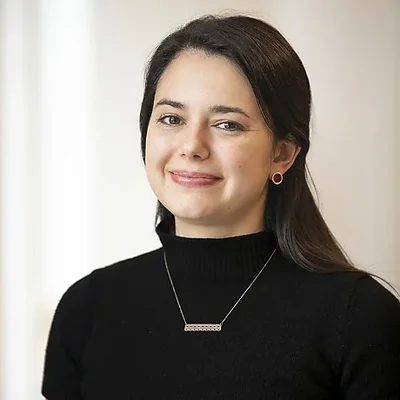
Reproductive endocrinology fellowship teaches you to run a cycle. Surgical training teaches you to fix what makes the cycle fail. Evelyn E. Minis went through both: after her REI fellowship at Massachusetts General Hospital, she completed the Society of Reproductive Surgeons Surgical Scholars Track as a member of its first cohort, a program based at only ten founding institutions in the country. The result is a physician who can do the laparoscopic excision of endometriosis and then program the IVF cycle that follows it, rather than handing you to a surgeon and back again.
Her published research targets a question patients ask constantly and clinics answer imprecisely: how likely is this person to respond to stimulation. She studies ovarian reserve markers and prediction of IVF response, the clinical outcomes of fertility preservation, and surgical outcomes — the last one mattering because it means her operative results are something she measures rather than assumes. Her listed clinical interests are wider than most: endometriosis, fibroids, minimally invasive and microsurgical reproductive surgery, Müllerian (congenital uterine) anomalies, oncofertility, PCOS, premature ovarian insufficiency, and Turner syndrome, the chromosomal difference that often leaves patients with very low egg counts and specific cardiac and anesthesia considerations before pregnancy.
She studied medicine at the University of Crete in Greece, trained in obstetrics and gynecology at Rutgers New Jersey Medical School, added a research fellowship at Weill Cornell Medicine, and teaches on the obstetrics, gynecology and reproductive biology faculty at Harvard Medical School. She consults in English, Greek and Spanish, holds clinic at the Yawkey Center in Boston and in Waltham, and — practically useful in a center where several physicians are closed to new patients — her profile lists her as accepting new patients. Her profile documents training and faculty status; a board certification statement is not recorded there.
Clinical Expertise
- Laparoscopic endometriosis excision: disease removal with ovarian function protected, since the ovaries are the operating field in a fertility patient
- Hysteroscopic and uterine surgery: septum, polyp, fibroid and cavity work relevant to implantation and recurrent loss, including congenital uterine anomalies
- Reproductive microsurgery and fibroid surgery: myomectomy planning for patients who intend to conceive
- Diminished ovarian reserve and premature ovarian insufficiency: evidence-based counseling on what stimulation can and cannot achieve, informed by her own marker research
- Fertility preservation: egg and embryo freezing before chemotherapy or radiation, and elective oocyte banking, with published outcomes work in this area
- Turner syndrome reproductive care: evaluation and risk consideration for a chromosomal cause of ovarian failure
- IVF and ICSI cycle management after surgical optimization, including PGT where indicated
Why Choose Dr. Minis
Surgical scholars training, first cohort. Extra operative years beyond fellowship, at a track designed for reproductive surgeons — and an SRS member clinic means the training happened here.
Her research answers a question she has to ask you. Ovarian reserve markers and predicted IVF response are the numbers a patient is handed; she publishes on how well they perform.
Three languages and two clinic sites. English, Greek and Spanish; Boston and Waltham monitoring.
Open to new patients. Documented on her profile, which shortens the practical path from inquiry to first appointment at this center.
Professional Affiliations
American Society for Reproductive Medicine; European Society of Human Reproduction and Embryology; Society of Reproductive Surgeons. Faculty, Department of Obstetrics, Gynecology and Reproductive Biology, Harvard Medical School. Reproductive endocrinologist and surgeon at Mass General Fertility Center, practicing at the Yawkey Center (Suite 10A) in Boston and 52 Second Avenue (Suite 402) in Waltham.
Suitable For
- Patients told they need surgery first — endometriosis, a fibroid distorting the cavity, a uterine septum — before or between IVF attempts
- Low ovarian reserve or early menopause, including premature ovarian insufficiency and Turner syndrome
- Cancer patients on a treatment clock who need egg or embryo freezing before therapy starts
- Greek- or Spanish-speaking patients wanting care in their own language
- Anyone starting fertility care in Boston or the MetroWest area who wants an open panel and two monitoring sites