'%20d='m0%200%2016%2011h61%2061%2061%2061%2060L47%2037h61%2061%2060%2061L16%2063h61%2061%2061%2061%2060L47%2089h61%2061%2060%2061L16%20115h61%2061%2061%2061%2060L47%20141h61%2061%2060%2061L16%20166h61%2061%2061%2061%2060L47%20192h61%2061%2060%2061L16%20218h61%2061%2061%2061%2060z'/%3e%3c/svg%3e)
About
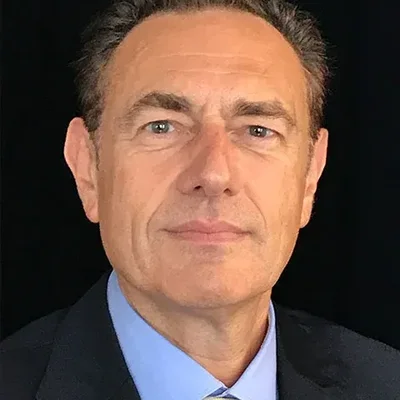
In 1992, a young researcher at Cornell’s fertility center injected a single sperm directly into a human egg and reported pregnancies that conventional IVF could not produce. That paper made Dr. Gianpiero Palermo the first describer of intracytoplasmic sperm injection (ICSI) — today the most utilized assisted reproductive technology in the world and the standard answer to severe male factor infertility and total fertilization failure.
Decades on, Palermo still runs the micromanipulation programs he built: he has been Director of Assisted Fertilization and Andrology at the Ronald O. Perelman and Claudia Cohen Center for Reproductive Medicine since 1993, holds the Blavatnik Family Professorship of Reproductive Medicine and a professorship of embryology at Weill Cornell Medicine, and sees patients at the Upper East Side flagship. He trained in Italy (medical degree, University of Bari), earned his Ph.D. in Reproduction and Development at Monash University in Australia, then completed residency and REI fellowship at NewYork-Presbyterian/Weill Cornell.
His current research targets better fertilization and pregnancy rates for male factor couples, preimplantation genetic testing, and human embryology — including work on generating sperm-like cells in the lab. He is a frequent first author in The Lancet, Human Reproduction, Fertility and Sterility and the Journal of Clinical Endocrinology and Metabolism, with more than 200 peer-reviewed articles, and he personally trained generations of clinical fellows and scientists in micromanipulation.
Clinical Expertise
- ICSI and Assisted Fertilization: the technique’s first describer; oversees the CRM lab’s micromanipulation program end to end
- Male Factor Infertility: evaluation and lab solutions for severe oligozoospermia, azoospermia and unconventional sperm sources
- Fertilization Failure Rescue: diagnosis and correction when standard IVF fails to fertilize eggs
- Preimplantation Genetic Testing: embryo biopsy and genetics integrated with the andrology program
- Human Embryology Research: fertilization biology, sperm development, and gamete lab techniques
Why Choose Dr. Palermo
You are seeing the origin of the procedure. ICSI was described in this building, by this physician, in 1992 — few specialists can claim authorship of the technique they still practice daily.
A lab director, not just a prescriber. He has run Assisted Fertilization and Andrology at CRM since 1993, so complex sperm preparation and micromanipulation questions land on his bench as well as his exam table.
Active at the research frontier. More than 200 peer-reviewed papers, first-author work in The Lancet, Human Reproduction and Fertility and Sterility, ongoing review duties, and a Gabbay Award in biotechnology and medicine from Brandeis University.
He teaches the technique forward. Fellow training in male infertility and micromanipulation is part of his standing role at the center.
Professional Affiliations
Board-certified by the American Board of Obstetrics and Gynecology in both Obstetrics and Gynecology and Reproductive Endocrinology and Infertility. Member of the American Society for Reproductive Medicine and the European Society of Human Reproduction and Embryology. Attending obstetrician and gynecologist at NewYork-Presbyterian Hospital. Awards include the Jacob Heskel Gabbay Award in Biotechnology and Medicine.
Suitable For
- Severe male factor infertility: the population ICSI was invented for, still his core practice
- Prior fertilization failure: couples whose conventional IVF cycle produced no embryos
- Complex andrology cases: surgical or unconventional sperm sources requiring lab micromanipulation
- Patients wanting the ICSI program itself: the assistant line at the Upper East Side office schedules directly into his practice