'%20d='m0%200%2016%2011h61%2061%2061%2061%2060L47%2037h61%2061%2060%2061L16%2063h61%2061%2061%2061%2060L47%2089h61%2061%2060%2061L16%20115h61%2061%2061%2061%2060L47%20141h61%2061%2060%2061L16%20166h61%2061%2061%2061%2060L47%20192h61%2061%2060%2061L16%20218h61%2061%2061%2061%2060z'/%3e%3c/svg%3e)
About
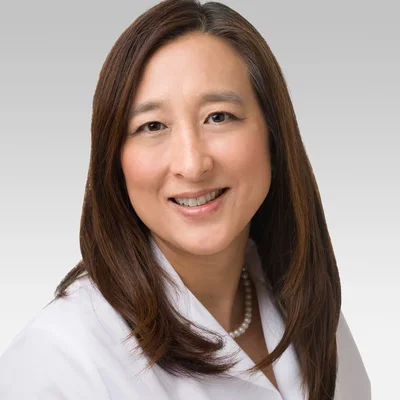
Third-party reproduction is the branch of fertility care where medicine, donor screening and family formation all have to clear the same case at the same time. At Northwestern Medicine that pathway — donor egg, donor sperm, gestational carrier — is Helen Kim’s to run, as the program’s medical director for patients who cannot, or do not have to, carry a genetically related pregnancy.
She came up through one pipeline. After a Brown degree in English and American Drama, magna cum laude, in 1985 and an MD at Cornell University Medical College in 1991, she did OB/GYN residency at Brigham and Women’s Hospital (1995), a research fellowship there (1996) and her REI fellowship (1998), then a postdoctoral research fellowship at Boston Children’s Hospital in 2000. Nearly three decades have passed since she finished subspecialty training, most of them spent on the assumption she states plainly: everyone who wants to build a family should be able to do so.
The practical shape of her role is coordination. Donor and carrier cycles pull in an andrology lab, a psychologist, genetic counselors and a financial counselor at once — Northwestern requires a one-hour psychology consult as part of IVF registration, and the center keeps two certified genetic counselors and a clinical psychologist on staff.
Clinical Expertise
- Donor egg IVF — recipient cycle preparation, fertilization by ICSI in the center’s IVF lab, embryo culture to day 5 and transfer
- Gestational carrier cycles — medical management of both the intended mother’s or donor’s side and the carrier’s preparation
- Therapeutic donor insemination — donor sperm placed through the cervix at ovulation; performed seven days a week at the Chicago office for women without a partner, same-sex couples and single parents
- Donor screening and workup — infectious disease, genetic carrier status and family-history review, with referral to genetic counseling when both partners carry the same mutation
- LGBTQ+ family building — the center’s written policy is care for all patients “regardless of gender, sexual orientation or marital status,” and Kim’s program is where most of that work lands
- IVF, ICSI and PGT-A for recipients who need embryo genetic testing before transfer
Why Choose Dr. Helen Kim
The physician who signs off on the program. Donor and carrier cases fail more often on coordination than on biology — screening lapses, cycle synchronization, paperwork between households. Kim’s title means one doctor owns the pathway end to end.
Twenty-eight years of REI practice. She finished fellowship in 1998, which puts her in the group of physicians who watched donor egg and gestational carrier medicine move from experimental to routine.
Trained end to end at Harvard-affiliated hospitals. Residency, research fellowship, subspecialty fellowship and postdoctoral work at Brigham and Women’s and Boston Children’s is an unusually complete Boston pedigree for a Chicago practice.
An undergraduate training in drama, and a program built on conversation. Reads as a curiosity until you notice what third-party reproduction consultations are: long negotiations about openness, anonymity, whose name goes where, and how much information a future child should get.
Professional Affiliations
American Society for Reproductive Medicine. Kim has practiced as a subspecialist since 1998, when she finished her fellowship at Brigham and Women’s Hospital, and teaches as an associate professor at Northwestern University Feinberg School of Medicine. Third-party cases at Northwestern reach more than one clinician by design: Susan C. Klock, PhD, the division’s clinical psychologist, and two certified genetic counselors work alongside the physicians, and the IVF and andrology lab that screens and prepares donor and carrier samples is part of the same practice.
Suitable For
Intended parents who need donor eggs — diminished reserve, premature ovarian insufficiency, advanced maternal age, or a known single-gene risk the couple wants to sidestep rather than test around.
Families building with a gestational carrier, where two medical plans have to run in parallel and the clinic’s psychologist consult and financial counseling sit inside the process, not beside it.
Lesbian couples and single parents who want donor insemination rather than IVF — the Chicago office runs TDI seven days a week, which shortens the path to a pregnancy test considerably.
Anyone whose case has a legal or ethical edge — known donors, related carriers, posthumous or multi-parent plans — where a program director’s judgment matters more than a protocol.