'%20d='m0%200%2016%2011h61%2061%2061%2061%2060L47%2037h61%2061%2060%2061L16%2063h61%2061%2061%2061%2060L47%2089h61%2061%2060%2061L16%20115h61%2061%2061%2061%2060L47%20141h61%2061%2060%2061L16%20166h61%2061%2061%2061%2060L47%20192h61%2061%2060%2061L16%20218h61%2061%2061%2061%2060z'/%3e%3c/svg%3e)
About
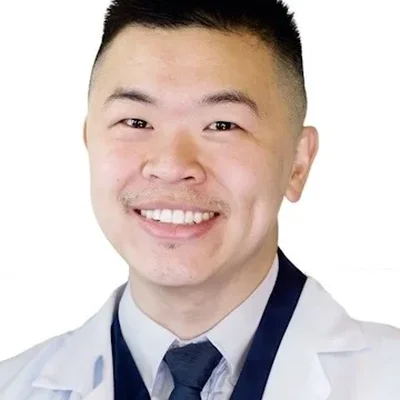
Four interests, none of them about embryos. Howard Li works on chronic pelvic pain, reproductive psychiatry, uterine factor infertility and the biological determinants of diminished ovarian reserve — a list that reads like the part of infertility care that is hardest to measure and easiest to dismiss. Pain and mental health are the two variables most likely to be left out of a treatment plan and most likely to determine whether a patient can complete one.
He trained at Harvard Medical School after undergraduate work at UC San Diego, completed obstetrics and gynecology residency at Yale-New Haven Hospital, and is now in his third year of a reproductive endocrinology and infertility fellowship at the National Institutes of Health — the intramural research program where clinical and basic science sit in the same building. He is originally from Los Angeles and joins HRC Fertility’s San Francisco practice on Francisco Street in 2026, one of the network’s newest offices.
Because he is arriving as a fellow rather than an established attending, expect the NIH flavor of medicine in the consultation: mechanism first, and a careful answer about what the evidence supports. Board-certified in obstetrics and gynecology and a Fellow of the American College of Obstetricians and Gynecologists, he will practice with HRC attendings and an in-house laboratory behind him.
Clinical Expertise
- Chronic pelvic pain in fertility patients: evaluation for endometriosis, adenomyosis, adhesions and central pain sensitization, with treatment sequencing that does not waste a cycle
- Reproductive psychiatry: perinatal and treatment-related anxiety and depression, the mood effects of hormonal stimulation, and coordination with mental-health care during ART
- Uterine factor infertility: submucosal fibroids, polyps, intrauterine adhesions and cavity abnormalities assessed before an embryo is transferred
- Diminished ovarian reserve: workup and protocol reasoning grounded in the biology of follicle recruitment rather than a single AMH value
- IVF cycle management: stimulation, monitoring, retrieval and transfer supervised within HRC’s clinical structure once he begins practice in San Francisco
Why Choose Dr. Li
He studies the two things clinics minimize. Pain and psychological state determine whether patients continue treatment, and both are frequently handled as side issues. A physician with an explicit research program in chronic pelvic pain and reproductive psychiatry is a better fit for patients whose history includes either.
NIH fellowship training. Intramural REI fellowship at the National Institutes of Health means exposure to clinical protocols designed as studies, with attention to mechanism — and to what is not yet proven. That is a useful skepticism to have in a consult room.
Harvard, Yale, NIH, then a new San Francisco practice. An unusual training chain for a private-clinic seat, and an arriving physician at HRC’s newest Bay Area office, which generally means open appointments rather than a waitlist.
Uterine-factor focus. For patients with recurrent implantation failure, a physician who researches the uterus as a cause asks about cavity assessment and adenomyosis earlier than most.
Professional Affiliations
Board-certified by the American Board of Obstetrics and Gynecology in Obstetrics and Gynecology; Fellow of the American College of Obstetricians and Gynecologists (FACOG). Member of the American Society for Reproductive Medicine. Third-year Reproductive Endocrinology and Infertility fellow at the National Institutes of Health following residency at Yale-New Haven Hospital and medical school at Harvard Medical School. Research and clinical training span chronic pelvic pain, reproductive psychiatry, uterine factor infertility and ovarian reserve biology.
Suitable For
Patients whose pain was treated as a complaint rather than a diagnosis. Endometriosis, adenomyosis and chronic pelvic pain considered inside a fertility plan instead of separately.
Anyone doing IVF while managing anxiety or depression. Reproductive psychiatry is one of his stated interests, which means the emotional load of treatment gets discussed as clinical, not incidental.
Repeat implantation failure with an unexamined uterus. Cavity evaluation, adhesions and fibroids worked up before another transfer attempt.
Low AMH or high FSH results and no explanation. A mechanism-oriented approach to diminished reserve, informed by NIH-based research training.
Bay Area patients who want a new physician with academic training. HRC San Francisco opens its calendar with each 2026 arrival; early availability is often the practical advantage.