'%20d='m0%200%2016%2011h61%2061%2061%2061%2060L47%2037h61%2061%2060%2061L16%2063h61%2061%2061%2061%2060L47%2089h61%2061%2060%2061L16%20115h61%2061%2061%2061%2060L47%20141h61%2061%2060%2061L16%20166h61%2061%2061%2061%2060L47%20192h61%2061%2060%2061L16%20218h61%2061%2061%2061%2060z'/%3e%3c/svg%3e)
About
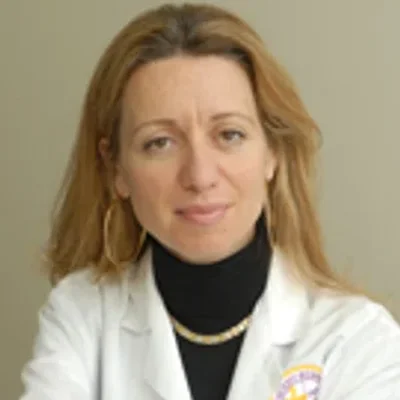
Every embryo biopsy that goes through this center’s genetic testing pathway runs through the PGD program, and Irene C. Souter directs it. That job is mostly decision-making before a cycle starts: which couple actually has an indication for preimplantation testing, which condition can be tested for reliably, what a result will and will not tell you, and what to do with an ambiguous answer. Her clinical list follows from that — IVF, PGT-A and PGT-M, donor gametes and gestational carrier cycles, egg freezing, and the chromosomal side of recurrent pregnancy loss.
She also trains the next cohort of specialists in this field as associate director of the center’s reproductive endocrinology and infertility fellowship, and holds an associate professorship in obstetrics, gynecology and reproductive biology at Harvard Medical School. Her own published work sits on the unglamorous middle of treatment — clinical outcomes of ovulation induction, and how environmental exposures affect reproductive health — rather than only on high-technology testing.
Her training path crossed three countries before Boston: a medical degree from the University of Athens School of Medicine, early obstetrics and gynecology training at Hippokration General Hospital in Greece and at Baragwanath Hospital in South Africa, US residency at Los Angeles County/USC Women’s Hospital, and an REI fellowship at UCLA Medical Center. That background is why she consults in four languages — English, French, Greek and Spanish — and why international patients and Greek-speaking families in Massachusetts end up in her schedule. She is active in both ASRM and ESHRE, the American and European reproductive societies. Her Mass General profile records training and program roles; a board certification statement is not included there.
Clinical Expertise
- PGT-M for known single-gene conditions: program-level responsibility for testing design, lab coordination and result interpretation for families carrying a heritable disease
- PGT-A at the blastocyst stage: aneuploidy screening decisions for advanced maternal age, repeated implantation failure and severe male factor
- Recurrent pregnancy loss evaluation: chromosome, endocrine and uterine anatomy workup, with genetic counseling brought in before testing rather than after a third loss
- IVF and egg freezing cycle management: stimulation protocols across a broad clinical practice that also covers PCOS, endometriosis and fibroid-related infertility
- Donor gamete and gestational carrier cycles: third-party paths where genetics, screening and legal sequencing all have to line up
- Ovulation induction outcomes: published clinical outcomes research on the lower-intensity treatments that precede IVF
Why Choose Dr. Souter
She runs the testing program you are considering. A consultation about PGT here goes to the physician accountable for how the program decides indications and handles unclear results, not to a generalist who refers the question onward.
Four languages, and two society memberships. Greek, French and Spanish consultations alongside English, and standing membership in ESHRE as well as ASRM — European guidance is not foreign to her practice.
She teaches the fellowship. Associate REI fellowship director means her day includes training physicians who are already practicing gynecologists, which tends to keep a clinician’s fundamentals sharp.
Professional Affiliations
American Society for Reproductive Medicine; European Society of Human Reproduction and Embryology. Director, PGD Program, Mass General Fertility Center. Associate Director, reproductive endocrinology and infertility fellowship. Associate Professor of Obstetrics, Gynecology and Reproductive Biology, Harvard Medical School. Practices in Boston at the Yawkey Center, Suite 10A.
Suitable For
- Families with a heritable condition weighing PGT-M, or carriers of a chromosome rearrangement
- Patients after two or more losses who want the genetic explanation ruled in or out before another cycle
- Egg freezers and donor-gamete or carrier patients who want the testing questions answered by the program director
- Greek-, French- or Spanish-speaking patients who do not want a consent discussion conducted through an interpreter