'%20d='m0%200%2016%2011h61%2061%2061%2061%2060L47%2037h61%2061%2060%2061L16%2063h61%2061%2061%2061%2060L47%2089h61%2061%2060%2061L16%20115h61%2061%2061%2061%2060L47%20141h61%2061%2060%2061L16%20166h61%2061%2061%2061%2060L47%20192h61%2061%2060%2061L16%20218h61%2061%2061%2061%2060z'/%3e%3c/svg%3e)
About
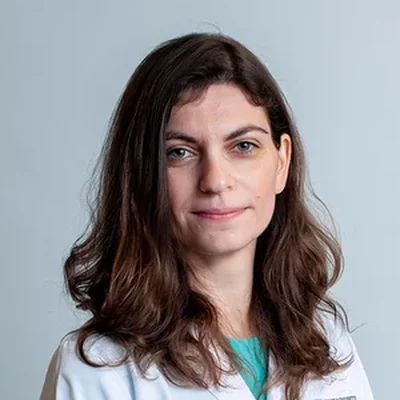
Donor eggs, donor sperm, a gestational carrier, or a partner carrying a pregnancy built from the other partner’s eggs: Irene Dimitriadis holds the medical director title over the program that organizes all of it at Mass General. Third-party reproduction is where medicine, screening, logistics and family law collide, and her role is to keep those threads in one place — donor medical and psychological screening, cycle synchronization, and the parentage paperwork that Massachusetts requires intended parents to settle through the courts rather than by birth record.
Her second occupation is with the embryology laboratory’s data. She works on applying artificial intelligence to embryo assessment, the attempt to grade embryos from patterns in culture imaging rather than from a single look by an embryologist, and she is an investigator on the EARTH Study, the NIEHS-funded project tracking how environmental chemicals, diet and body composition bear on reproductive outcomes. Her clinical interests run from recurrent pregnancy loss and congenital uterine anomalies — including endometrial polyps and fibroids — to premature ovarian insufficiency, PCOS, fertility preservation and PGT.
She trained in Athens at the National and Kapodistrian University of Athens School of Medicine, completed obstetrics and gynecology residency at Tufts Medical Center, and did her reproductive endocrinology and infertility fellowship at Massachusetts General Hospital, the same program where she now practices. She consults in English and Greek, splits clinic between the Yawkey Center in Boston and Waltham, and holds an assistant professorship at Harvard Medical School. Recognition on her record is individual and dated: ASRM research awards and a Healthgrades patient experience excellence award. Her profile lists training and program roles rather than a board certification statement.
Clinical Expertise
- Donor egg and donor sperm cycles: donor screening, matching, cycle synchronization and the transfer that follows, run as a single program with a named director
- Gestational carrier pathways: carrier medical and psychological screening plus coordination with reproductive counsel on parentage orders
- Reciprocal IVF and LGBTQ+ family building: two-mother protocols where one partner provides eggs and the other carries
- Congenital uterine anomalies and loss prevention: diagnosis and hysteroscopic or surgical management of uterine structural causes of recurrent pregnancy loss
- AI-graded embryo selection: laboratory research translating imaging-based embryo assessment into clinical decisions
- Environmental reproductive health: exposure, diet and body-composition counseling from EARTH Study findings
Why Choose Dr. Dimitriadis
One physician owns the third-party pathway. Instead of assembling a donor agency, a lab, a lawyer and a clinic separately, patients get the director who coordinates the medical half of that sequence at Mass General.
She reads the lab research she is part of producing. Embryo-assessment algorithms and exposure epidemiology both feed directly into how a cycle is run and what you are told about your own odds.
Insurance reality is on her profile. Accepted commercial plans are published on her listing — Aetna, Blue Cross Blue Shield, Cigna, Harvard Pilgrim, Tufts and UnitedHealthcare — which still needs a benefits check for fertility-specific coverage, but is a starting point most patients have to dig for.
Greek-language consultations, and clinic days in both Boston and Waltham.
Professional Affiliations
American Society for Reproductive Medicine. Medical Director, Third Party Reproduction, Mass General Fertility Center. Assistant Professor of Obstetrics, Gynecology and Reproductive Biology, Harvard Medical School. EARTH Study investigator; research on machine-learning embryo assessment. Practice sites: Yawkey Center Suite 10A, Boston, and 52 Second Avenue Suite 402, Waltham.
Suitable For
- Families built with donated eggs or sperm, or with a gestational carrier
- Lesbian couples planning reciprocal IVF who want the program director rather than a generalist
- Patients with a uterine anomaly, polyps or fibroids behind repeated loss
- Anyone whose path crosses medicine and law at the same time — screening, contracts and parentage in one workflow
- Greek-speaking patients seeking care without an interpreter