'%20d='m0%200%2016%2011h61%2061%2061%2061%2060L47%2037h61%2061%2060%2061L16%2063h61%2061%2061%2061%2060L47%2089h61%2061%2060%2061L16%20115h61%2061%2061%2061%2060L47%20141h61%2061%2060%2061L16%20166h61%2061%2061%2061%2060L47%20192h61%2061%2060%2061L16%20218h61%2061%2061%2061%2060z'/%3e%3c/svg%3e)
About
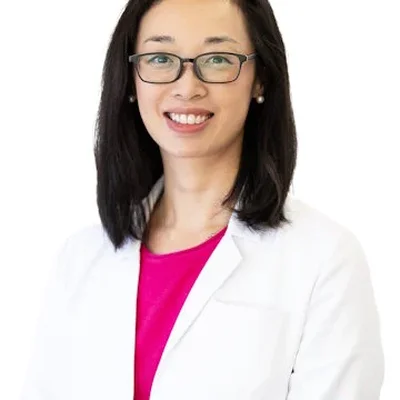
The injection calendar is what patients remember about IVF: roughly ten to fourteen days of self-administered gonadotropin injections, with monitoring visits every other morning. Irene Woo’s stated specialty is the version of a cycle that asks for less of that. Minimal stimulation uses lower daily doses, and sometimes oral agents in place of injectables, trading expected egg yield for a lighter medication burden — a real option for patients with diminished reserve, a prior over-response, or a plain preference not to take more hormone than the case requires. It is also the sort of cycle that gets offered only as a fallback after conventional stimulation has already disappointed someone. Few physicians between Santa Clarita and the Westside list it as a primary specialty.
She trained in a chain that is unusually broad for one curriculum: a molecular biology degree at the University of Pennsylvania, earned Cum Laude with an art history minor, then medical school at Penn State College of Medicine on the strength of an NIH Summer Research Fellowship, obstetrics and gynecology residency at Johns Hopkins, and a reproductive endocrinology and infertility fellowship at USC. She is board-certified by the American Board of Obstetrics and Gynecology in both fields — the general specialty and the subspecialty — and was twice given the Johns Hopkins resident teaching award, in 2012 and 2014, which is the kind of recognition that comes from residents rather than from attendings.
She now sees patients at two HRC offices, Encino on Ventura Boulevard and Santa Clarita Valley on McBean Parkway, which matters logistically: an IVF cycle asks for several early-morning monitoring visits in a ten-day window, and having a site on the valley floor as well as in the city is the difference between a feasible schedule and a dropped appointment. Her third stated interest, oncofertility, covers patients banking eggs or embryos before gonadotoxic treatment. She publishes in Fertility and Sterility and the Journal of Assisted Reproduction and Genetics, has written book chapters on infertility, and consults in English, Cantonese and Mandarin.
Clinical Expertise
- Minimal-stimulation IVF: reduced gonadotropin dosing with individualized monitoring, an option patients with poor reserve, prior OHSS, or medication burden concerns ask about directly
- Conventional IVF and frozen embryo transfer: standard stimulation, trigger, retrieval and transfer, with single-embryo transfer as the default where embryo assessment supports it
- Oncofertility: fertility-banking consults for patients facing chemotherapy, radiation or pelvic surgery, where the clock is set by the oncology calendar rather than the menstrual cycle
- Egg and embryo cryopreservation: vitrified eggs and embryos for medical and non-medical indications, with storage terms and disposition decided at the time of consent
- Fertility evaluation in both partners: tubal, uterine, ovulatory and semen factors worked up before a protocol is chosen, since about a third of cases carry a male factor alone and another third alongside a female factor
- Precision medicine in protocol selection: ovarian reserve markers and prior cycle response used to set dosing, rather than age-based defaults
Why Choose Dr. Woo
A named minimal-stimulation practice. Because the approach is her stated specialty rather than a rescue protocol, the argument about dose, expected yield and trade-offs happens in the first consult instead of after a canceled cycle.
Dual boards, not just one. ABOG certification in obstetrics and gynecology plus reproductive endocrinology and infertility means she completed general residency training before subspecializing — relevant for patients whose history includes fibroids, endometriosis or abnormal uterine bleeding alongside infertility.
Two offices, one physician. Encino and Santa Clarita Valley coverage gives patients in the northern San Fernando Valley a monitoring site that is not a 40-minute round trip each way, in a treatment where travel days add up quickly.
A research record in the top two journals in the field. Papers in Fertility and Sterility and JARG, plus a PCRS Outstanding Prize Paper third-place award in 2017, indicate work presented to reproductive medicine’s own reviewers rather than to marketing.
Consultation in Cantonese or Mandarin. For patients whose medical vocabulary is stronger in Chinese than in English, the interpretive step is removed from the conversation where cycle decisions are actually made.
Professional Affiliations
Board-certified by the American Board of Obstetrics and Gynecology in Obstetrics and Gynecology and in Reproductive Endocrinology and Infertility; Fellow of the American College of Obstetricians and Gynecologists (FACOG). Active member of the American Society for Reproductive Medicine and the Pacific Coast Reproductive Society, whose 2017 meeting awarded her paper third place for outstanding prize paper. Affiliate medical staff at Providence Cedars-Sinai Tarzana Medical Center. NIH Summer Research Fellowship (2007) and the Hershey Company Award for Academic Excellence (2010) from medical school.
Suitable For
Low AMH, high FSH or a prior poor response. Patients for whom a maxed-out dose produced few eggs anyway, and who want the argument for a lighter protocol heard on its merits.
Anyone starting cancer treatment in the next few weeks. Oncofertility consults are a race against the first cycle of chemotherapy, and a physician who names the specialty handles the urgency as a routine case.
Social egg freezing with a specific timeline in mind. Cryopreservation counseling where the numbers quoted are about your age and reserve, not a clinic-wide average.
Valley patients who cannot take a month of mornings off work. Two HRC sites within the San Fernando Valley make monitoring easier to schedule around a job.
Chinese-speaking patients and their families. Care delivered in Cantonese or Mandarin, which changes how much of a consent discussion is actually understood.