'%20d='m0%200%2016%2011h61%2061%2061%2061%2060L47%2037h61%2061%2060%2061L16%2063h61%2061%2061%2061%2060L47%2089h61%2061%2060%2061L16%20115h61%2061%2061%2061%2060L47%20141h61%2061%2060%2061L16%20166h61%2061%2061%2061%2060L47%20192h61%2061%2060%2061L16%20218h61%2061%2061%2061%2060z'/%3e%3c/svg%3e)
About
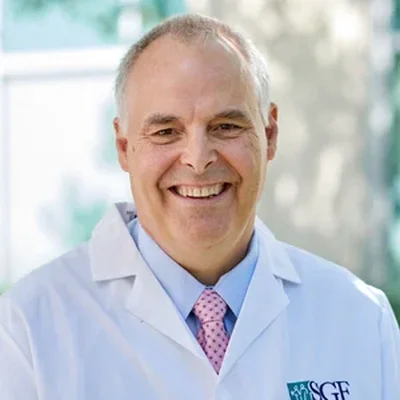
Some fertility problems are not hormonal or genetic. They are structural: adhesions scarred across the inside of the uterus, a cavity that cannot hold an embryo, a tube blocked by endometriosis. Dr. James K. Robinson III is the surgeon Shady Grove Fertility puts in front of those cases as its Director of Reproductive Surgery, working from the Rockville office with consultation, office-based procedures and outpatient operations. Before that title he ran minimally invasive gynecologic surgery as a division: Director of MIGS at MedStar Washington Hospital Center and Vice Chair of its Department of Women’s and Infants’ Services, and before that Director of MIGS and associate professor at the Medical Faculty Associates of George Washington University. A surgeon who has directed a MIGS division twice, in two institutions, is used to deciding which cases are worth operating on and which are not.
His named specialty is Asherman’s syndrome — intrauterine adhesions, usually after a dilation and curettage or a uterine infection — and the complex hysteroscopic and outpatient laparoscopic surgery that treats it. Asherman’s is unforgiving work: the adhesions come back, and results depend more on the surgeon’s restraint than on the equipment. He also performs two procedures most IVF practices do not offer in-house: laparoscopic hysterectomy for transgender male patients, and laparoscopic interval cerclage placement for patients with cervical insufficiency, placed between pregnancies rather than during one.
Robinson is board certified in obstetrics and gynecology and fellowship-trained in minimally invasive gynecologic surgery, with residency at the University of Wisconsin Hospital and Clinics in Madison and MIGS fellowship at the Minimally Invasive Gynecologic Surgery Center at Newton Wellesley Hospital in Newton, Massachusetts. He holds a master’s degree alongside his medical degree. He is not a reproductive endocrinologist: patients still see one of the practice’s REI physicians for stimulation, retrieval and transfer, and Robinson handles the surgical layer that makes those cycles more likely to work.
Clinical Expertise
- Hysteroscopic surgery for intrauterine adhesions (Asherman’s syndrome): lysis of adhesions and cavity restoration, his stated specialty focus
- Complex hysteroscopic resection: polyps, submucosal fibroids and septum repair, done as outpatient procedures
- Outpatient laparoscopic surgery: endometriosis, adhesiolysis and hydrosalpinx management before an IVF transfer, and other complex laparoscopic gynecologic work
- Office-based procedures and surgical consultation: evaluation that does not automatically require an operating room
- Laparoscopic hysterectomy for transgender men: fertility-preserving planning before gender-affirming surgery, performed in-house
- Laparoscopic interval cerclage: cervical insufficiency addressed between pregnancies rather than emergently during one
Why Choose Dr. James Robinson
He directed MIGS programs before he joined a fertility practice. MedStar Washington Hospital Center and George Washington University both gave him the division role — the job description is deciding operative strategy, not only performing it.
Reproductive surgery inside an IVF practice means no referral out. The surgeon who evaluates your uterus is in the same building as the laboratory that will culture your embryos and the physician who runs your cycle.
A narrow, hard specialty. Complex hysteroscopy and adhesion lysis are among the most technically demanding procedures in gynecology, and repeat surgery is common when they are done poorly.
Care for patients most fertility clinics do not list. Transgender hysterectomy and interval cerclage appear in his practice description, not buried in a general surgery menu.
Board certified in OB/GYN with formal MIGS fellowship training — the surgical subspecialty credential, stated plainly, without borrowing an endocrinology credential he does not hold.
Patient review: “Dr. Robinson was great to work with, he took what could have been an incredibly scary surgery and made it approachable and eased all of my fears.”
Professional Affiliations
Board certified in obstetrics and gynecology. Fellowship-trained in minimally invasive gynecologic surgery (Newton Wellesley Hospital MIGS Center) after residency at the University of Wisconsin Hospital and Clinics. Prior appointments: Director of Minimally Invasive Gynecologic Surgery and Vice Chair, Department of Women’s and Infants’ Services, MedStar Washington Hospital Center; Director of MIGS and Associate Professor, Medical Faculty Associates, The George Washington University Medical Center. Current role: Director of Reproductive Surgery at Shady Grove Fertility, based at the Rockville, Maryland headquarters. The practice’s published profile for him lists no formal awards.
Suitable For
- Patients told their uterine cavity is the problem: adhesions, submucosal fibroids, polyps, septum, or a cavity that has failed transfer after transfer
- Asherman’s syndrome, especially after curettage, and cases where adhesions have already recurred after a prior lysis
- Endometriosis or tubal disease that should be treated before an IVF cycle, including hydrosalpinx, which lowers transfer success until it is addressed
- Transgender men planning hysterectomy, with or without oocyte cryopreservation beforehand
- Cervical insufficiency in a prior pregnancy, candidates for interval cerclage before the next one
- Note on scope: he is a surgeon. Stimulation, retrieval and embryo transfer are managed by the practice’s reproductive endocrinologists at the same office