'%20d='m0%200%2016%2011h61%2061%2061%2061%2060L47%2037h61%2061%2060%2061L16%2063h61%2061%2061%2061%2060L47%2089h61%2061%2060%2061L16%20115h61%2061%2061%2061%2060L47%20141h61%2061%2060%2061L16%20166h61%2061%2061%2061%2060L47%20192h61%2061%2060%2061L16%20218h61%2061%2061%2061%2060z'/%3e%3c/svg%3e)
About
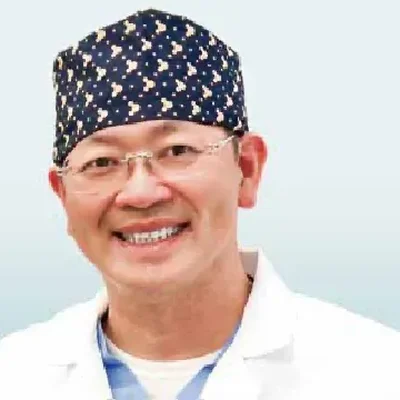
The International Society of Reproductive Genetics (ISRG) exists because embryo genetic testing moved from research labs into IVF rooms, and James P. Lin helped start it. He sits on the society’s executive board as treasurer, a role held alongside clinical practice, and ISRG’s own description of its global conferences is a few hundred researchers and clinicians trading new work in reproductive genetics. That combination — a private-practice physician with a standing seat in reproductive genetics — is the unusual part of his profile.
He came to private practice through academia. From 2000 to 2014 he directed the division of reproductive endocrinology and infertility at Harbor-UCLA Medical Center in Torrance, and he also ran the laboratory at what our sources describe as the largest fertility center in Orange County. He founded INCINTA Fertility Center in 2014 and holds a clinical associate professor appointment at the University of Southern California Keck School of Medicine. He is certified in reproductive endocrinology and infertility per the clinic’s materials.
His training record is inconsistent across sources and we have kept both versions rather than pick one: a biology degree at MIT (earlier biographies say USC biochemistry), a medical degree from Harvard Medical School (earlier biographies say Chicago Medical School), REI fellowship training at Yale, and postdoctoral work in reproductive endocrinology at UCLA. Our sources credit him with 63 peer-reviewed papers, 21 of them as first author, two NIH R01 grants and three patents including a culture-medium formulation, and with an abstract at the 2023 ASRM annual meeting comparing time-lapse and algorithmic embryo scoring against conventional morphology. His language record lists English, Mandarin, Cantonese, Hokkien and Spanish; the structured record on this page lists English and Chinese. Language is how you get your questions answered here, not a measure of his clinical work.
Clinical Expertise
- Reproductive genetics and PGT-A: embryo screening for chromosome number designed into the program rather than bolted on, with sequencing done in the clinic’s own laboratory
- Diminished ovarian reserve: stimulation strategies for patients with low AMH or a poor response to standard doses
- Mild and mini-stimulation: lower medication doses with a freeze-all plan, the approach he is credited with pushing at INCINTA
- Recurrent implantation failure: workup of transfer number, embryo quality, uterine cavity and timing when successive transfers do not implant
- Family building after 40: realistic counseling on per-cycle odds alongside screening
- Embryo laboratory oversight: the medical director has run an IVF laboratory as well as a clinic, and this program’s time-lapse culture and algorithmic scoring sit under his supervision
Why Choose Dr. Lin
He helps set the standard he practices under. ISRG’s officer role means the reproductive genetics literature does not reach him secondhand; he is on the board of the society that is producing it.
Fourteen years of academic division leadership. Directing reproductive endocrinology at Harbor-UCLA meant teaching residents, running consultation services for complex cases and supervising lab operations — not only seeing scheduled patients.
A screening-first program he designed. INCINTA reports a freeze-heavy, PGT-A-heavy cycle mix — 98.6% frozen transfers and PGT-A in over 97% of cycles by the clinic’s own figures — which is the medical director’s treatment philosophy made operational rather than a service you have to request.
Consultation in Chinese. For patients who read their lab values better in Mandarin or Cantonese, the physician explaining them is the one who founded the clinic.
Professional Affiliations
Co-founder, executive board member and treasurer of the International Society of Reproductive Genetics (ISRG). Clinical associate professor, University of Southern California Keck School of Medicine. Division leadership at Harbor-UCLA Medical Center through 2014. Our sources do not publish his full society membership list or a complete publication record, so nothing beyond the above is claimed here; regional patient-vote and magazine awards in his older promotional biographies are not treated as credentials on this page.
Suitable For
- Low ovarian reserve or a prior poor response: protocols designed for patients who recruit few eggs, where dose escalation is not automatically the answer
- Two or more failed transfers: the genetics-and-timing workup is this program’s home ground
- Patients over 40 deciding between own-egg and donor-egg paths: screening-first counseling, in Chinese if that is easier
- Anyone who wants fewer, better-timed transfers: mild stimulation with freeze-all and PGT-A is the default here, not an upsell
- Couples using donor eggs or a surrogate: third-party cases route through the coordination team he built alongside the lab