'%20d='m0%200%2016%2011h61%2061%2061%2061%2060L47%2037h61%2061%2060%2061L16%2063h61%2061%2061%2061%2060L47%2089h61%2061%2060%2061L16%20115h61%2061%2061%2061%2060L47%20141h61%2061%2060%2061L16%20166h61%2061%2061%2061%2060L47%20192h61%2061%2060%2061L16%20218h61%2061%2061%2061%2060z'/%3e%3c/svg%3e)
About
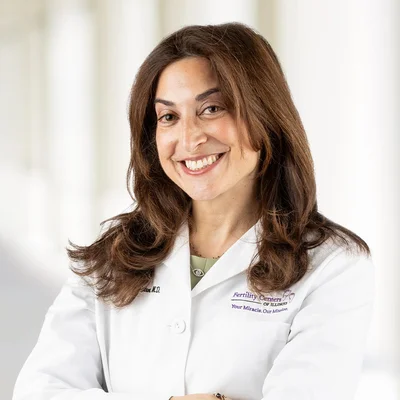
In 2025 the American Society for Reproductive Medicine presented Dr. Jennifer Hirshfeld-Cytron with the Arnold P. Gold Foundation Humanism in Medicine Award — one of the highest distinctions the society bestows, given to physicians whose clinical practice is marked by compassion, honesty and respect for the patient. It is an unusual award for a scientist who has spent her career quantifying the economics of fertility treatment, and the two are not separate projects. Her research exists because patients at a decision point deserve numbers, not reassurance.
She is board-certified in Obstetrics and Gynecology and in Reproductive Endocrinology and Infertility, and has practiced medicine since 2004. She trained at the University of Chicago (internship and OB/GYN residency) and then completed a three-year REI fellowship at Northwestern University, where she also earned a Masters in Clinical Research and Investigation in 2011. A Doris Duke Research Fellow from 2008 to 2011, she was formally trained in methods, not only in reading the literature — which shows in how she answers questions about odds.
At Fertility Centers of Illinois she is IVF Medical Director, the role that has her signing the clinic’s annual SART report, and she sees patients at FCI’s Chicago and Glenview campuses. Her published work clusters on two questions: how to preserve fertility for women whose disease or treatment threatens ovarian function, and how much fertility treatment actually costs — per cycle, per live birth, and per year of delay. She has published more than 30 manuscripts and given more than 100 presentations at national meetings.
She describes her own practice philosophy as coming from two places at once: clinical training and her experience as a woman and a mother. What she is proudest of, in her account, is hearing what a patient is actually saying and making sure the patient feels like an active participant in the decision rather than a recipient of one.
Clinical Expertise
- Fertility preservation for medical indications: Egg, embryo and ovarian-tissue freezing for patients facing treatment that can impair ovarian function, including comparison of outcomes by cancer diagnosis — a distinction that matters when the window before chemotherapy is days, not weeks.
- Elective (social) egg freezing: Cost-based decision analyses of freezing eggs for non-medical reasons, including an international comparison of cost-effectiveness. She will discuss expected live-birth yield per vitrified oocyte rather than a marketing number.
- Recurrent pregnancy loss: A systematic review of managing recurrent loss when a parent carries a reciprocal translocation, plus evaluation of the other causes that repeat losses point toward.
- IVF and protocol choice framed by evidence and cost: Head-to-head cost analyses of tubal reanastomosis versus IVF, and validation of prognosis-based criteria for selecting who receives infertility grant funding.
- The psychology of fertility treatment: Co-principal investigator of a structured yoga trial measuring anxiety in infertility patients, and author of work on depression and anxiety among female fertility-preservation patients and on counseling them.
- Family building for LGBTQ+ patients: She co-authored a 2022 survey of transgender, gender-nonconforming and non-binary people on how they value fertility preservation, and speaks publicly on insurance and legal access to fertility care.
Why Choose Dr. Hirshfeld-Cytron
The physician who signs FCI’s SART report. IVF Medical Director is a role with accountability attached — the person who certifies the clinic’s annual outcome submission to the Society for Assisted Reproductive Technology. The title appears both in FCI’s own care-team listing and on the 2023 SART final report for the clinic.
A humanities award from her own specialty society. The Gold Humanism in Medicine Award is not a patient-satisfaction prize; it is a named recognition from ASRM for how a physician treats people in vulnerable circumstances. For a treatment path that runs months and involves repeated monitoring appointments, communication quality is a clinical variable.
She researches the money question as a formal topic. Few clinicians have published on the cost-effectiveness of oocyte cryopreservation, the cost of society’s delayed childbearing, or a decision analysis comparing tubal reversal surgery with IVF. If you want a doctor who can say what a cycle is likely to return rather than only what it might achieve, that is her published lane.
Methodology training, not just authorship. A Doris Duke Research Fellowship (2008-2011) and a masters in clinical research from Northwestern (2011) mean study design is part of her own training. She also received the 2010 Reproductive Endocrinology Award at the Pacific Coast Reproductive Society meeting, and one of her resident mentees earned a travel scholarship at ASRM in 2012 on the strength of work done under her.
Peer nomination, twice, plus a women-in-medicine citation. Castle Connolly Top Doctor in 2024 and 2026, and Castle Connolly Exceptional Women in Medicine in 2026 — recognition built on peer recommendation and credential verification.
Advocacy that is continuous rather than occasional. As Vice President of the Chicago Coalition for Family Building she works on insurance coverage and legal access to fertility care, and encourages patients, employers and elected officials to understand how those laws shape real families.
Professional Affiliations
American Society for Reproductive Medicine (2025 Gold Humanism in Medicine Award; 2022 Congress and Scientific Expo presentations); Pacific Coast Reproductive Society (2010 Reproductive Endocrinology Award); Vice President of the Chicago Coalition for Family Building. Her work appears in Fertility and Sterility, Human Reproduction, the American Journal of Obstetrics & Gynecology, Obstetrical & Gynecological Survey, Seminars in Reproductive Medicine, Journal of Psychosomatic Obstetrics & Gynecology, Biology of Reproduction and Trends in Endocrinology & Metabolism, and she contributed a chapter on fertility preservation in patients with endometrioma to Endometriosis: Science and Practice. Hospital privileges span Advocate Christ, Advocate Illinois Masonic, Advocate Lutheran General, Northshore Evanston, Glenbrook, Highland Park and Skokie, Ambulatory SurgiCenter Downers Grove and 900 North Michigan Surgery Center.
Suitable For
- Patients facing chemotherapy, radiation or pelvic surgery: She publishes on preservation outcomes by cancer diagnosis and on non-malignant diseases that cause primary ovarian failure — the group whose fertility risk is often never raised.
- Women freezing eggs for personal reasons: Two of her papers are decision analyses of social egg freezing and its cost-effectiveness, so expectations can be set with numbers.
- Recurrent pregnancy loss with a chromosomal factor: A systematic review on parental reciprocal-translocation carriers is directly on point for couples being told to “try again.”
- Couples choosing between surgery and IVF: Her tubal-reanastomosis-versus-IVF cost analysis is exactly this decision, made with data.
- LGBTQ+ family building: Her 2022 survey asked transgender and non-binary people what fertility preservation is worth to them, and she supports every path to parenthood.
- Anyone budgeting a treatment plan: Cost analysis of fertility therapies is a named research interest, alongside work on complementary approaches among uninsured patients.