'%20d='m0%200%2016%2011h61%2061%2061%2061%2060L47%2037h61%2061%2060%2061L16%2063h61%2061%2061%2061%2060L47%2089h61%2061%2060%2061L16%20115h61%2061%2061%2061%2060L47%20141h61%2061%2060%2061L16%20166h61%2061%2061%2061%2060L47%20192h61%2061%2060%2061L16%20218h61%2061%2061%2061%2060z'/%3e%3c/svg%3e)
About
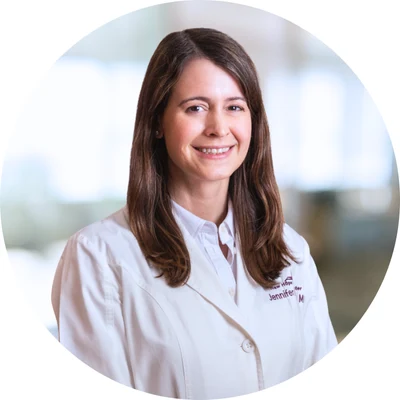
Dr. Jennifer Kulp-Makarov is the double board-certified reproductive endocrinologist on the New Hope Fertility Center team, and the one whose page publishes the fewest dates. The clinic titles her “Board-Certified OB/GYN & REI Specialist” and, in its current-position block, “Board-Certified Reproductive Endocrinologist, New Hope Fertility Center”; she is a fellow of the American College of Obstetricians and Gynecologists (FACOG). Her obstetrics and gynecology residency was at Johns Hopkins Hospital and her reproductive endocrinology and infertility fellowship at Yale University School of Medicine. The clinic publishes no year for her bachelor’s degree, medical degree, residency or fellowship, and this page does not estimate one.
Her clinical center of gravity is the difficult-reserve patient. Her profile states that she offers individually tailored protocols for women with decreased ovarian reserve and has extensive experience with hard infertility cases, including recurrent pregnancy loss and multiple failed IVF cycles, and that her Mini-IVF and natural-cycle work is meant to reduce physical burden while maintaining excellent outcomes - the last phrase being the clinic’s own, not an independent finding.
Two naming and sourcing details are worth recording because the clinic’s pages are inconsistent about them. Inside her own profile the clinic switches between “Dr. Kulp-Makarov” and “Dr. Makarov”; and the team page card credits only Yale, while her personal page lists both Johns Hopkins and Yale. This page follows the personal page. Her profile also has no Languages Spoken section at all, unlike those of her colleagues Dr. Zhang and Dr. Zeitoun, so English is the only language this page documents for her.
Clinical Expertise
- Mini-IVF and Natural Cycle IVF: listed first among her specialties on her profile as minimally invasive fertility treatment, using low-dose medication or an unstimulated cycle.
- Decreased ovarian reserve: individually tailored protocols rather than a standard dose ladder; this is the item her profile expands on most.
- Recurrent pregnancy loss: diagnosis and treatment as a named specialty item.
- Complex cases and repeated failure: complex infertility and multiple failed IVF cycles appear together in her specialization list.
- IVF, IUI and donor sperm insemination: in vitro fertilization, intrauterine insemination and donor sperm insemination are all on her list, which is how she covers the non-IVF routes as well as the laboratory ones.
- Egg donation programs and PGT: donor-egg cycles and genetic testing of embryos are listed items.
- Fertility preservation and egg freezing: named on her profile for patients postponing parenthood for medical or personal reasons.
- Male factor infertility: included in her specialization list.
- LGBTQ+ family building: given its own section on her profile. She works with single women and same-sex couples to start or grow families and has authored guides on reciprocal IVF - where one partner provides the eggs and the other carries - and on family building for same-sex couples.
Why Choose Dr. Jennifer Kulp-Makarov
Two board certifications, stated that way by the clinic. Her profile lists board certification in Obstetrics and Gynecology and board certification in Reproductive Endocrinology and Infertility, plus FACOG. That contrasts with the practice’s founder, Dr. John Zhang, whose profile describes him as board-eligible in the REI subspecialty rather than board-certified. She and Dr. Zeitoun are the two physicians on this team whose pages claim REI board certification.
Johns Hopkins and Yale training, in the clinic’s own account. Residency at Johns Hopkins Hospital, fellowship at Yale University School of Medicine. Her research direction grew out of those two places, per her profile: molecular mechanisms of embryo implantation, HOX gene regulation in the endometrium, endometriosis and its effect on fertility, minimally invasive IVF protocols, and PCOS and assisted reproduction.
Named work, unpublished dates. Her publications are listed by journal and topic rather than by citation: Reproductive Sciences and Journal of Assisted Reproduction and Genetics, with studies on HOXA10 gene regulation in endometrial stromal cells, the effects of aromatase inhibitors on uterine receptivity in endometriosis patients, the evolutionary biology of the human reproductive tract, and pregnancy outcomes in natural versus stimulated IVF cycles. The clinic gives no year, volume or page for any of them, so this page cannot. She also wrote a textbook chapter, “Endometriosis and Infertility”, on the molecular mechanisms of endometriosis and IVF success rates, and patient education material for RESOLVE, the national infertility association, titled “PCOS and Assisted Reproduction”.
Two five-year award streaks. Castle Connolly Top Doctors in the New York Metro Area for 2019, 2020, 2021, 2022 and 2023; New York Magazine Top Doctors for 2021, 2022, 2023, 2024 and 2025. Her profile also refers to multiple research awards without naming them, and notes that she is frequently cited by medical and mainstream media on artificial embryos and stem cell research, pregnancy after loss, LGBTQ+ fertility and reciprocal IVF. Those are a directory listing and a magazine listing, not outcome data.
The LGBTQ+ pathway is documented, not implied. Reciprocal IVF has specific medical and legal mechanics that many clinics explain badly. She has written guides on it, and her profile states her work with single women and same-sex couples directly. Her profile publishes no state license entry, unlike Dr. Zeitoun’s, so this page makes no licensing claim about her either way.
Professional Affiliations
Board certification: American Board of Obstetrics and Gynecology, Obstetrics and Gynecology; American Board of Obstetrics and Gynecology, Reproductive Endocrinology and Infertility. Fellowship of the American College of Obstetricians and Gynecologists (FACOG) appears in her name line on both the profile and the team page. Memberships: American Society for Reproductive Medicine, American College of Obstetricians and Gynecologists, and the Society for Reproductive Endocrinology and Infertility.
What her page does not carry: any state medical license line (her colleague Dr. Khaled Zeitoun’s page does, for New York and Texas), any year for her education or training, and any language list. The clinic’s own text also differs between the team card, which mentions only Yale, and her personal page, which lists both training institutions; the personal page is used here.
Her patients should also know the registry context for the practice she works in: on CDC NASS 2022, New Hope Fertility Center’s live birth rates per intended egg retrieval are below the national row in every age band, while its cycle mix is heavily weighted to patients over 40. That comparison, with denominators, is set out on the clinic page.
Suitable For
- Women with low reserve or a short window: individualized mild protocols are the item her profile develops in most detail.
- Recurrent loss or repeated IVF failure: both are named specialties, and the review-and-redesign work is part of her listed experience with complex cases.
- LGBTQ+ families, single mothers by choice and same-sex couples: reciprocal IVF and donor-sperm paths she has written guides about, with an explicitly stated practice focus.
- Patients who want fewer drugs: Mini-IVF and natural-cycle IVF are her first-listed specialties at a clinic built around them.
- Anyone who wants the credential set spelled out: double board certification plus FACOG, with the caveat that her published page leaves dates, licenses and languages undocumented.